


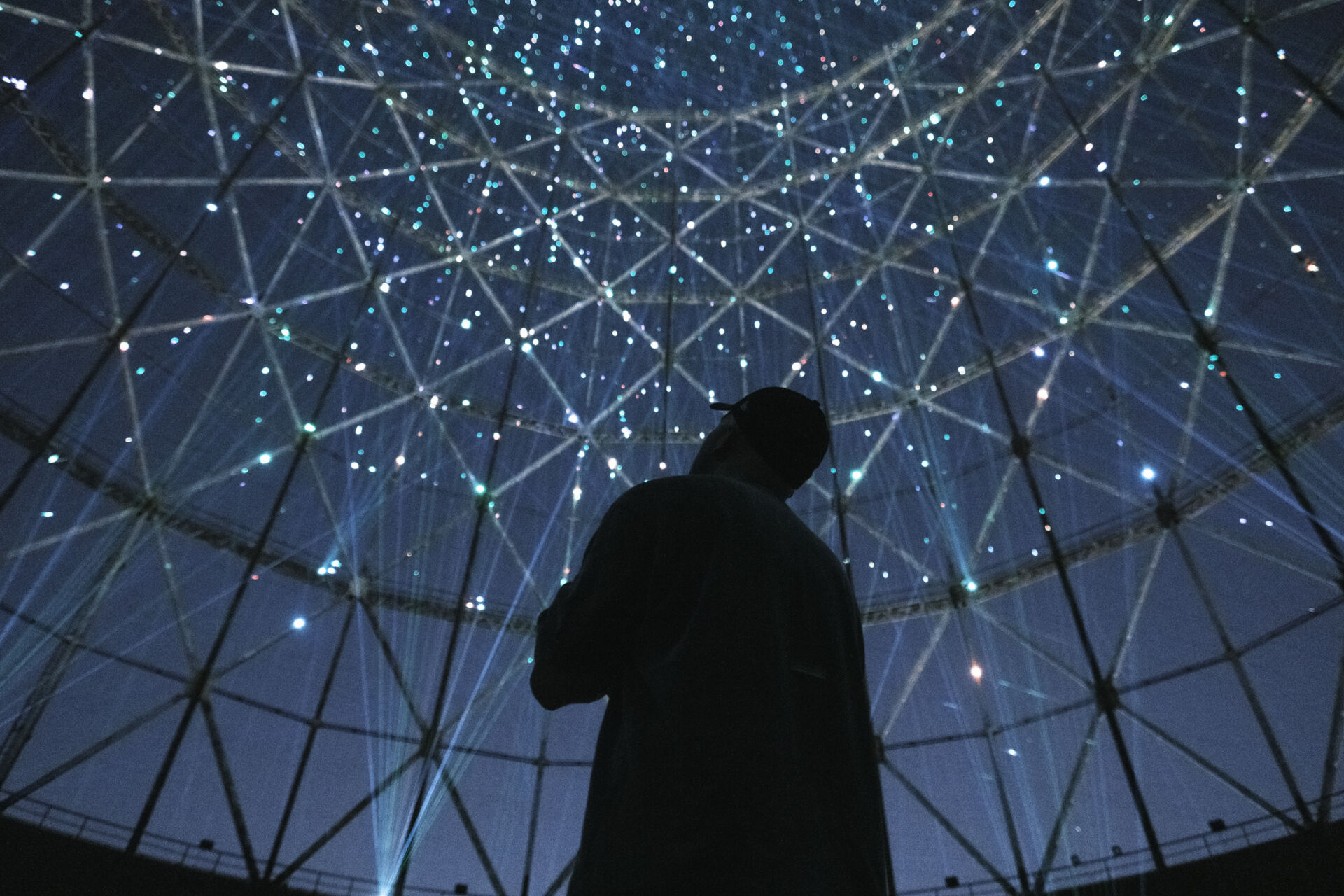
In July thousands of spectators were enchanted by their site-specific work, Nebula, presented inside the Gazometro in Rome. It was created for Videocitt – , the video-art festival, in collaboration with the maestro of electronic music, Giorgio Moroder. The Quiet Ensemble is a duo of Italian creative artists specialised in digital art and among the most active creators of immersive installations in Europe. The duo is composed of Fabio di Salvo and Bernardo Vercelli; they have taken part in some of the most important international festivals such as Noor Riyadh, Sonar, and Signal, and their work is focussed on exploring the increasingly more complex and multilayered relationship between man and nature.
For Videocitt – they created an installation composed of four hundred thousand artificial stars that lit up the gigantic metal cylinder, seventy five metres high and with a surface of over three thousand square metres. The work was completed with original music composed specifically by Giorgio Moroder, pioneer of the synthesizer, three time Oscar winner, and recently awarded the David di Donatello for lifetime achievement. For this event, we went to interview the artists.
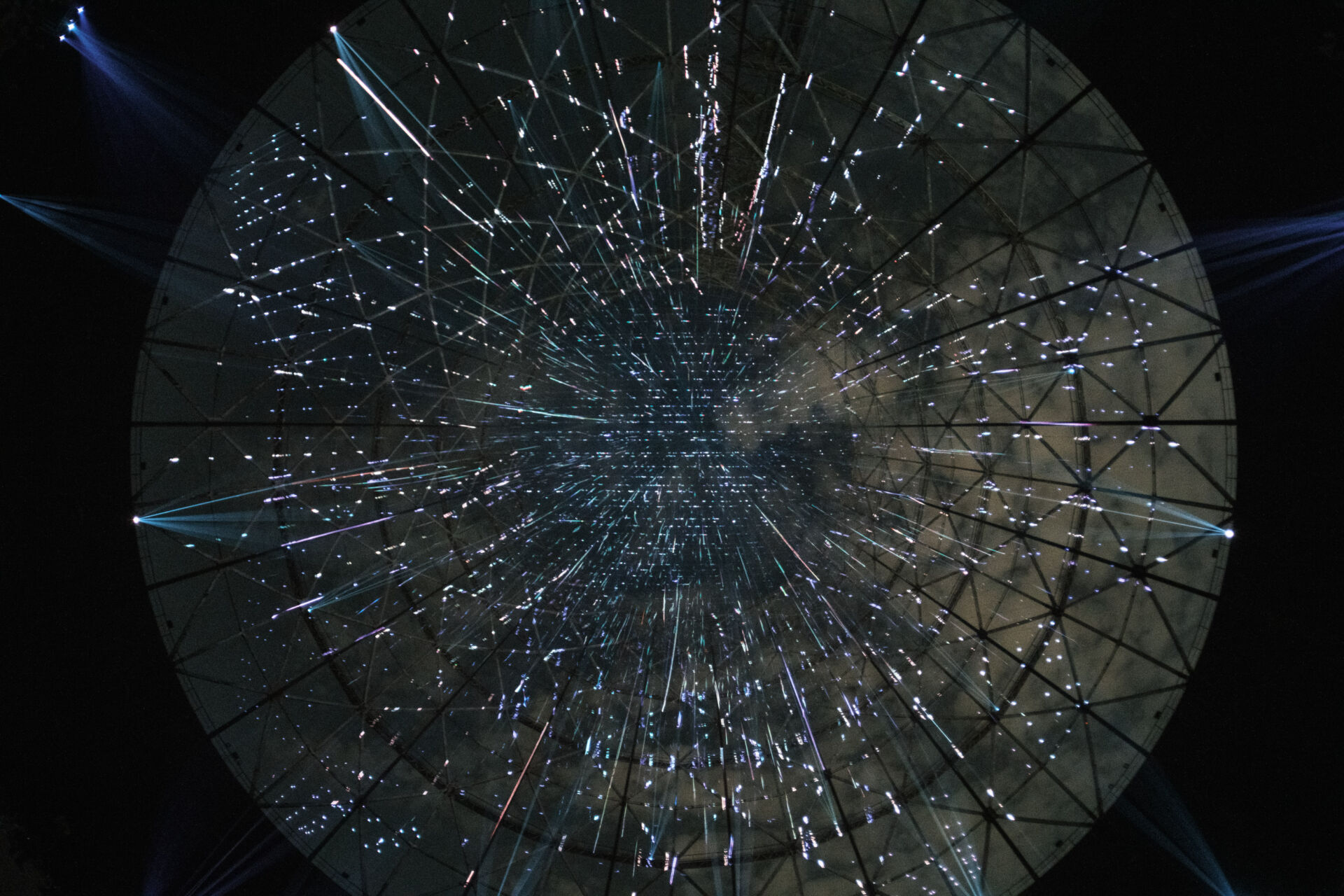
Nebula is our latest work in which we symbolically transferred a section of the cosmos inside the Gazometro. In this case, we had to deal with an enormous location: when we first went inside, we realised that it was a truly demanding challenge. In creating the work we wanted to be in unison with the instinct of spectators when they enter the space, as they look up and observe the sky. Our aim was to try to bring man closer to the stars, bringing part of the cosmos down into the Gazometro. Nebula is a fifteen minutes theatrical performance that involves a theoretical voyage at the speed of light: It begins from ground level, or from the Earth, and travels towards the firmament, showing everything a celestial traveller would encounter during the journey. After a very rapid contact with leafy tree branches, they move through the clouds, to then wander for most of the time in the cosmic void, where they experience different entities and energies. One of the elements that we were most interested in reproducing was of course, the nebulae: masses of gas and star dust. Within these nebulae, stars are born and die.
This work is coherent with a type of research we have been working on ever since we began because it represents a combination of nature and technology. In this case, the technology (laser programming designed by Davide Carbone) reproduces a well-known natural element that we bring down to the Earth. Our work is not – simply a meaningless exercise in style: we decided to focus on restraint, emptying space rather than filling it with superfluous elements. Our work is concentrated on highlighting the beauty of minute things and all those hidden or unknown events that exist before our eyes without our according them their true importance.
Working with Giorgio Moroder was a very powerful and exciting experience. Our collaboration evolved quite naturally: he immediately understood what we wanted to express and when we tested his audio track inside the location, along with the lights, we realised it was perfect. We had only one or two suggestions on a couple of variations. He is extremely intuitive and we found him wonderfully curious, open-minded and modest. For us, he is a great role model.
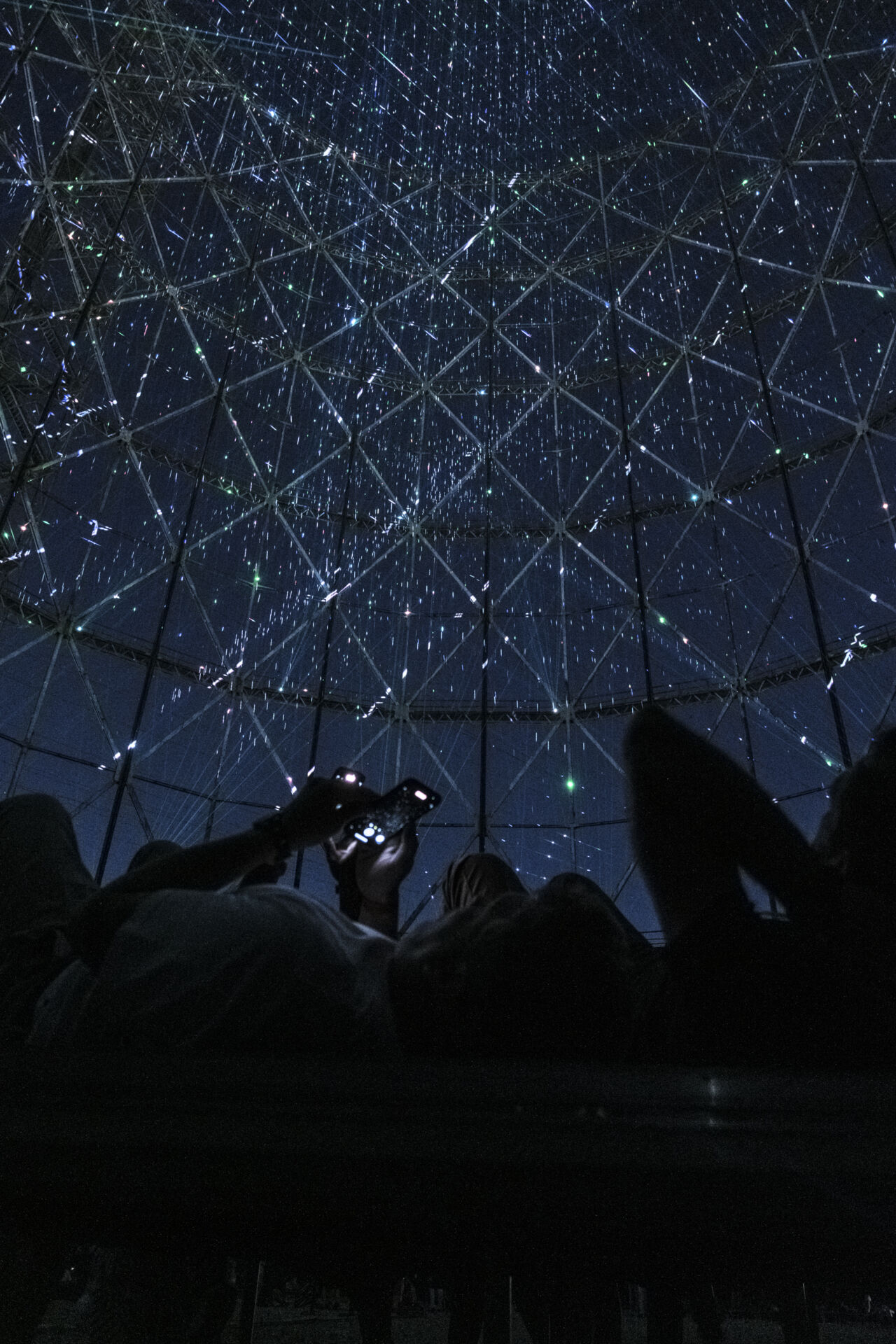
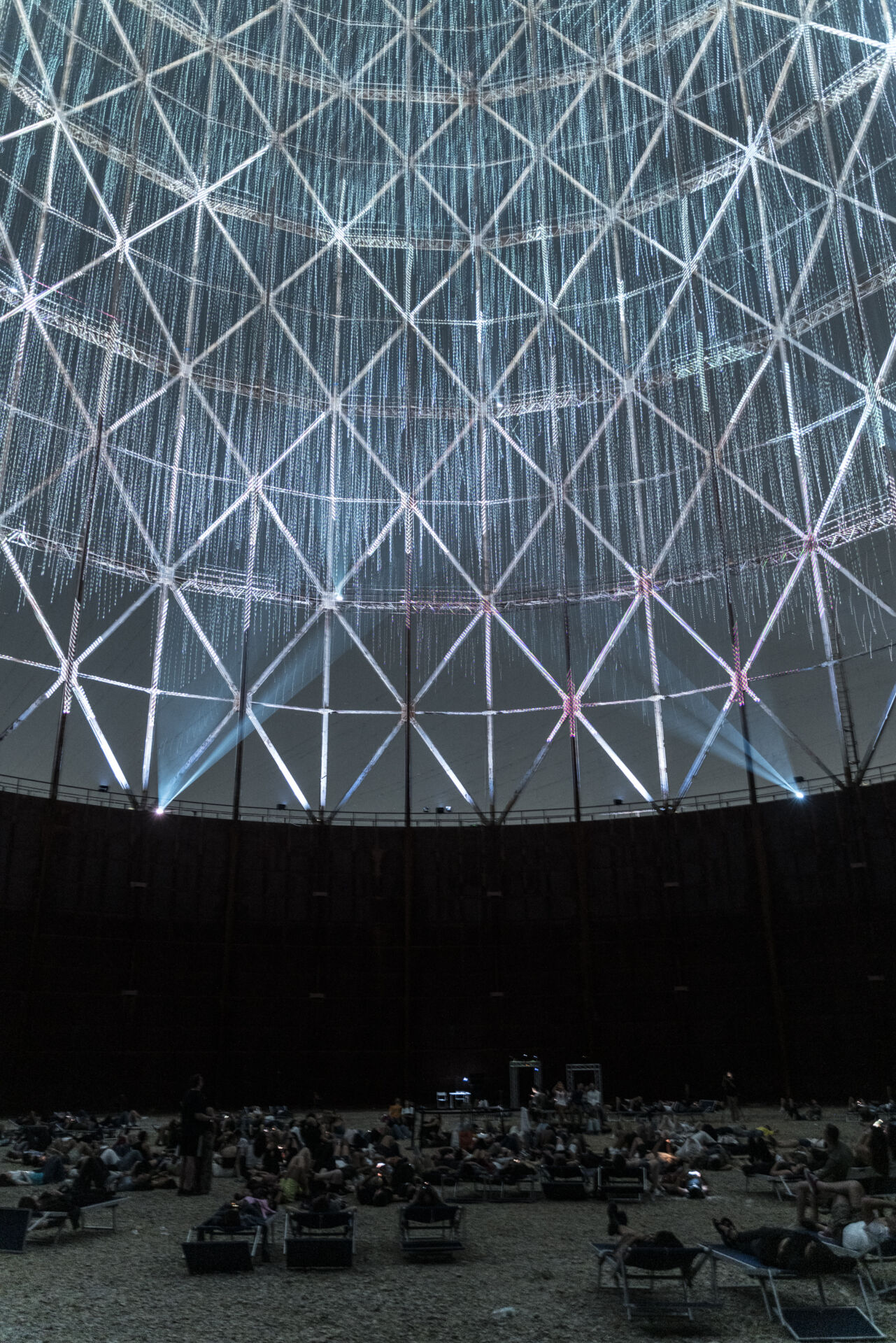
We love Rome, it is a splendid city with many positive and just as many negative aspects. Even though normally we work more often outside Italy, there are a few events and festivals that allow us to work here, and one of these is Videocitt – . Unfortunately, at the moment we aren – t able to live and work in Rome. The problem with Roman audiences is that they need a little guidance, and they also need to be a bit bored, in the sense that, we feel that you should never give them what they are expecting. This is the reason why we tried to – pare down – our performance, without overdoing the special effects which is something that is requested very frequently lately. People want a photo opportunity, a selfie room; they want to post the work on social media. Instead, we want to create a certain distance with this habit in some way. Potentially, we want to create works where the spectator manages to keep his phone in his pocket and wants to cherish the moment, exactly like watching a beautiful sunset, when you suddenly realise that it is far better to experience the reality rather than taking a souvenir photo.
Our route has not been straightforward, the needle on the weighing scale has moved back and forward constantly. Initially we focussed far more on nature, then moving forward, we shifted towards technology; but precisely, it is a needle that continues to move and shift, and even we are surprised by the changes that occur. Nature provides an infinite range of ideas and incentives, and this is very hard to manage. We have used technology to try and create a balance between chaos and control. For us, this galloping technology that advances so rapidly is a catalyst for ideas, reflection, and stimulus. Every day, there is some new equipment that allows us to reproduce or collaborate with natural elements. We don – t want to say we have succeeded because a statement like that would mean we have attained a goal, whereas we want to continue to be open to new research, hungry for new ideas, maintaining our curiosity constantly alive.
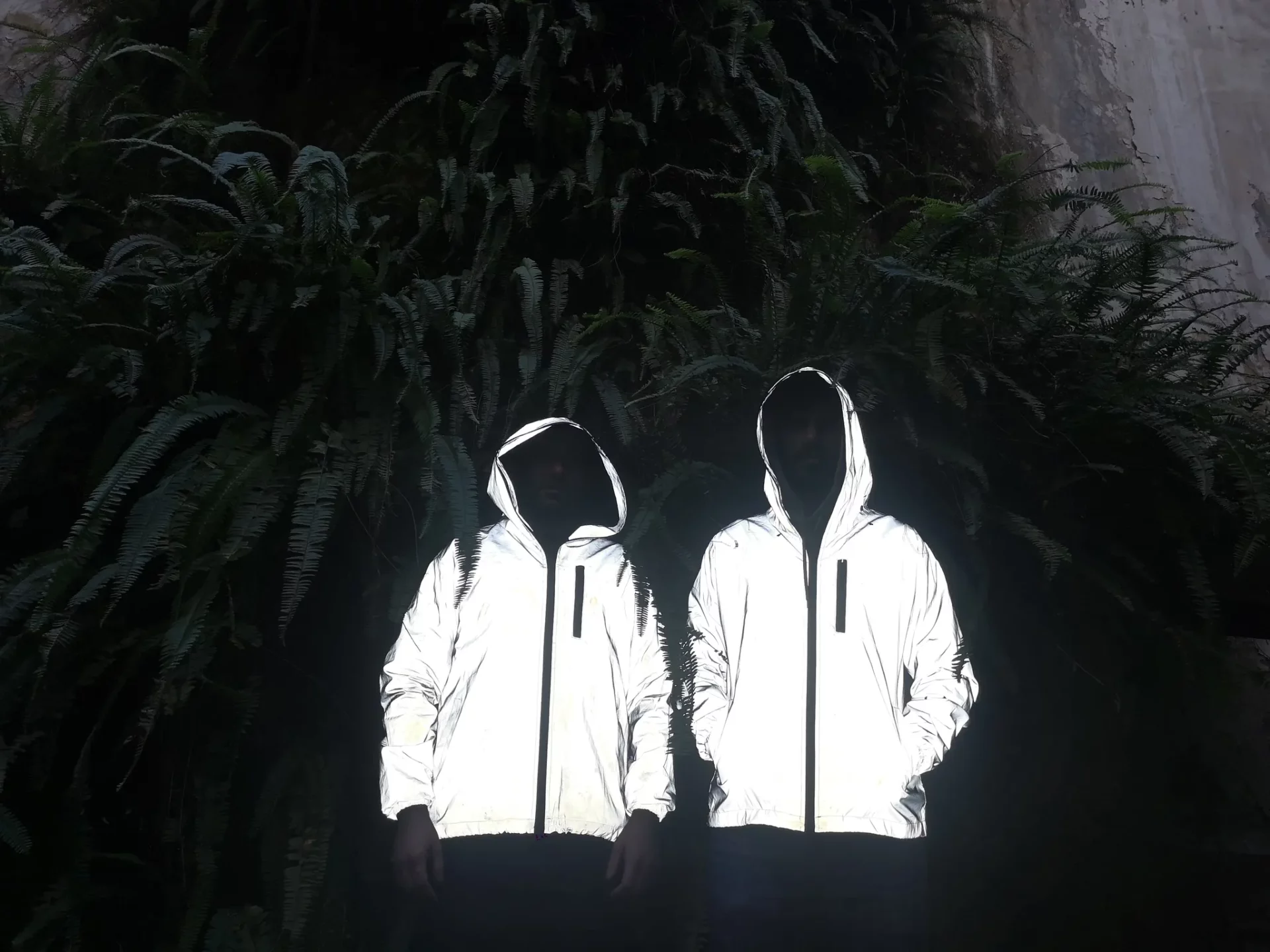
Sound and light are fundamental elements in artistic research where time represents the canvas. In a temporal situation, the instruments that are used are the visual, made possible through lighting, and the auditory, or sound. This does not mean that a performance must necessarily contain both elements. Some works can be exclusively visual without the need for sound, and vice-versa. Generally, if we wish to communicate something specific, we prefer to remove rather than add elements that can confuse the public.
Artificial intelligence is extremely interesting because in a certain way it approaches nature because it has a – life of its own – that is convincing, fascinating, and, at the same time, frightening. We have created a couple of works using AI: in the first, Malerba, meaning – Weeds – , we filmed weeds that grow in the wild and we projected them in giant format onto screens, transforming them into trees in danger of extinction. In this case, we found artificial intelligence very useful because it carried out a job of meticulous research and animated the video according to the idea we had in mind – in other words – creating a parallel between the weeds and the trees considered as such. For the rest of our work we haven – t yet experimented much with this new technological frontier. We will keep you informed.
Has a Publishing and Writing degree from Sapienza University in Rome; he is a freelance journalist, content creator and social media manager. From 2018 to 2020 he was – editorial director of the online magazine Artwave.it, which he founded in 2016, specialised in contemporary art and culture. His writing is mainly focussed on contemporary art, work, social rights and inequality.