


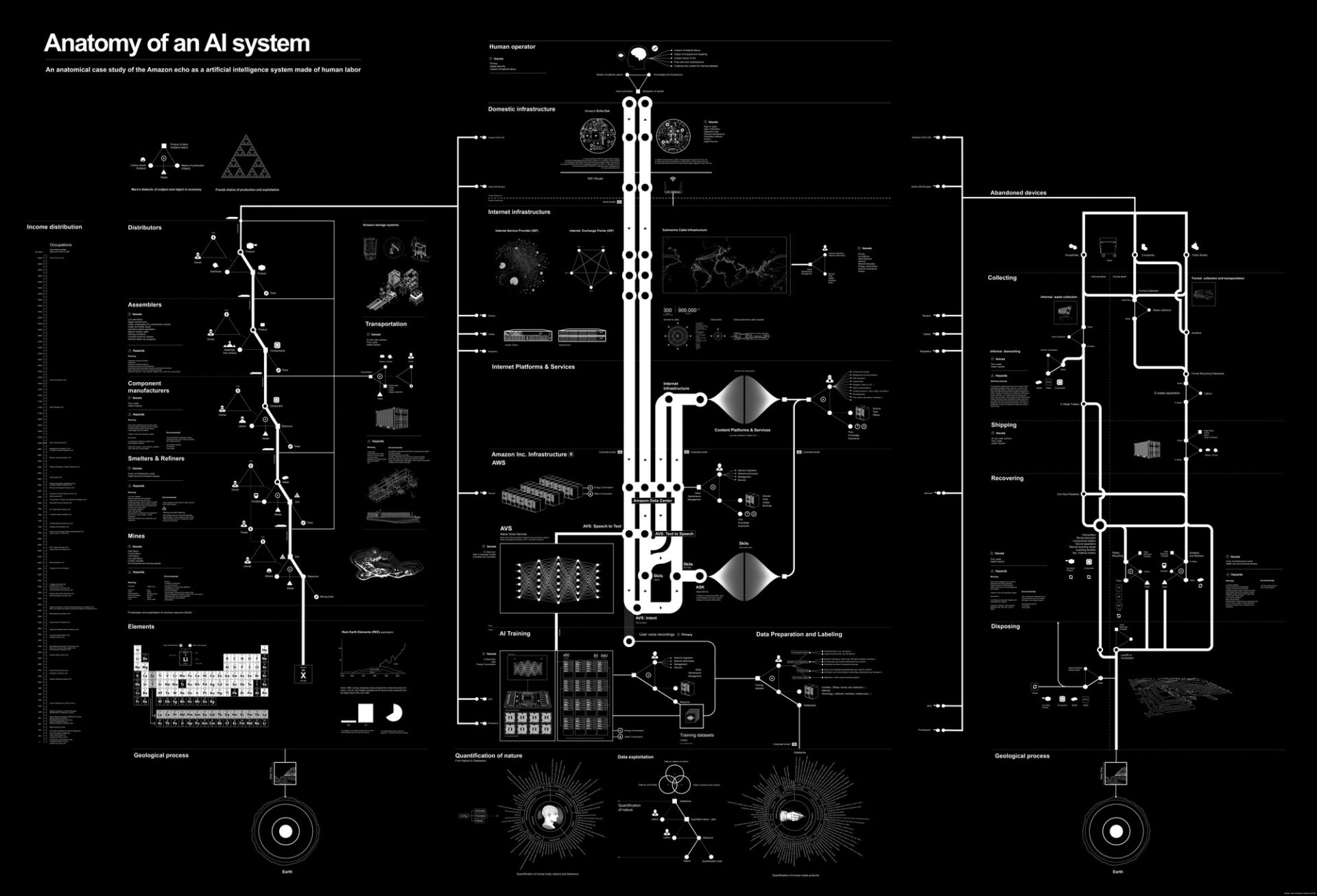
At the center of the project is the Amazon Echo a domestic object, docile, almost invisible. But it is precisely in this docility that a sophisticated network of power condenses. The work, formally a hyperdense and multidimensional diagram, dissects the lifecycle of this device from its mineral genesis to its toxic obsolescence to render visible its global, colonial, necropolitical infrastructure. The Echo becomes a point of access to understand what AI rhetoric conceals: not an artificial mind, but a transnational assemblage of relationships between resources, labor, and data, inscribed within historical dynamics of exploitation.
Technology, the work reminds us, is first and foremost transformed geology. It is not abstraction, but an accumulation of geochemical, thermodynamic, and logistical processes that begin in the earths crust. The coltan from Congo, the lithium from Chile, the copper from Peru, the rare earths from Inner Mongolia the materiality of the device is layered like a cross-section of terrain. From this perspective, Anatomy of an AI System participates in a radical critique of digital dematerialization, showing that every computational operation has a terrestrial origin, a mineral genealogy.

But this geology is not neutral. It is already political, already biopolitical in fact, necropolitical, in the sense of Achille Mbembe: it is a cartography of power that determines who lives, who dies, who works, who breathes toxic air. Extraction is not just a technical process; it is a device for the global organization of value and vulnerability. In this sense, media geology is also a geography of violence.
The promise of AI is that of automation, of intelligence without a subject, of processing without human intervention. But what Anatomy of an AI System demonstrates with extraordinary clarity is that every form of automatic intelligence is supported by a multitude of precarious, displaced, exploited human intelligences.
Every Echo is made possible by invisible bodies: the miners who extract the materials, the workers who assemble the components in Foxconn factories, the Amazon logistics laborers, the anonymous annotators who feed the algorithms with ordered and classified data. Even the consumer becomes part of the machine not just as a user, but as a data source, as an unconscious producer of value.
This dynamic challenges the classical separation between machine and human, between user and system. AI is not an entity distinct from the human, but an infrastructure that absorbs, exploits, redistributes it. Crawford and Joler make this human subsoil visible, overturning the techno-utopian narrative and showing that artificial intelligence is a form of algorithmic division of labor a continuation of capitalism by other means.
If the birth of the device is founded on extraction, its death is no less violent. Electronic waste represents the terminal phase of the cycle, but it does not mark its end. Rather, the death of the device is its toxic diffusion: non-degradable materials accumulating in illegal landfills, especially in the Global South, returning to the earth as corrupted, unstable, carcinogenic matter. The e-waste burning in Agbogbloshie or Guiyu embodies what Shannon Mattern calls ghost infrastructures: systems that continue to act even after being declared obsolete, contaminating lands and bodies.

Crawford and Joler speak the language of residue: technology as debris, as waste that prolongs its destructive action beyond its use. In this phase, a form of toxic temporality emerges, breaking the linearity of technological progress. E-waste does not age: it persists, contaminates, stratifies. The work reminds us that the promise of innovation comes with a cost that is never paid in the time and space where value is produced, but elsewhere in other bodies, in other ecosystems.
The aesthetic power of Anatomy of an AI System lies in its diagrammatic form. In an era when visualization tends toward simplification, Crawford and Joler choose complexity. Their diagram is not an illustration, but a conceptual machine: a topography of the socio-technical system that demands a kind of slow, layered, counter-intuitive attention.
The work does not offer a view from above, but a cross-section: a horizontal cut that slices through the surface and penetrates the deepest layers of technological production. It is an act of critical excavation, an artistic practice that becomes geophilosophy, a visual ecology capable of restoring the weight of the world to an object sold to us as levitating.
In an era that seeks to rise above all gravity, the work restores our responsibility to look downward, to touch the ground from which all originates and to which all returns, often in toxic form. Rethinking technology from its geology means resetting our relationship with media no longer as tools at our service, but as artificial ecologies that imply, shape, and consume the world. Art, in this context, is not decoration, but an instrument of revelation. Anatomy of an AI System offers us a lens to read the political matter of the digital, and challenges us to conceive a form of intelligence not based on prediction, but on memory: the memory of the earth, of bodies, of wounds.
Is an art historian specialising in art and new technologies and new media aesthetics. Since 2019 she has been collaborating with Artribune (for which she is currently in charge of new media content). In 2020 she founded Chiasmo Magazine, an independent and self-funded Contemporary Art magazine. From 2023 he is web editor for Sky Arte, and from the same year he takes care, for art-frame, of the column New Media, dedicated to digital art.




















© COPYRIGHT THE BUNKER 2025. ALL RIGHTS RESERVED.
THE BUNKER MAGAZINE is a registered publisher at the Florence Court Register of Press, n.6214 / 03.03.2025