


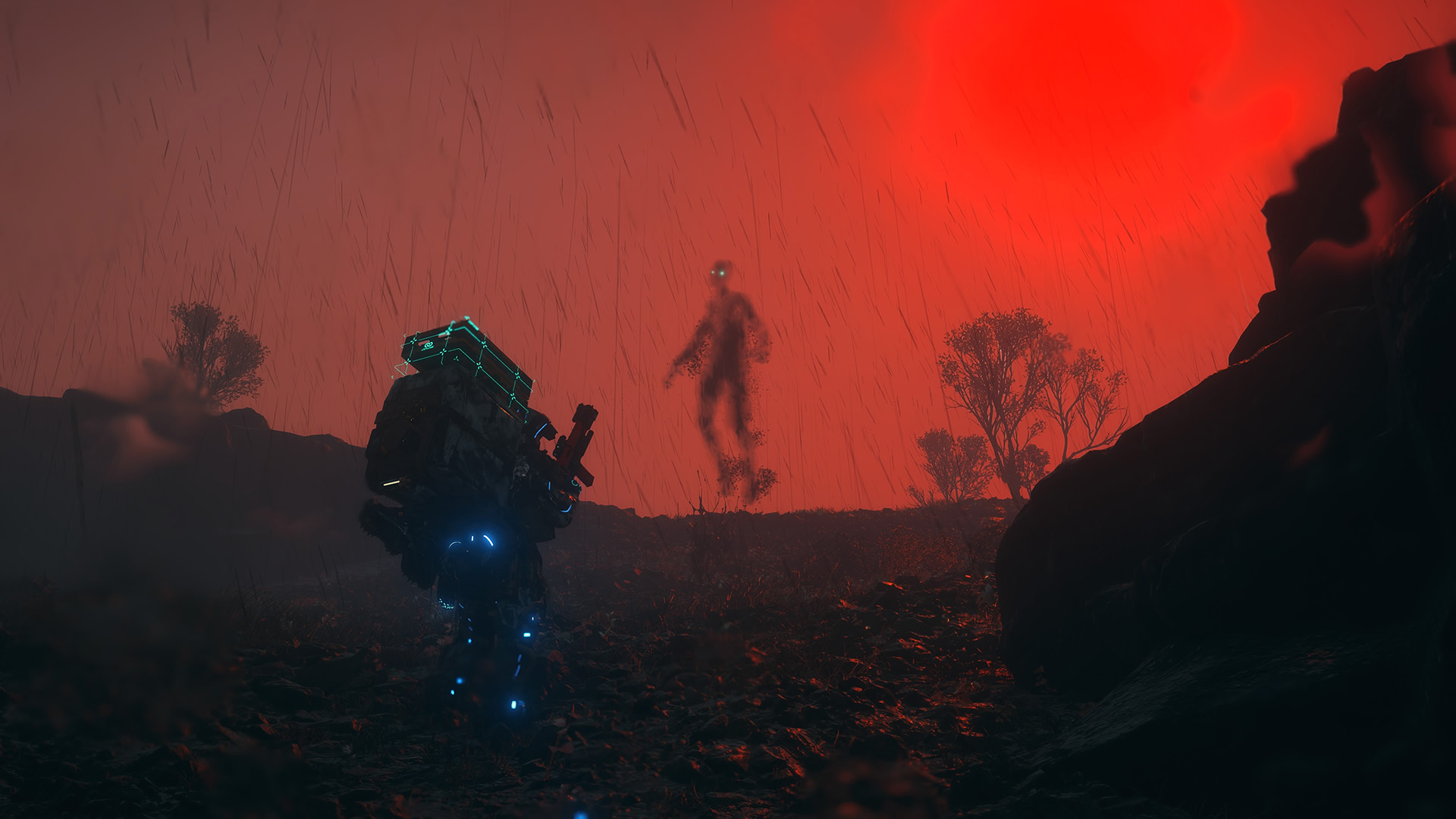
“And You May Find Yourself Living in an Age of Mass Extinction” is the title of the opening essay in All Art is Ecological by Timothy Morton (Penguin Classics, 2021). And you might find yourself playing in an era of mass extinction if you play Death Stranding (Kojima Productions, Sony Interactive Entertainment, 2019) and Death Stranding 2: On the Beach (Kojima Productions, Sony Interactive Entertainment, 2025), recently released for PlayStation 5.
In the Death Stranding series, we play as Sam Porter Bridges, a deliveryman in a possible apocalypse where an event called the Death Stranding has blurred the boundaries between life and death. Now, the souls of the deceased sometimes remain stuck in our world as Beached Things (BTs), obsessed with finding the bodies they lost, accompanied by a rain that accelerates time and consumes buildings and living creatures – Timefall – and by a substance resembling tar. To escape BTs and Timefall, the human population has taken refuge in bunker cities connected by couriers like the protagonist and by the Chiral Network, a kind of internet that uses the ability to communicate through the Beach, a liminal dimension beyond time, between life and whatever comes after. In both games, our task is not only to deliver parcels from one settlement to another but also to expand the network: in Death Stranding, across the territory of what is now the United States, and in Death Stranding 2: On the Beach, across Mexico and Australia. On our mission, we can help ourselves by placing structures and infrastructure such as bridges and roads, and what we build (as well as the cargo we lose along the way) can appear in other players’ worlds, helping them in their game.
What we cross is, in the game’s fiction, the sixth Death Stranding in Earth’s history, and each time this event has been connected to a major mass extinction. At the end of the first installment, the protagonist manages to delay the onset of the sixth extinction, but we know it will ultimately be inevitable – just as the effects of the Death Stranding are now inevitable: the coexistence of life and non-life, human and non-human, present and past. The Death Stranding strongly resembles climate change and, like climate change, is a good example of what Morton has defined as hyperobjects – a concept introduced in The Ecological Thought (Harvard University Press, 2010) and further explored in Hyperobjects: Philosophy and Ecology after the End of the World (University of Minnesota Press, 2013). Hyperobjects are “things that are massively distributed in time and space relative to humans” so vast that we can only ever perceive individual parts of them, capable of triggering that epistemological and ontological revolution at the heart of the Anthropocene crisis – that is, making us understand that “nonhuman beings are responsible for the next moment of human history and thinking”.
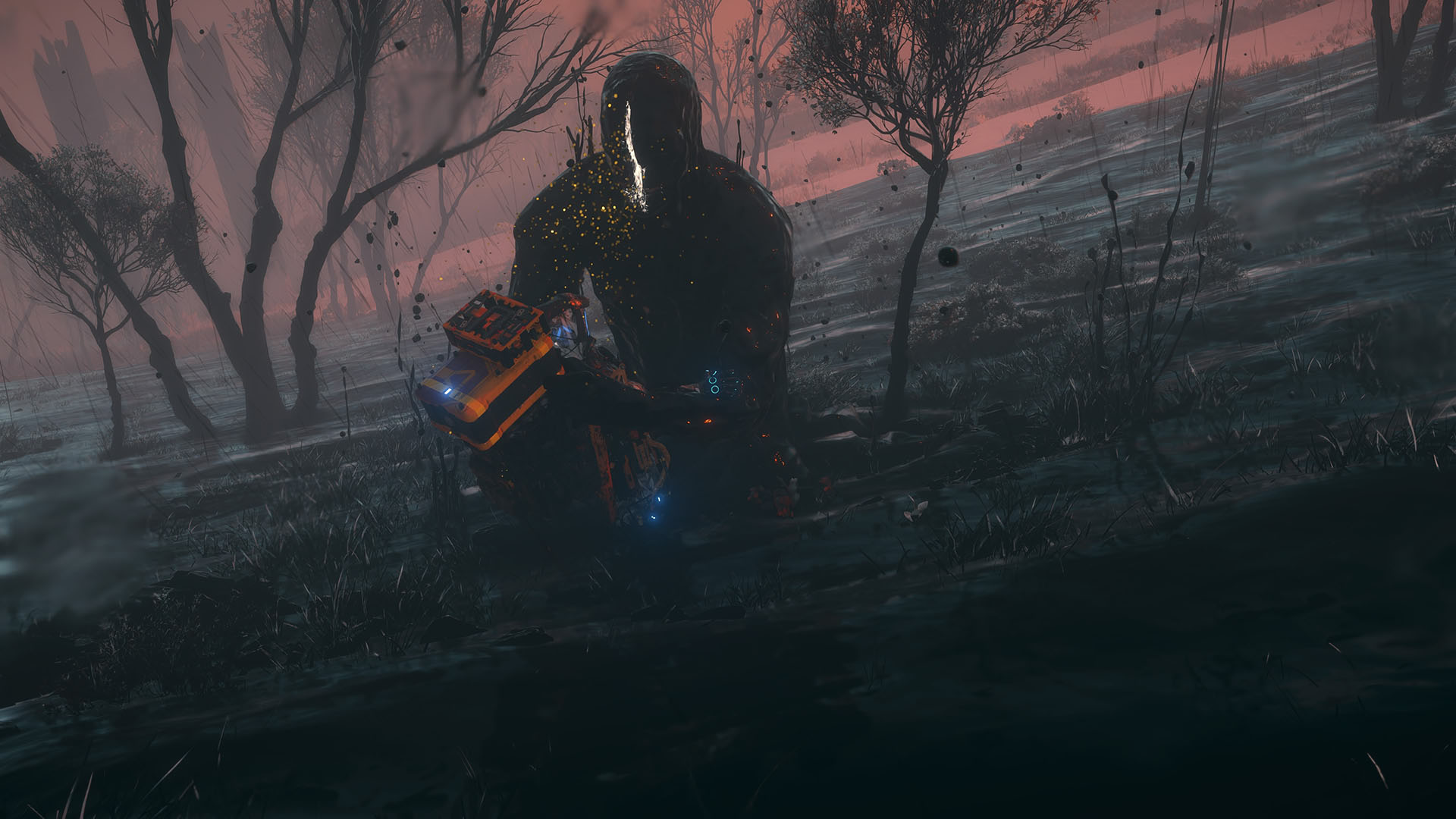
Hyperobjects are sticky, viscous: they get inside us, they cling to us. Timefall carries from the Beach a substance called chiralium, and people who are exposed to it for too long suffer both physical and psychological consequences – they become invaded by it. Hyperobjects are non-local: climate change is a global phenomenon of which we locally perceive only limited effects. We see the weather, not the climate – just as we see Timefall, not the Death Stranding. Hyperobjects exist on a temporal scale different from that of humans and bring us into contact with different temporalities. In Death Stranding, time is sometimes accelerated; at other times, ruins from the past emerge from tar swamps. The manifestations of the Death Stranding and those of other hyperobjects appear and disappear, as if they only occasionally intersect our dimension. Hyperobjects are interobjective – that is, they manifest in relation, in the imprint they leave, in distortion. BTs appear precisely as tar footprints on the ground and provoke physical, even allergic, reactions in some characters. Moreover, Death Stranding is about connection: the one we bring into the game world through our work as a courier and the expansion of the Chiral Network, and the one between players who share objects and structures. And connection is at the core of what Morton calls “ecological thought”, which means precisely thinking of everything as interconnected.
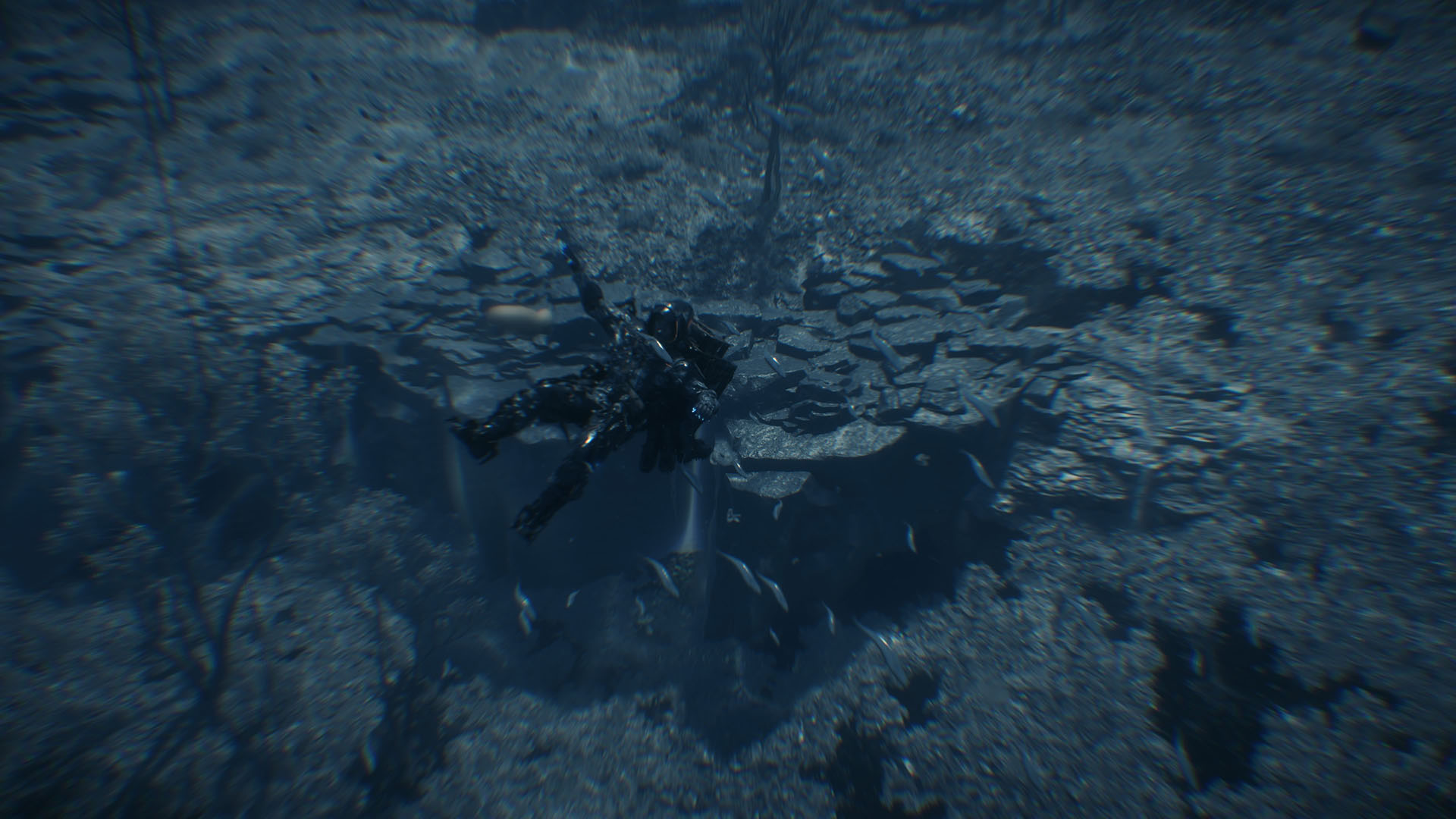
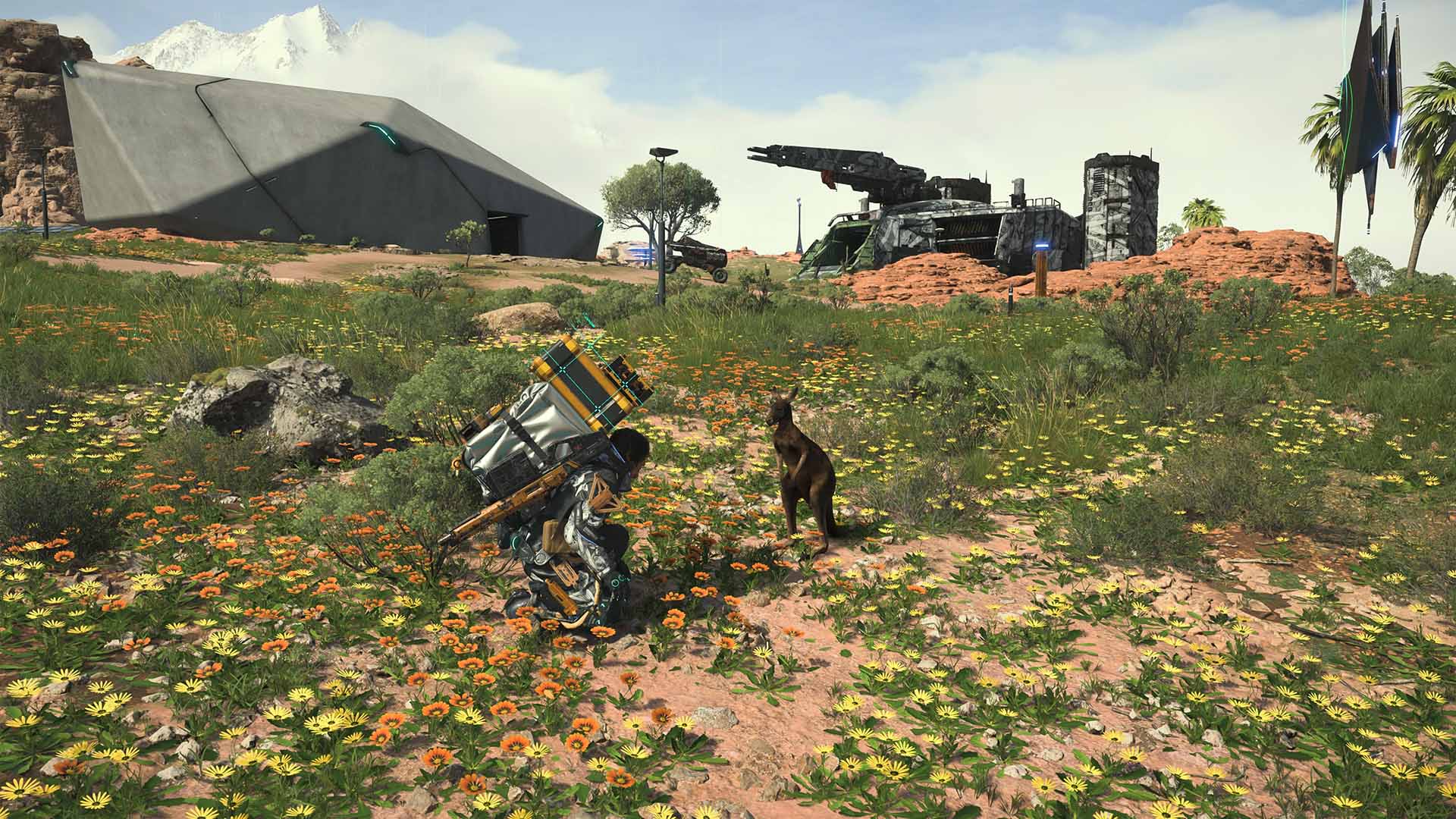
However, the point of view in Death Stranding remains very anthropocentric. The sixth extinction is a problem that concerns humans above all. There is no real simulation of the ecosystems we traverse, and in the first game, non-human animals are almost entirely absent – they seem already extinct: there is no concern for their fate, nor for that of flora or other forms of life. It is also unclear where the materials we collect, deliver, and use come from. For Morton, “we coexist with human lifeforms, nonhuman lifeforms, and non-lifeforms, on the insides of a series of gigantic entities with whom we also coexist”. In Death Stranding, however, there is still an “outside,” an invisible elsewhere from which we extract infinite resources – opposed to an “inside,” a nature opposed to culture, just as a body is opposed to a soul. In Death Stranding, all human beings are connected, and they are connected to entities that are no longer properly human but still closely related to them – namely, the souls of the dead. But there is little connection with other animals, with plants, or with minerals. It is also doubtful whether, in the conflict between the living and the BTs, that care for even the most disgusting and terrifying parts of reality (waste, radioactive residues), which Morton discusses for example in Dark Ecology. For a Logic of Future Coexistence (Columbia University Press, 2016), can be imagined. The perspective does not change much in Death Stranding 2: On the Beach, although there is more interest in these themes. In Australia, we can rescue wild animals and bring them to a shelter, and the game world is less static, with a day/night cycle, sandstorms, snowstorms, floods, and earthquakes. This time, we also see (and use) the mines from which the materials needed to build tools and structures come – yet the extraction process itself is never questioned.
Perhaps, in the end, what truly links Morton’s philosophy to Death Stranding is the weirdness. Death Stranding and Death Stranding 2: On the Beach aim for photorealism, with mainly Western actors portraying and voicing the characters (the protagonist is Norman Reedus, known for the TV series The Walking Dead), seemingly sliding into what has been called the uncanny valley – the space where something artificial (like a robot) resembles a human so closely that it becomes unsettling. But for Morton, the uncanny valley doesn’t exist, because everything is disturbing and ambiguous. Just like everything is disturbing and ambiguous in Death Stranding, which first embraces the suspension of disbelief and then rejects it – reminding us that it is software, quoting and self-referencing, contradicting itself. Narratively, it piles together, in disorder, science, science fiction, psychology, critique and celebration of U.S. technology and culture, tragedy pushed to the pathetic, and meta-comedy pushed to the ridiculous. Testifying to Morton’s wide influence on the arts, the catalog (curated by Klaus Biesenbach) of the 2015 exhibition the Museum of Modern Art (MoMA) in New York dedicated to the singer Bj – rk includes an email exchange between Bj – rk and Morton.”Earth needs this tenderness”, – Morton writes. “I think there is some kind of fusion between tenderness and sadness, joy, yearning, longing, horror (tricky one), laughter, melancholy and weirdness. This fusion is the feeling of ecological awareness” Death Stranding often feels a bit like that.
Matteo Lupetti si occupa di critica di arte, arte digitale e videogioco su testate come Artribune e Il Manifesto e all’estero. Ha fatto parte della redazione della rivista radicale menelique e della direzione artistica del festival di narrazioni di realt – Cretecon. Il suo primo libro – “UDO. Guida ai videogiochi nell’Antropocene” (Nuove Sido, Genova, 2023), rilettura del medium videoludico nell’epoca del cambiamento climatico e all’interno dei nuovi percorsi multisciplinari che mettono in primo piano il non umano e la sua agency.