


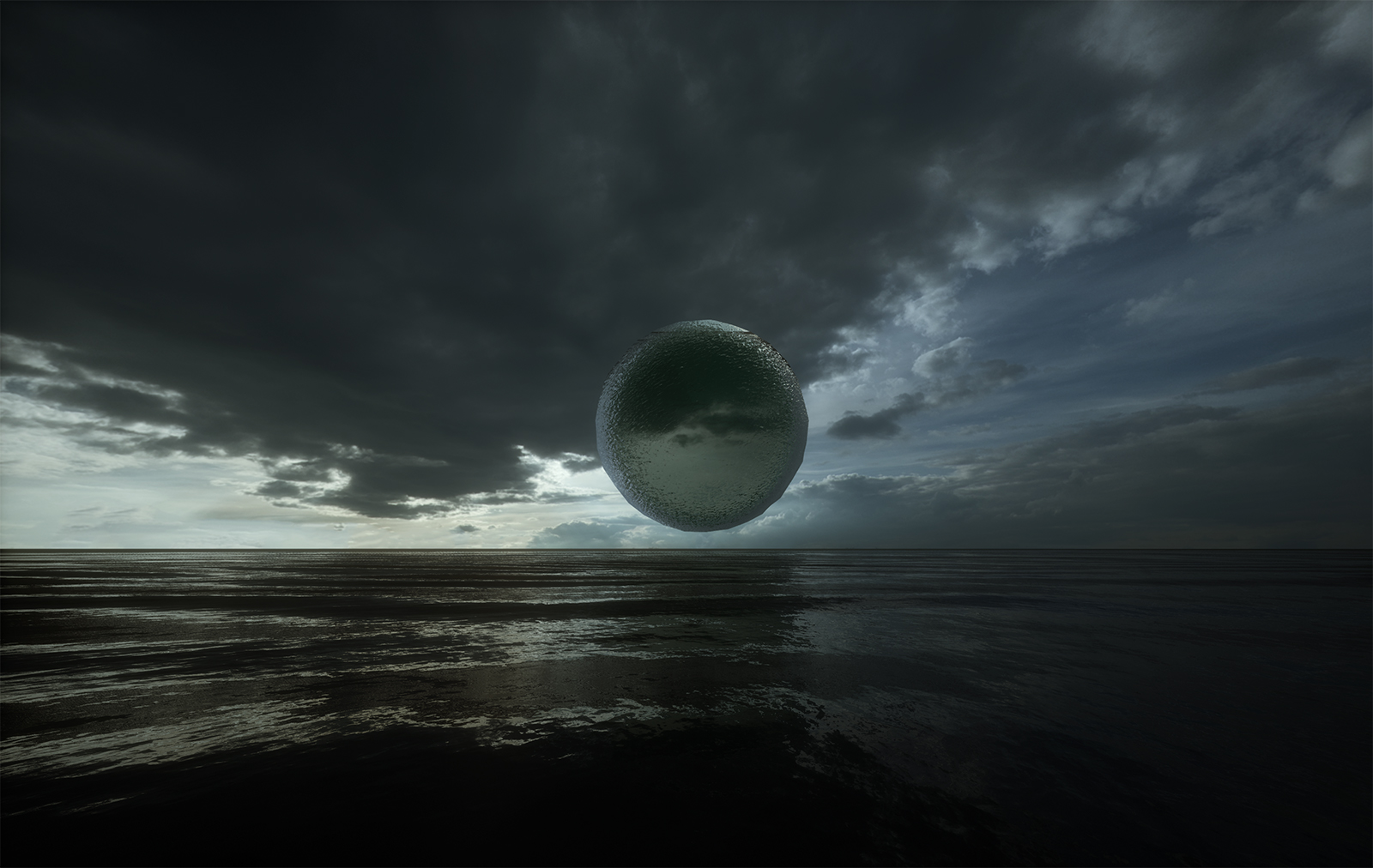
In the age of the Anthropocene – that geological epoch marked by the irreversible impact of humans on the planet – art is more than ever called upon to act as a “device of revelation.” Let me explain: faced with an imaginary now saturated with data, statistics, and satellite imagery, many artists (digital and otherwise) have taken on the task of making the invisible visible, translating the abstraction of ecological disaster into tangible forms. It’s no longer just about representing the climate crisis, but about making it felt – through immersive installations, speculative narratives, artificial intelligences trained on ecological archives, and landscapes generated from data. It is within this context that a new “aesthetics of the end of the world” emerges, one that seeks to visually process the tension between geological time and technological present.
T.J. Demos, in his essay Beyond the World’s End, emphasizes that “the climate crisis is also a crisis of imagination.” In a world where environmental catastrophes overlap with social and political ones (hence the concept of polycrisis), art has the task of producing new forms of critical thinking and new imaginable futures. As Edwin Coomasaru and Theresa Deichert also show in their book Art in Apocalyptic Times, contemporary art reacts to the sense of ending not with a spectacular aesthetics of disaster, but with images that reveal the slow layering of ecological agony.
This is the case with Jenna Sutela, who in works like nimiia c – ti – explores the language of microbes and the interaction between non-human life forms and machine learning algorithms. Here, the end of the world takes on biopoetic tones, suggesting an alien ecology where communication and survival occur beyond human language. Sutela shifts the focus from anthropocentric centrality to a symbiotic vision, in which the climate crisis also becomes an opportunity to redesign the very concept of subjectivity.
The same applies to Aquaphobia (2017) by Jakob Kudsk Steensen, a work that uses virtual reality to imagine a post-apocalyptic future in which humans have disappeared and an aquatic entity becomes the narrator. Once humanity is extinct, what remains is a liquid consciousness that guides us through the remnants of a submerged landscape – mud, roots, and fragments of abandoned infrastructure. In this speculative landscape, it is precisely the absence of humans that allows the environment to tell its story. The liquid entity that accompanies the visitor – an alien, amorphous creature evoked through underwater sounds and poetic verses – seems to reclaim an ecosystem that has regained its autonomy. A voiceover narrates a love story that has ended – a “breakup” between the natural world and its colonizer, humankind, who tried in vain to control what it could not understand. “You think you’re not a part of me, but you are,” the voice says, reminding us that every artificial structure, every urban surface, still rests on the living matter we have tried to dominate. The fear of water – a vital and destructive element, geological memory and poetic subject – thus becomes a metaphor for humanity’s inability to accept its ecological interdependence.
The installation becomes a metaphor for an era in which even our relationship with nature is mediated by simulations, by data generated from abstract models, more concerned with computational coherence than with the complexity of the living.
Yet the apocalyptic imaginary, however permeated by darkness and unease, can also become a fertile ground for revelation – just as suggested by the Greek etymology of the word apok – lypsis, which does not indicate the end itself, but an unveiling, an opening to what has remained hidden. From this perspective, some contemporary artists use technology not to glorify innovation, but to question its salvific promise. Among them, Hito Steyerl stands out for her deeply critical and ironic approach to the ideology of progress, especially that conveyed by artificial intelligence and predictive algorithms.
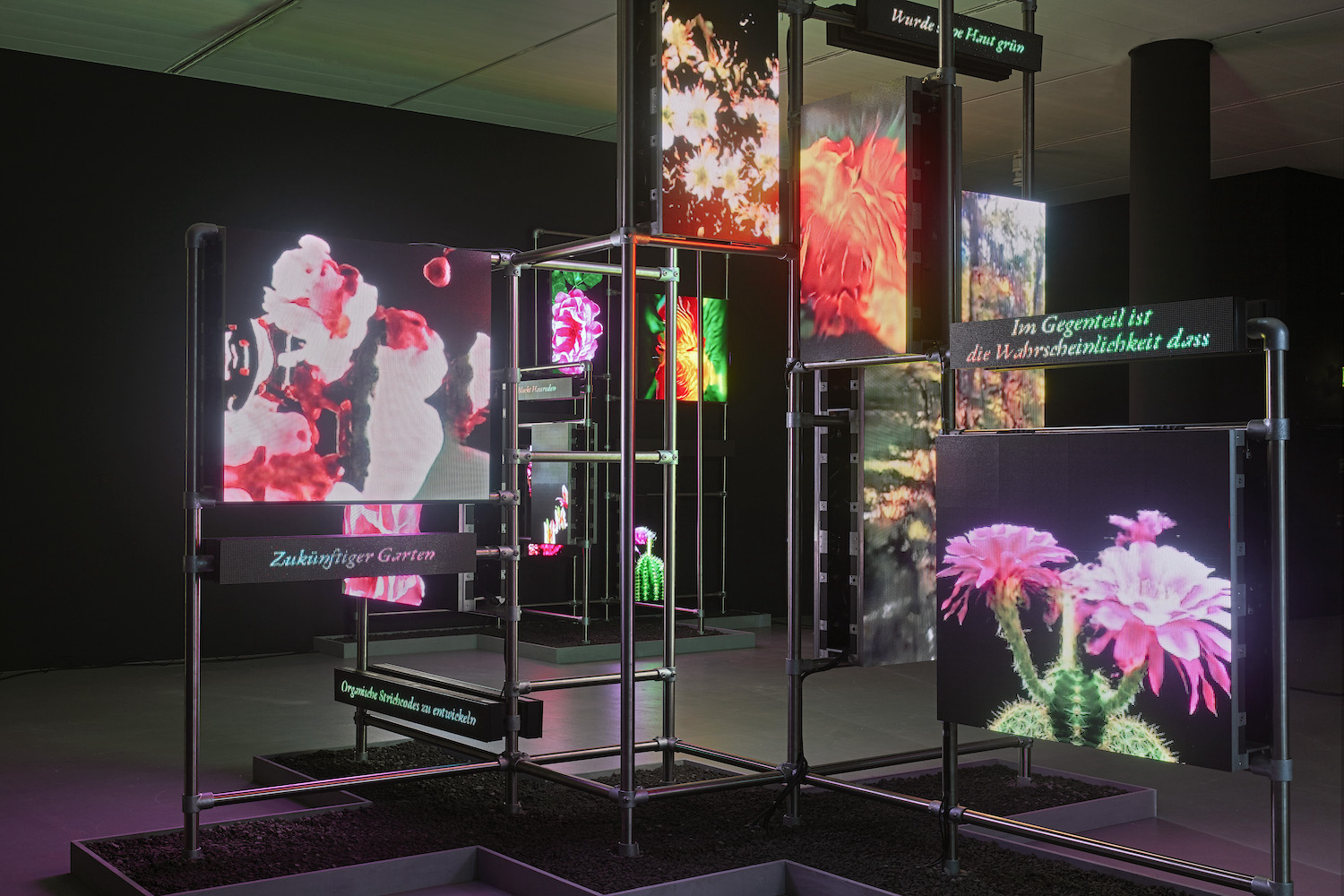
In the installation This is the Future, presented at the 2019 Venice Biennale, the German artist constructs a futuristic digital garden – seemingly idyllic – inspired by lagoon landscapes and their raised walkways, but entirely simulated by a neural network. Visitors move through an immersive space where digital flowers grow, bloom, and wither in endless cycles, without ever “truly” existing. The life unfolding before their eyes is a predictive sequence generated by an AI trained on incomplete, fallible data – and yet presented as believable. In this way, Steyerl questions the blind trust in AI’s ability to forecast and solve future problems: she shows us a future that feeds on the same fallacies of the present – a dystopia disguised as a garden.
In this artificial space, technology is not a tool of salvation but a lens that distorts, amplifies, and sometimes replaces reality. The installation becomes a metaphor for an era in which even our relationship with nature is mediated by simulations, by data generated from abstract models, more concerned with computational coherence than with the complexity of the living.
Thus, Steyerl doesn’t merely criticize the cult of technology – she deconstructs it from within, using its own languages and mechanisms to expose its contradictions. In doing so, she invites the viewer to consider that, in the age of artificial intelligence and pervasive simulation, the true apocalypse may not be an explosive event, but a slow and seductive process of disconnection from reality, where even the environmental crisis is turned into an interactive spectacle – refined, yet ineffective.
This aesthetics of the Anthropocene – as stated by Heather Davis and Etienne Turpin in Art in the Anthropocene: Encounters Among Aesthetics, Politics, Environments and Epistemologies – is “a sensorial phenomenology of living in a toxic world.” But it is also an ethical device: art becomes a field of action in which to rethink our bonds with the living and the non-human. No longer apocalyptic narratives as exercises in catharsis, but images capable of triggering processes of collective awareness.
As Demos asserts, we are at the “endgame of democracy, of capitalism, of the cool planet, and of imagination itself.” But it is precisely in this twilight that spaces for creative resistance open up. Works that thematize the end of the world do not ask us to accept it – but to fully see it, and then decide how to respond. In this sense, the aesthetics of the end is also an aesthetics of beginning – an opportunity to imagine what might come next. Or, as Alexis Pauline Gumbs writes, “after the small and present apocalypses, after and with the end of the world as we knew it.”
Ultimately, the aesthetics of the end of the world is neither a simple exercise in representing disaster nor an extension of the collapse industry. Rather, it is a critical and imaginative space in which art confronts the invisibility of the Anthropocene, challenging the insufficiency of traditional categories of perception and empathy. In this sense, these works do not represent the end – they offer a tool to think it, feel it, inhabit it. They give us back an aesthetics that is also a pedagogy and a form of resistance: an invitation to see with new eyes what we have learned to ignore, to reckon with our place in deep time, and perhaps – as Demos hopes – to imagine worlds beyond the end.
Is an art historian specialising in art and new technologies and new media aesthetics. Since 2019 she has been collaborating with Artribune (for which she is currently in charge of new media content). In 2020 she founded Chiasmo Magazine, an independent and self-funded Contemporary Art magazine. From 2023 he is web editor for Sky Arte, and from the same year he takes care, for art-frame, of the column – New Media’, dedicated to digital art.