


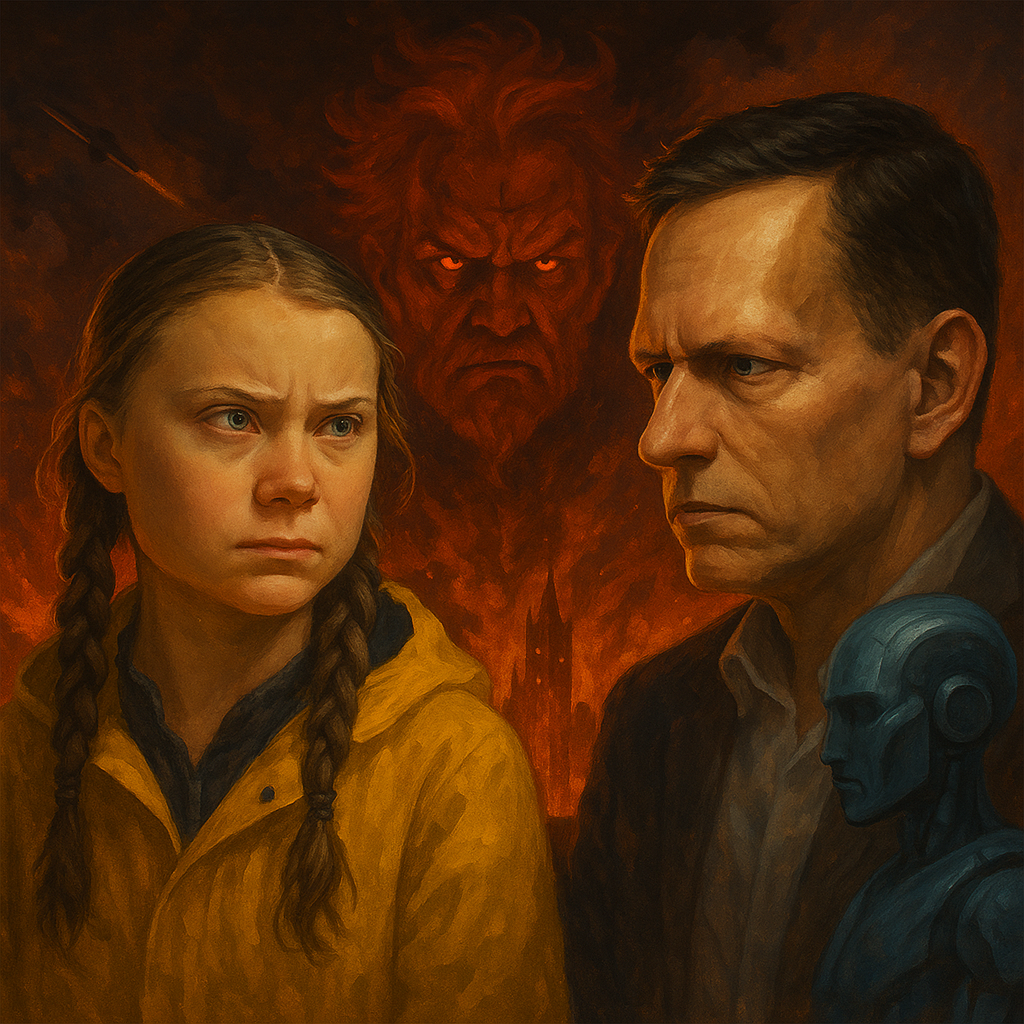
For several years, Greta Thunberg—at least in the media’s imagination—was the girl in the yellow coat with braids, fighting for the most righteous of causes: saving the planet.
Unless one was a climate denier, a right-wing newspaper columnist amused by using the term “gretini,” or Donald Trump, it was practically impossible not to agree with her.
Greta, in short, was the harmless symbol of the fight against the climate crisis. And as such, she was constantly invited to speak in national parliaments and international forums, where she received standing ovations.
But for some time now, perceptions have radically changed. Thunberg never bowed to the docile and harmless image that the media and global elites had crafted around her; instead, she has become a full-fledged political activist fighting against social injustice, capitalism, imperialism, colonialism, misogyny, and technocratic oligarchy. And she does not limit herself to speaking or posting on social media: she puts her own body on the line in the most radical climate protests or in attempts to breach the naval blockade around the Gaza Strip, as happened recently with the Global Sumud Flotilla.
She herself often repeats that “there can be no climate justice without social justice.” And this position has made her an uncomfortable, disturbing, and threatening figure. Greta is no longer the adolescent with braids: she is “an antisemite,” a “morally confused” person, even the Antichrist.
Peter Thiel, one of Silicon Valley’s most important magnates and a leading figure of the tech-right, is firmly convinced of this. The co-founder of PayPal and founder of Palantir does not mean it hyperbolically or ironically, but literally: Thunberg really is the Antichrist, or at least one of its possible incarnations.

Thiel appears genuinely consumed by an obsession with the Antichrist, a figure explicitly mentioned only in a few passages of some of John’s letters. According to Robert Fuller, professor of religious studies and author of an essay on what he calls “an American fixation,” the Antichrist “embodies Christ’s ultimate enemy, destined to appear at the end of History to lead Satan’s forces in a final, desperate battle against those of God.”
Its form has never been specified but left largely to the imagination. The first to write about it systematically, organizing the various speculations of early Christianity, was the Benedictine monk Adso of Montier-en-Der in the booklet De Antichristo, written between 949 and 954.
According to Adso, the Antichrist will have the features of a tyrannical king who deceives humans with miracles, gifts of gold and silver, and terror. He will be killed directly by Jesus or by the archangel Michael on the Mount of Olives, where the Lord ascended into heaven.
The Antichrist is thus an eschatological concept, closely tied to the idea of the end of the world. Not surprisingly, it constantly appears in apocalyptic literature and in the millenarian anxieties of cults and sects, especially of the evangelical variety.
But it is also a political concept: over the centuries, many leaders have been labeled with that term—from Napoleon to Saddam Hussein, passing through Osama Bin Laden and even Donald Trump.
In the past two years, Thiel has been presenting his personal version of the Antichrist in a series of private, hours-long lectures held in university classrooms or private venues. The latest stop of this sort of tour took place in San Francisco between last September and October.
Despite a ban on filming or recording, the content of these pseudo-lectures has leaked to the press, and it is both very bizarre and very unsettling. As Adrian Daub, professor of comparative literature at Stanford University (Thiel’s alma mater), wrote in The Guardian, the oligarch’s sermons resemble a Dan Brown novel more than a learned “political theology” dissertation.
The major problem is that this is not a work of fiction playing with folklore and pseudo-historical beliefs, but a syncretic mishmash that one of the world’s most influential men genuinely believes.
Thiel draws rather confusedly from various sources: biblical imagery; the theories of the Catholic French philosopher René Girard (his former professor at Stanford) on mimetic desire and the scapegoat mechanism; those of German jurist Carl Schmitt, who joined Nazism in 1933 and viewed politics as a life-and-death struggle between “friends” and “enemies”; and finally from popular culture, including the manga One Piece and Alan Moore’s Watchmen.
In any case, according to Thiel, the main problem of our “apathetic,” “zombified” age is a “quasi-pathological fear” of technology. In its neurotic attempt to avoid Armageddon—be it nuclear war, climate collapse, or the development of a general intelligence that escapes human control—modern civilization is supposedly opening the door to a far worse danger: the Antichrist.
The latter, the magnate continues, could rise to power “by leveraging our anti-technology phobia and seducing us with slogans about peace and security.” In other words, this figure would drag us straight toward the end of the world while promising to save us from it.
Throughout the various lectures, Thiel listed at least two other potential Antichrists besides Greta Thunberg: futurist Nick Bostrom, known for his apocalyptic predictions about artificial intelligence; and theorist Eliezer Yudkowsky, formerly funded by Thiel, who argues that AI development must be completely halted before it becomes too late for humanity.
Essentially, the Palantir owner is convinced that the Antichrist is a Luddite who wants to stop progress by establishing a “one-world government”—an expression that harks back to an anti-communist conspiracy theory from the 1950s (later revived and updated in the 1990s) and that conceals the true fears of Silicon Valley’s oligarchs: regulation of their business and taxation of their obscene wealth.

In one lecture, for example, Thiel complained that “it is becoming increasingly difficult to hide one’s money” because of cross-checks by international financial authorities. In another, he sarcastically wondered what the marginal tax rate of a hypothetical unified global government might be.
The solution to the coming of the Antichrist therefore lies in the so-called katechon, a force that “restrains” the Apocalypse, mentioned by the apostle Paul in the Second Letter to the Thessalonians in the New Testament.
Carl Schmitt, to cite one of Thiel’s inspirations, sought his katechon in Nazism. The jurist was in fact convinced that Adolf Hitler could stop the Antichrist—that is, the Soviet Union, and more generally internationalist ideologies. It was a tragic mistake, of course, because in the end the Antichrist turned out to be Hitler himself.
For Thiel, the katechon must be understood in technological and political terms: the Antichrist will be stopped by a world fragmented into nation-states that do not interfere in the affairs of innovators (i.e. the tech oligarchs), allowing them to accelerate progress and avert the Apocalypse, which coincides with the advent of a single totalitarian state.
It is a vision that, ultimately, has little to do with religion and much to do with the radically libertarian and anti-state ideology that Thiel has long promoted.
Journalist Gil Duran, author of the newsletter The Nerd Reich, wrote in The New Republic that the magnate’s fixation on the Antichrist should be seen as “a cynical ploy to further stoke political divisions” in an already highly polarized country.

All this apocalyptic talk, moreover, would be nothing more than “clumsy attempts to strengthen the alliance with religious nationalists inside the Republican Party, who in turn rely on apocalyptic language to advance their political goals.” Indeed, journalist Matthew D’Ancona has described Thiel’s Antichrist theories as “an erudite version of MAGA end-times theology.”
Pointing to an Antichrist at all costs—and even naming names—remains an extremely controversial and dangerous operation.
This was made clear by Wilhelm Guggenberger, dean of the theology faculty at the University of Innsbruck, where the Palantir president gave a lecture deemed “disappointing” and “alarming” by the professors present.
“Thiel believes almost fanatically in the potential of technology to solve problems,” Guggenberger told the Austrian magazine Falter. “For this reason, he identifies the main evil of the present in the fact that innovation seems to have long entered a phase of stagnation. Thiel links this view to a type of apocalyptic thinking and to the biblical images of the Antichrist and the katechon. In a problematic way, Thiel tries to identify these ideas with specific people or institutions in current world events.”
After all, as Professor Robert Fuller explained in an interview with Gil Duran, the entire concept of the Antichrist “feeds an existential-threat mentality. And with that mentality, all differences are put aside: tribal cohesion and tribal unity are created, and even immoral acts end up being justified because, to defeat an evil enemy, a satanic enemy, one considers any action permissible.”
To be clear: it is hard to consider Greta Thunberg a mortal danger to humanity if one considers her for what she actually is—a well-known and influential political activist who has fought determinedly for progressive causes for years. But if she is transfigured into the Antichrist, then she must be stopped at all costs.
The point, however, is that Thiel is infinitely more powerful than Thunberg. And this is precisely the most enormous paradox of his Antichrist theories: the traits he finds in that apocalyptic figure apply perfectly to himself.
The magnate holds impressive economic and political power, second only to that of his former partner Elon Musk. Besides having funded Trump’s first campaign, he literally built from scratch the political career of JD Vance, the current vice president. And above all, he owns companies that are at the center of the global surveillance system and crucial to the U.S. military, technological, and repressive apparatus.
Palantir, for instance, has billion-dollar contracts with the Department of Defense and the Department of Homeland Security. Last September, the NGO Just Futures Law obtained documents showing that ICE—the feared federal immigration-control agency that has effectively become Trump’s secret police—uses Palantir systems to identify people to be deported from the United States.
Thiel’s company, however, is not just a simple software provider; it is much more. “It is a government partner that helps determine how investigations are conducted, how priorities are set, how algorithms work, and how decisions are justified,” researcher Nicole Bennett wrote on The Conversation. All this, it must be remembered, takes place in total opacity and outside any democratic oversight.
LEONARDO BIANCHI
Leonardo Bianchi is a journalist and writer. He mainly collaborates with – Internazionale, – Valigia Blu, and – il Manifesto. He is the author of the newsletter – Complotti!, which focuses on conspiracy theories and disinformation. His latest book is – The First Drops of the Storm: Myths, Weapons, and Terror of the Global Far Right.