


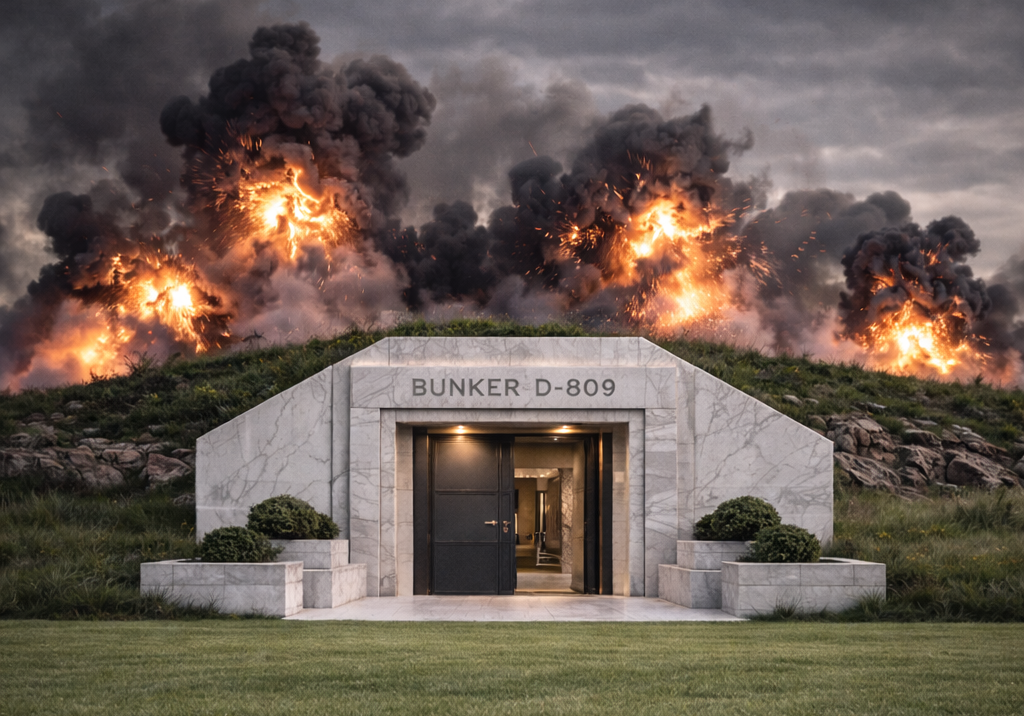
Every human civilization is obsessed with its own end, which coincides with the end of the world. Our civilization is particularly obsessed with it: one need only think of the enormous success of the post-apocalyptic dystopian genre, which for decades has defined pop culture across all latitudes.
As the Irish journalist Mark O’Connell wrote in his essay Notes from an Apocalypse, “we live in an age of apocalyptic scenarios. The world we have inherited seems worn out, destined for an absolute and definitive downfall.”
Between demographic winters, pandemics, economic recessions, climate change, the rise of authoritarianism, rivalries among superpowers, wars, genocides, nuclear rearmament, growing inequalities, and fears surrounding the uncontrolled development of artificial intelligence, the signs of an impending Apocalypse are everywhere, and our societies appear too fragile to confront them all at once.
For this very reason, one must be prepared for every eventuality. Or at least, that is what those who belong to a specific subculture have long been doing: the preppers.
This expression, derived from the colloquial English prep, refers to people who prepare — precisely — for catastrophic and apocalyptic scenarios of a climatic, economic, military, health-related, and social nature.
As can be read on the various websites dedicated to the subject or in certain interviews, prepper philosophy is a sort of “art of the plan B,” whose main rule is to “always prepare for the worst and hope for the best.”
In an interview with VICE Italia, an Italian prepper explained that “it all stems from concern, experienced in a rational rather than paranoid way, that something in our daily lives might go wrong and that the services of modern society might temporarily fail.”
Preparation can take various forms: stockpiling long-lasting food supplies, purchasing technical equipment of various kinds, and learning survival techniques for both urban and natural environments. In this regard, people also speak of “survivalism.”
The roots of the discipline lie in the Cold War: it emerged between Northern Europe and the United States as an autonomous variation of civil defense programs in anticipation of a possible nuclear war with the Soviet Union.

In the 1970s it spread mainly within American libertarian circles thanks to The Survivor, a newsletter by Kurt Saxon, a writer who had been involved with the John Birch Society (a far-right anti-communist organization), the American Nazi Party, and the Church of Scientology.
Between the late 1980s and the 1990s, prepping gradually became associated with the patriot movement — an informal network of far-right anti-government militias — and took on predominantly political overtones.
This negative reputation partly survives to this day: in films and television series (one need only think of Leave the World Behind or The Last of Us), preppers are often portrayed as socially isolated individuals devoted to gun culture, paranoid, and consumed by conspiracy theories about the “New World Order.”
However, the Covid-19 pandemic, natural disasters accelerated by the climate crisis, and geopolitical tensions have changed this perception, contributing to the legitimization and normalization of prepping among broader segments of the population.
According to a survey conducted in 2023 by the Federal Emergency Management Agency (FEMA), more than 20 million Americans engage in prepping.
And as proof of the phenomenon’s growing popularity, several variants have emerged in recent years. One is the anarchist version, which is more inclusive than right-wing survivalism and opposed to the state-centered approach that — as stated in an article published in Red Pepper magazine — “prioritizes governmental continuity rather than the continuation of human life.”
More recently, again in the United States, prepping has also been adopted by small segments of the African American community as a defensive, anti-racist, and anti-Trump practice. “I think it’s very important for people of color to be armed and ready for anything,” a prepper interviewed by Capital B magazine said, “because unfortunately with this president, much like what happened the first time, there is reason to be afraid.”
All this — note Robert E. Kirsch and Emily Ray in the essay Be Prepared: Doomsday Prepping in the United States — demonstrates that prepping is no longer an eccentric anomaly, but rather “an expression of consumer society that transforms security into a private matter entrusted to families, within a neoliberal framework that reduces and weakens state intervention.”
Unsurprisingly, there is also a luxury form of prepping reserved for the super-rich and the broligarchs.
An increasing number of companies now sell fully equipped bunkers built inside decommissioned military silos and fitted with every comfort needed to survive the collapse of society in comfort. Ron Hubbard, CEO of the Texas-based Atlas Survival Shelters, stated that “after the invasion of Ukraine my phone rang every thirty seconds. My clients are worried about nuclear war, biological attacks, or any type of chemical attack.”
For his part, Peter Thiel attempted to build a personal mega-bunker in a remote area of New Zealand, a country whose citizenship he obtained despite never having lived there. Local authorities, however, blocked the project because it would have had a devastating environmental impact.
Mark Zuckerberg, by contrast, succeeded in building a 460-square-meter underground bunker — which he described as “a small shelter” — within his more than $270 million Koolau Ranch in Hawaii. The project remains shrouded in mystery, as builders and workers signed non-disclosure agreements. “It’s like Fight Club: you don’t talk about Fight Club,” one of them told Wired magazine.
Reid Hoffman, co-founder of LinkedIn, has spoken about the existence of an “apocalypse insurance policy” (a bunker or emergency plan) that half of America’s ultra-wealthy supposedly possess in the event of catastrophe.
According to journalist Karen Hao, author of the essay Empire of AI, OpenAI co-founder Ilya Sutskever reportedly said that “we will definitely build a bunker before releasing AGI [artificial general intelligence].”
Furthermore, other Silicon Valley magnates, inspired by the concept of the network state formulated by entrepreneur Balaji Srinivasan, would like to build entire fortified city-states reserved for a select few.
In this sense, media theorist Douglas Rushkoff emphasized in the book Survival of the Richest: Escape Fantasies of the Tech Billionaires that wealth and technological advancement allow techno-oligarchs to “isolate themselves from the concrete and real dangers of climate change, mass migration, pandemics, and resource depletion” — all problems caused or worsened in part by their own activities.
For them, Rushkoff concludes, “the future of technology will concern only one thing: how to escape from all of us.”
So much so that, for figures like Jeff Bezos and Elon Musk, Earth is no longer enough: for the human species to survive, humanity must colonize and “terraform” (make habitable) Mars, which has become a kind of secular Noah’s Ark.
This is an escapist fantasy — emphasize writers and activists Naomi Klein and Astra Taylor in an article published in The Guardian — that has much in common with the evangelical interpretation of the biblical “Rapture,” in which “the faithful ascend to heaven in a golden city, while the damned remain on Earth to face an apocalyptic battle.”
The problem is that a future escape to Mars (or the Moon) is entirely useless for the challenges humanity must confront now. According to Kim Stanley Robinson, author of the celebrated Mars Trilogy, Musk’s plans represent a “moral hazard,” since they create “the illusion that we can destroy Earth and still get away with it, when that is absolutely not the case.”
Broligarch prepping is closely connected to the latest form of prepping to emerge in recent times: that of “millenarian” or apocalyptic fascism, as Naomi Klein and Astra Taylor define it.
Drawing inspiration from Umberto Eco’s concept of Ur-Fascism, the two authors argue that every far-right movement possesses an “Armageddon complex” that can be resolved only through a great final battle in which enemies are eliminated and control of the planet is secured.
However, unlike the totalitarianisms of the 1930s, “millenarian fascism” has no grand salvific vision for a post-Armageddon society. On the contrary: precisely because we are immersed in so many crises that authoritarian right-wing movements have neither the intention nor the capacity to resolve, their “underlying ideology has become a monstrous supremacist survivalism.”
The nation must therefore transform itself into an enormous fortress-bunker, closed off to all internal and external adversaries. And exactly as individual preppers compulsively fill their basements with supplies, the prepper-state also hoards resources.
But it does so on a planetary scale: perhaps eyeing the Panama Canal, seizing Ukraine’s minerals through an openly coercive agreement, coveting Canada’s freshwater reserves, threatening to annex Greenland for reasons of “national security,” and so on.
“The old colonial fig leaves of exporting democracy or the word of God are no longer necessary,” explain Klein and Taylor. “When Trump greedily scans the world, he does so to stockpile supplies for the collapse of civilization.”
Paradoxically, “apocalyptic fascism” is a self-fulfilling prophecy. The more the Trump administration dismantles state and international structures designed to respond to emergencies and subsidizes industries that are rendering the planet uninhabitable, the more bunker mentality is inevitably strengthened and private opportunities emerge to profit from the absence of collective protection.
After all, as Mark O’Connell observes, “preppers are not preparing for their fears: they are preparing for their fantasies.” And for those who can afford it, in the end, the Apocalypse really is excellent business.
Leonardo Bianchi