


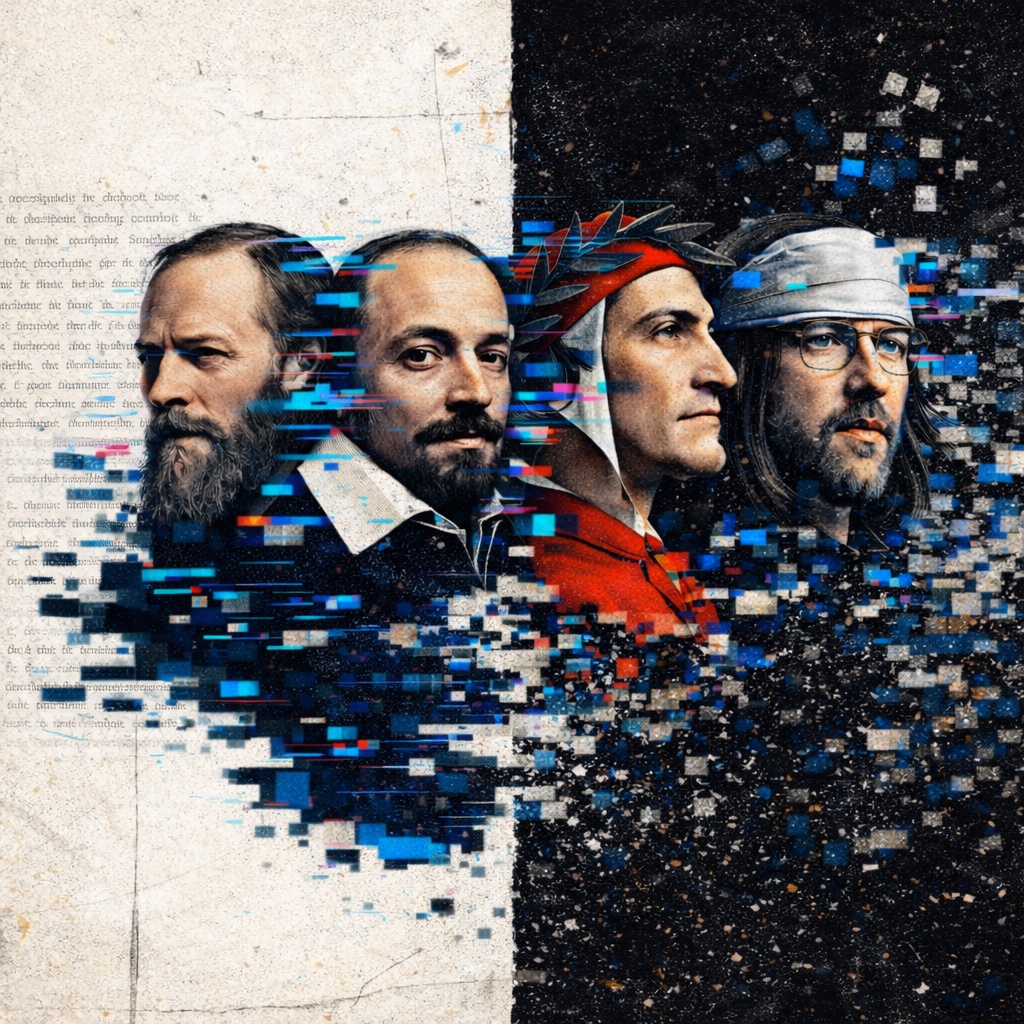
Many years ago I read this sentence somewhere: “the purpose of fiction is to soothe the troubled and trouble the soothed.” I liked it very much, because it captured one of the pleasures I have always found in reading: the sense of gaining access to an in-between place where reality and fantasy meet—where the chaotic, material state of the former encounters the ethereal, gaseous state of the latter in an endless exchange that redefines both. An ouroboros of sublimation and frosting, capable of generating order and confusion at the same time.
I feel a great deal of nostalgia for that time, when I had such a naïve approach to this art form; when it was still possible to sit somewhere alone, in silence, without feeling the world’s short breath on your back, its insistence and its constant demand for perceptual performance. Today, though, if fiction still has a purpose—one that goes beyond mere entertainment for people tired of being bombarded with images—perhaps it is to ruffle language. To air out a closed room. Or, more precisely, to remind us that the room was already closed before, and that literary language worthy of the name is not there to decorate it so much as to disarticulate it.
How long has it been since you read something that was not written, at best, like a final-term paper—some little computational exercise in which adjectives and lexical relationships exist only in the name of expository clarity? And today one should add: how long has it been since you read something that did not seem to have already incorporated, from the outset, its own summarized, optimized, metadata-ready version, prepared to be extracted by a machine and handed back to another human in the form of lukewarm semantic mush? Even the stalest bureaucratic prose retained a certain fierce involuntary liveliness; this is worse: it is prose that is moderately correct, the sentence that is almost never wrong and therefore never risks anything, the period born to sound plausible.
And this is where the age of artificial intelligence stops being merely a technical matter and becomes a stylistic one—and therefore a moral one. Because a language model normalizes expectations: that is what it is designed to do. It accustoms us to a language that flows too smoothly, that connects concepts without showing too many of the gaps. And the point is not even to decide whether this is useful—often it is, enormously so—but to understand what happens to a culture when it begins to mistake smoothness for thought.In Italy, AI has already entered the publishing pipeline decisively: according to an AIE study presented in 2025, 75.3% of the publishing houses involved already use AI tools in their processes, above all for paratexts and metadata, but also for editing, proofs, translations, covers, and illustrations. We are not facing a future threat: we are already inside the material reconfiguration of what it means to “package” a book, position it, and circulate it.
So one is led to ask whether the true task of fiction today is not to remind us that language has always been a place of friction. Not a transparent conduit carrying thought onto the page—as though thought itself were already fully formed, solid, and coherent, ready to slide down the pen like water through a well-sealed pipe—but rather a rough surface, strewn with cracks and protrusions, that forces the writer to stumble and the reader to take responsibility for that stumble. Gadda’s monstrously tentacular sentences, Wallace’s layered recursiveness, Lobo Antunes’s broth-like flow did not seek to “embellish” a lucid thought with baroque prose: rather, they sought to show us that thought itself is murky, that it cannot always be reduced to a flowchart. Language, used in this way, is not a simple container: it is the instrument that deforms and at the same time renders visible the intrinsic deformity of experience. In this dimension, writing reaches the status Nabokov called “blue magic.”
Now, the curious thing is that while the number and intensity of readers are thinning out, fiction as a commercial sector is not disappearing at all; on the contrary, in some cases it is holding steady, growing, branching out.
In Italy, the share of literate people who had read at least one book for pleasure was 40.1% in 2023, a slight recovery from 39.3% in 2022, but still far from the 46.8% peak reached in 2010. And even within this relative minority, the picture remains fragile: among readers, 43.7% read no more than three books a year, while so-called heavy readers make up 15.4%. In short: books continue to circulate, but the act of reading is becoming concentrated, narrowing, ceasing to be a widespread practice and increasingly becoming an unequal one.
On the market side, however, the story is less linear and precisely for that reason more revealing. AIE estimated that Italy’s trade market for general-interest books closed 2024 at €1.5338 billion, down 1.5% from 2023. And yet, looking more closely at fiction, one sees that Italian fiction in the trade channels tracked by NielsenIQ-GfK reached €138.1 million and 9.6 million copies in 2024, growing both over 2023 and over 2019; moreover, as early as 2022, Italian and foreign fiction together were worth €546.4 million and accounted for 34% of the trade market by genre, compared with 32% in 2021. In the first nine months of 2025, AIE was still recording growth in Italian fiction (+3%) and foreign fiction (+0.1%), while general nonfiction, how-to books, comics, and specialist nonfiction were all retreating. This is not a secondary detail: it means that in a weaker, more intermittent ecosystem, one poorer in habitual readers, the hunger for stories does not disappear. It becomes concentrated, changes shape, but it does not disappear.
Outside Italy too, the picture is full of the kind of contradiction fiction knows very well, because it is its daily bread: the coexistence of two apparently incompatible truths. On the one hand, in 2024 the international NielsenIQ/GfK report signaled fiction revenue growth in 16 out of 18 markets, with particularly strong performance in romance and fantasy. On the other hand, indicators of reading practice and reading competence tell the story of progressive erosion. In the PISA 2022 results, the OECD spoke of a drop of about 10 points in reading skills compared with 2018, an unprecedented setback in recent comparisons between successive cycles; and in the 2023 Survey of Adult Skills it found that adult literacy had remained stagnant or declined in most participating countries, with 24 countries out of 27 showing either stagnation or decline in the skills of young adults. In other words: the novel sells, but the anthropological ground on which it ought to be read is thinning out.

If one then wants to look at two specific and rather eloquent cases: in the United Kingdom, the National Literacy Trust found in 2025 that only 32.7% of young people between 8 and 18 say they love reading in their free time, the lowest level in twenty years, and that only 18.7% read something every day in their free time; in the United States, a study spanning twenty years of the American Time Use Survey recorded a decline in reading for pleasure from a peak of 28% in 2004 to 16% in 2023, a relative decrease of 3% per year. The international picture, then, is not uniform but convergent: reading as a broad habit is receding, while stories continue to function as objects of cultural and commercial desire. And perhaps this is precisely where the decisive question lurks: what are we buying, when we buy fiction but lose the mental patience necessary to truly read it?
Because the risk, in the age of AI, is not at all that no one will produce text anymore. If anything, the opposite: the risk is an overproduction of text good enough to make necessary writing rarer, and therefore harder to recognize. A machine can generate—and already does generate—a virtually infinite quantity of well-formed sentences, coherent plots, convincing imitations of tone, summaries, variants, continuations, synopses, dialogues, descriptions; what it cannot do—or at least cannot do in the full sense in which a human being exposed to time, the body, shame, memory, resentment, aging, and death can do it—is to truly have something at stake in the use of language.
Let us set aside the question of originality: great fiction is precious because in every formal twist it lets us glimpse the perceptual and moral cost of having been alive in a certain way. There is nothing else like it.
We will still need fiction not despite artificial intelligence, but because of it. The more everyday language is outsourced into forms of servile writing, the more evident the value of a language that does not obey the first functional impulse will become—a language not born to save us time, but to make us spend time inside a consciousness that is not our own. Fiction, when it rises to its own level, does not inform us better: it disorganizes us better. It pulls us away from the contemporary superstition that understanding quickly is the same as understanding truly. And above all, it gives back to us something the automatic ecosystem tends to erode: the experience of an opacity that is not defective, of an indigestible complexity.
Ultimately, what fiction still offers us—when it dares to do so—is proof that language is not a transmission cable, but a field of possibilities. Every sentence that stumbles, every construction that veers off the track of communicative efficiency, every voice that cannot be turned without residue into a successful prompt, is an act of resistance against the reduction of the world to caption. And perhaps this, today, is its most urgent task: not to save us from technology through some nostalgic cult of paper and ink, but to save us from the idea that a perfectly functional language is enough to house a human existence.
Great narrative language never truly reassures us, because it forces us to look at the fact that absolute clarity does not exist, that the voice we read never fully coincides with the one we think we hear, that the space between word and meaning is an abyss that will never be entirely filled. But for precisely that reason it opens us to the possibility of breathing inside that abyss, of making it the place where oxygen is never a given.
In the age of industrial writing—which seems more centrifugally extracted from reality than expressed—the only way fiction will continue to matter is if it remains the place where language stops being a service and becomes a risk again: the place where not everything is immediately translatable, because it has been produced by someone who does not merely speak but is (or has been) alive.
Niccolò Carradori