


There is a kind of quiet misunderstanding that runs through almost all contemporary conversations about artificial intelligence and work: the idea that we are on the verge of substitution—machines replacing humans, jobs disappearing, time freed up (or emptied) from something no longer needed. It is an effective narrative because it is simple, but precisely for that reason it risks obscuring what is actually happening. Work is not ending: it is changing structure, and it is doing so unevenly.
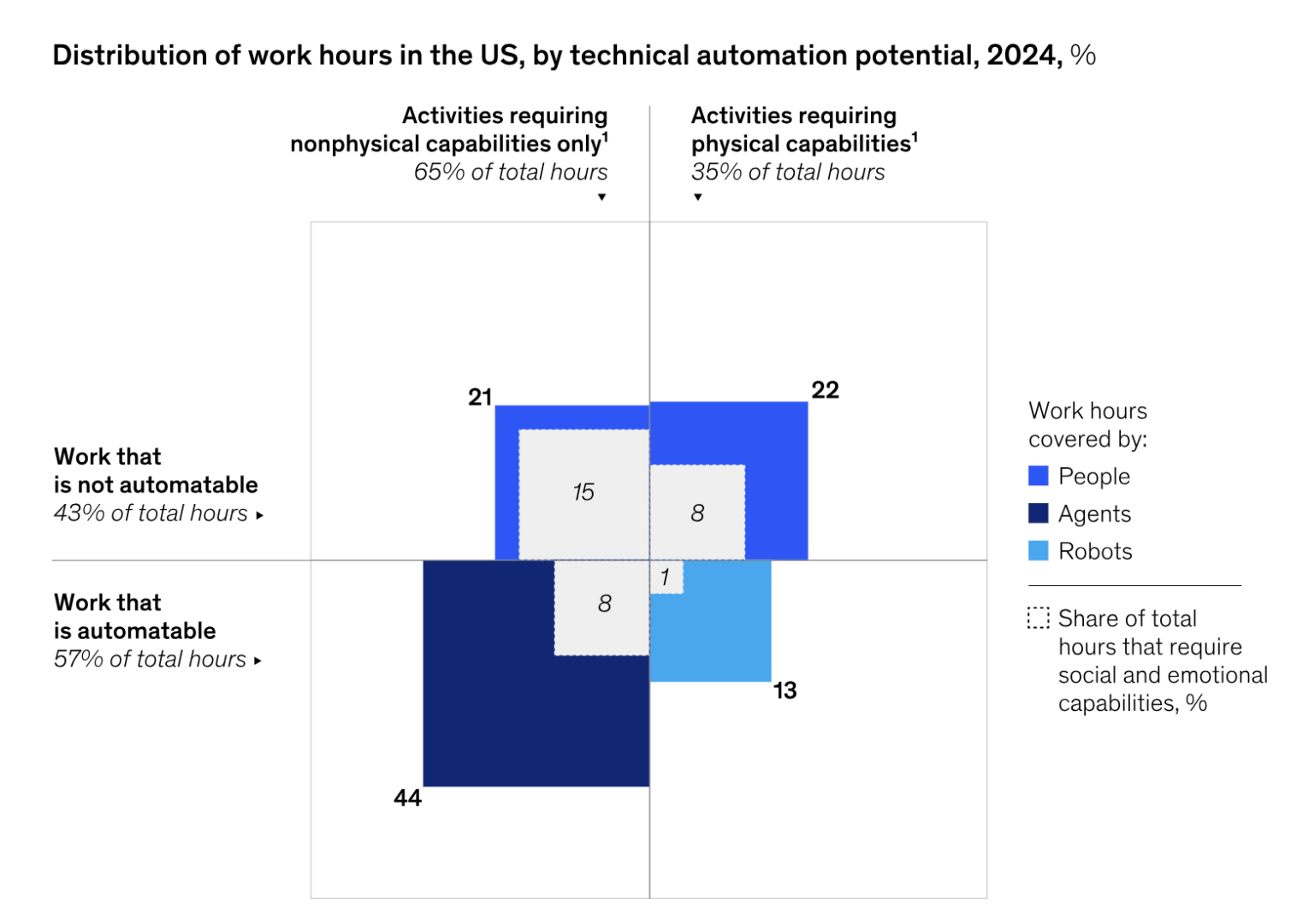
At present, the data and projections one might cite point in directions that appear contradictory when taken individually. The Future of Jobs Report 2025 by the World Economic Forum estimates that by 2030, 170 million new jobs will be created against 92 million eliminated. At the same time, McKinsey & Company estimates that current technologies could automate approximately 57% of working hours in the United States. Taken together, however, these two statements do not contradict each other: they simply indicate that work is not a fixed quantity of jobs, but a dynamic composition of activities. And it is precisely these activities—the smallest units—that are being progressively redefined.
The point, then, is not that we are losing work, but that we are losing parts of it. According to the OECD, around 27% of jobs in advanced economies are highly exposed to automation, but with very different effects depending on skill level and position within the production process. This is where the issue shifts from a technological plane to a cultural and political one: not everyone will be affected in the same way because not everyone relates to artificial intelligence in the same way.
AI does not act as a uniform force, but as a multiplier. It amplifies the capabilities of those who know how to use it and, in some cases, reduces the gap between more and less experienced workers—but only when the latter have real access to the tools and skills needed to integrate it into their work.
This “only when” is the critical point. Because it introduces a new line of fracture, less visible than traditional ones but potentially more pervasive: a cognitive inequality. It is no longer only about who owns capital and who sells labor, but about who is able to extend their cognitive capacities through artificial systems and who, instead, remains in a position of passive or subordinate use.
This inequality is already manifesting today, in subtle but recognizable ways. In many organizations, one part of the workforce uses AI to synthesize information, generate scenarios, and support decisions; another part executes tasks increasingly defined by those processes. It is not an explicit division, nor yet stabilized, but it is a trend. And like all structural trends, it tends to consolidate. The result is not a society without work, but a society in which work is distributed along a cognitive hierarchy: those who design and interpret with machines, those who work through machines, and those who work under machines.
Within this framework, productivity becomes an ambivalent variable. Recent studies indicate significant increases, up to 20–60% depending on specific contexts. But productivity, in itself, says nothing about how benefits are distributed. It can translate into a reduction of work, or into its intensification and reorganization. Historically, it is more often the latter.
The issue, therefore, inevitably shifts onto the political plane. Because cognitive inequality does not concern income alone, but decision-making power. Those who control the tools, or simply know how to interpret them, have a greater capacity to influence economic and social processes. This has direct implications for democracy: in a society where a growing share of decisions is mediated by complex systems, the ability to understand and challenge them becomes a form of political participation. And, conversely, the inability to do so produces a new form of dependency.
Institutions are beginning to respond, but still in a partial way. The European Union has chosen the path of regulation, attempting to define limits and responsibilities through instruments such as the AI Act. However, as the OECD has long observed, the central issue is not only regulatory, but educational and cultural: most workers will need to adapt to a continuous transformation of required skills (this has always been the case, granted, but we are now facing unprecedented competitive accelerations).
In this sense, the question of “post-work” appears misplaced. We are not exiting work, but making it even more unstable than it already became with the advent of Thatcherism and later the gig economy. Work remains, but it becomes more fluid, more fragmented, more dependent on external systems. And above all, more differentiated. Not between those who work and those who do not, but between those who extend their intelligence through machines and those who merely operate within systems they do not control. Owning a lathe at the beginning of the twentieth century did not make the owner more competent than the worker; owning increasingly sophisticated AI tools today does.
And here a less technological and more deeply economic question emerges—almost classical in its structure, yet returning today with new urgency. Because if it is true that in recent decades productivity has systematically prevailed over labor rights, and equally true that advanced capitalism has progressively shifted its center of gravity toward the needs of the consumer—ever faster, more demanding, more selective—there remains a basic fact that is rarely fully discussed: those consumers are, in most cases, the same individuals who participate in the production process.
Henry Ford had grasped, in an almost naive but powerful way, that his workers needed to earn enough to buy the cars they produced. It was a circular, almost rudimentary but stable vision: production and consumption sustained each other because they resided in the same subjects. Today that circularity is breaking down, not so much because work is disappearing, but because it is being redistributed in increasingly unequal ways.
If a growing share of value is generated by systems that amplify the capabilities of a highly skilled minority, while a larger portion of the population sees its role reduced to executive or intermittent functions, the question is no longer only social or moral. It becomes structurally economic. Because a system based on mass consumption presupposes a mass that can consume.
And so the final question—both political and economic—can only be formulated in a direct, almost brutal way: if cognitive inequality continues to expand, translating over time into inequality of income, stability, and access to opportunities, who will sustain the demand on which the entire system rests? In other words, if more and more people are progressively marginalized—not necessarily expelled from work, but placed at its least remunerative and least decision-making margins—who will massively consume what an increasingly productive economy is capable of offering?
Niccolò Carradori