


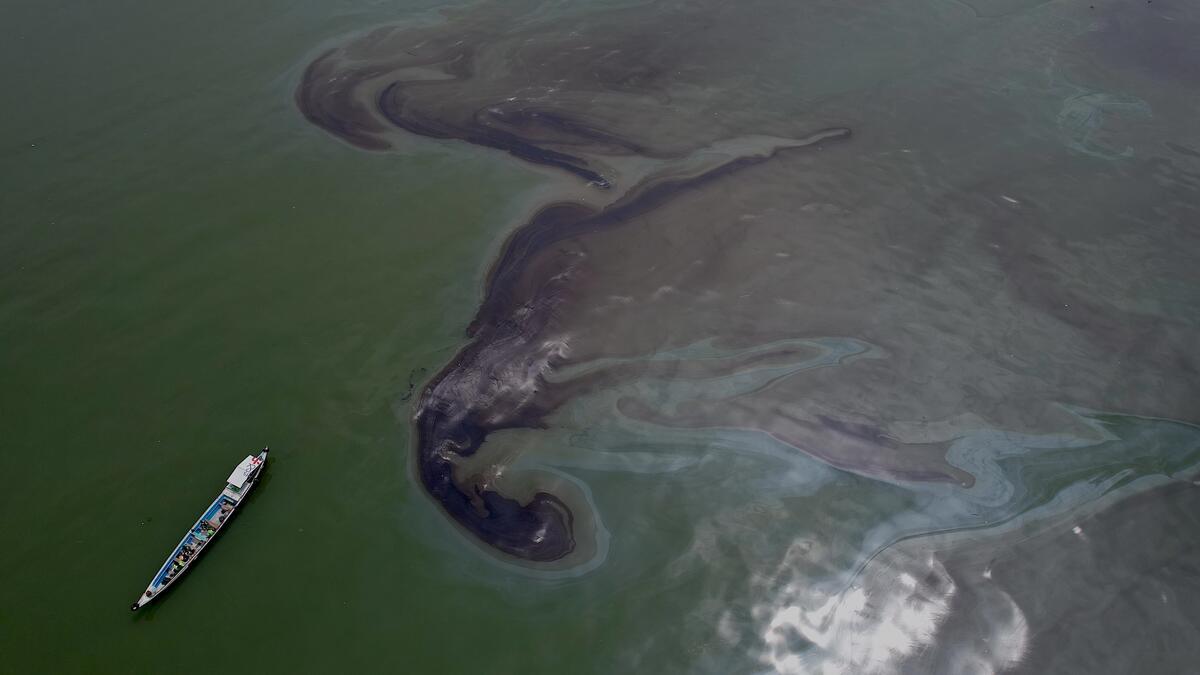
Oil spills at sea remain one of the most serious environmental emergencies worldwide: they destroy ecosystems, endanger marine fauna and flora, and involve enormous economic costs for cleanup operations. Despite the progress made in recent decades, the tools used today are often inefficient and largely dependent on environmental conditions.
The methods currently employed are based mainly on absorbent materials, floating barriers that help prevent oil from spreading across the sea surface, or mechanical collection systems called skimmers, which exploit the viscosity of oil to separate it mechanically from water. In some cases, chemical agents are used to disperse it, but these are not without drawbacks: they often risk promoting dispersion itself, making the oil more accessible to living organisms.
The main problem is that these interventions work only under ideal conditions, and they also tend not to be selective, collecting water along with the oil and thus reducing the efficiency of cleanup operations.
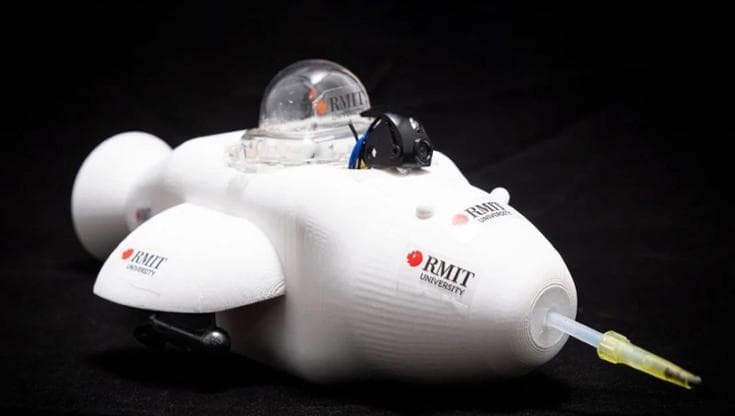
It is in this context that a new proposal developed by a group of engineers at RMIT — the Royal Melbourne Institute of Technology, in Australia — comes into play. The team has designed a small floating robot nicknamed the “Electronic Dolphin,” intended to suction oil directly from the sea surface as precisely as possible. The device was carefully described in a scientific study recently published in the journal Small and represents a concrete example of the application of biomimetics, that is, the imitation of natural processes and structures to solve technological problems.
The remote-controlled robot is compact, roughly the size of a shoebox, and has an elongated shape reminiscent of a dolphin. It moves across the water’s surface and is equipped with a suction system that channels the collected liquid into an internal tank. But the core of the innovation lies not so much in the shape or structure of the device as in its ability to separate oil from water.
The engineers have in fact developed a biomimetic filter inspired by sea urchins that retains hydrocarbons and repels water. When analyzed under an electron microscope, it reveals tiny spikes that repel water and capture hydrocarbons. In other words, the material is able to “select” what it should absorb, avoiding unnecessary saturation.
This approach makes it possible to overcome one of the main limitations of traditional technologies. In conventional systems, oil collection is often imprecise and involves recovering large quantities of water, which then has to be separated and disposed of at additional cost. The filter developed by the Australian team, by contrast, makes it possible to obtain a much purer collected fluid, improving the efficiency of the entire process.
In laboratory tests, the prototype showed promising results: it is capable of recovering about 2 milliliters of oil per minute with a purity of over 95%, while keeping water absorption to a minimum. The filter also demonstrated particularly advanced properties: corrosion inhibition of over 90% in simulated seawater, self-cleaning capacity against biological fluids, and high oil absorption efficiency (15–65 g/g) with an efficiency above 97%, confirming its potential in terms of sustainability.
Another crucial aspect concerns safety. Cleanup operations in the open sea are often difficult and dangerous: weather conditions can deteriorate rapidly, and the presence of toxic substances increases the risks for operators. The use of robots such as the “Electronic Dolphin” could reduce the need for direct human intervention, especially in the early stages of a spill, when rapid action is essential to contain the damage.
The project is still in the experimental phase, but the researchers are already working on future developments. Among the goals is the creation of larger, autonomous devices capable of operating for extended periods, emptying the collected oil, and quickly returning to action. The challenge, therefore, is to create a wider filtering surface combined with a higher-capacity pump without affecting overall efficiency. For this next phase, field testing as well as long-term durability assessments are planned.
Beyond its immediate applications, this research highlights the potential of biomimetics as a tool for addressing environmental challenges. By observing living organisms, such as sea urchins in this case, it is possible to conceive and develop materials with advanced properties that would be difficult to achieve using conventional approaches.
Naturally, no technology can replace prevention. Reducing the risk of spills remains the absolute priority, through stricter controls and an energy transition that reduces dependence on oil. However, tools like this can make a difference in limiting the damage when accidents do occur.
At a time when the health of the oceans is becoming increasingly precarious, the idea of a small robot inspired by a dolphin offers a concrete prospect: that of an innovation capable of working with nature, rather than against it, to protect one of the planet’s most fragile ecosystems.
Alessia Mircoli