


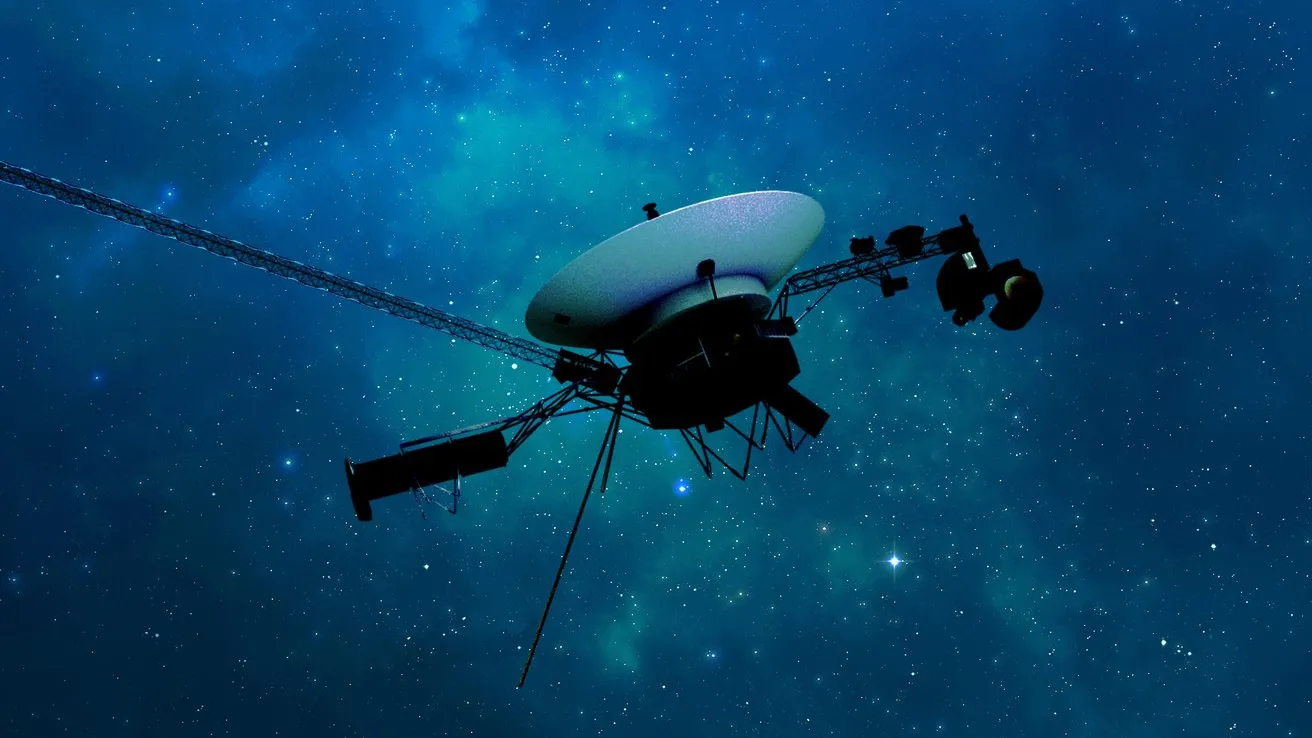
The first to be launched was Voyager 2, which departed from Cape Canaveral on August 20, 1977, aboard a Titan rocket. Its twin probe, Voyager 1, followed 16 days later, on September 5. Destination: the outer Solar System.
The Voyager mission was one of the most ambitious in history, capable of going “where no one had gone before,” to borrow the words of Star Trek. Taking advantage of a unique planetary alignment, the Voyagers managed to fly past all four giant planets, Jupiter, Saturn, Uranus, and Neptune, in less than 12 years, hopping from one to the next using a maneuver that had only recently been discovered: the gravitational slingshot.
But the Voyager mission did not end there. The two probes continued their journey, passing one milestone after another. Voyager 2 is the oldest spacecraft still active in space; Voyager 1, also still active, is the farthest, now approaching a distance of one light-day from Earth.
Since 2012, Voyager 1, and since 2018, Voyager 2, have crossed the boundary of the Sun’s magnetic field, becoming the first interstellar probes in history. The same fate also awaits Pioneer 11 and Pioneer 12, which launched a few years earlier but have been inactive for more than 20 years, and New Horizons, which flew past Pluto 10 years ago and will become interstellar in the 2040s. In short, they are ancient and incredibly far away, but how did they manage to achieve these records?
The first secret lies in the atom. The Voyagers travel through regions extremely far from the Sun, where solar panels would be useless. Each probe therefore carries three radioisotope thermoelectric generators, or RTGs, small power generators based on nuclear energy.
Each generator contains 24 spheres of plutonium-238 oxide, for a total of 4.5 kilograms. Since this isotope of plutonium is radioactive, it decays, and the particles emitted during the decay process heat the RTG. That heat is converted into electricity, which powers the onboard instruments. The estimated lifespan of these batteries is around 60 years, so we will lose contact with the Voyagers in the next decade. Still, the fact that we can communicate with them today is already extraordinary.
We do this thanks to NASA’s enormous Deep Space Network antennas. In Madrid, Spain; Goldstone, California; and Canberra, Australia, NASA operates huge antennas 70 meters in diameter that allow communication with deep-space probes via radio waves.
The probes have onboard computers equipped with software that controls the various systems: antennas, instruments, batteries. The radio signals are modulated so that they can carry data packets, traveling from the antennas to the probes or from the probes back to the antennas. This makes it possible to communicate with them, receive scientific and telemetry data, or command the probes to perform any given action.
One of the extraordinary aspects is how these data are recorded. The Voyagers launched with early-1970s technology: modern hard drives did not exist, and the data were, and still are, stored on a magnetic tape recorder. Basically, something not too different from the technology used in audio or video cassettes.
It is called the 8-Track Digital Tape Recorder: the onboard computer records the data onto the tape. The data are then read, packaged as radio waves, and sent toward Earth. At that point, the same tape is written over again, replacing the previous data. And so it goes, repeating this process for 48 years in space.
It almost sounds like the stereotype of “good old-fashioned technology,” but in this case, that is partly true. The secret to the longevity of the Voyager probes also lies here, in this technology halfway between analog and digital. Electronic components tend to wear out over time because of bombardment by cosmic rays and interplanetary plasma, while analog components are less vulnerable to this type of degradation.
To save energy, NASA engineers are gradually switching off all the probes’ instruments, and in the coming years only telemetry will remain. Then even that will end, and we will say goodbye to the greatest space mission in history.
Luca Nardi