


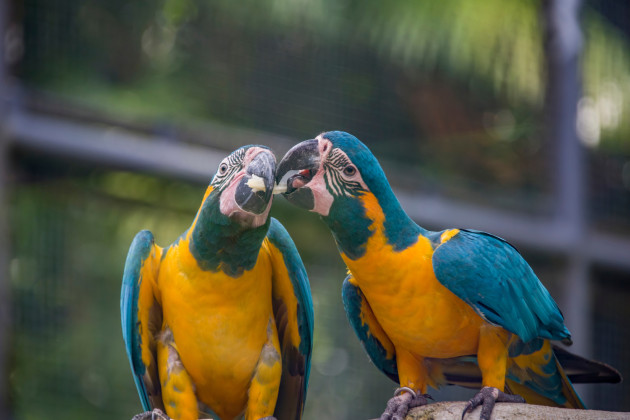
For a long time, altruism was considered a typically human trait: helping someone without gaining an immediate advantage, and sometimes even at a personal cost, seemed to be something linked to particularly advanced cognitive and social abilities. However, a study published in the journal Current Biology challenges this idea and shows that some birds, especially parrots, are capable of complex altruistic behaviors.
The protagonists of this discovery are two species that differ greatly in terms of habitat and social organization: the African grey parrot (Psittacus erithacus) and the blue-headed macaw (Primolius couloni). The former is found in the rainforests and wooded areas of central and western Africa. It is one of the most intelligent bird species known: it can solve problems, imitate sounds and, in some cases, understand and repeat human words. Ecologically, it feeds mainly on fruit and seeds, contributing to seed dispersal and therefore to the maintenance of forest ecosystems. But it is above all its social structure that makes it interesting: it lives in large, dynamic flocks, made up of dozens or even hundreds of individuals, whose composition changes frequently. This means frequent interaction with different, unrelated individuals, in a context that encourages flexible and cooperative relationships.
The case of the blue-headed macaw (Primolius couloni) is different. This South American species is found in the tropical forests of the western Amazon, across Peru, Bolivia and Brazil. These parrots also feed on fruit, seeds and vegetation, and are closely tied to forest environments. However, they have a more stable social structure: they tend to live in small groups or pairs, with long-lasting bonds and more clearly defined hierarchies. Their interactions therefore take place in more predictable contexts, often among individuals that have known each other for a long time. This difference in social organization is one of the key elements for interpreting the results of the study.
The study, conducted by Désirée Brucks and Auguste von Bayern of the Max Planck Institute for Ornithology in Seewiesen, Germany, tested these two parrot species to determine whether, and to what extent, they were capable of helping one another.
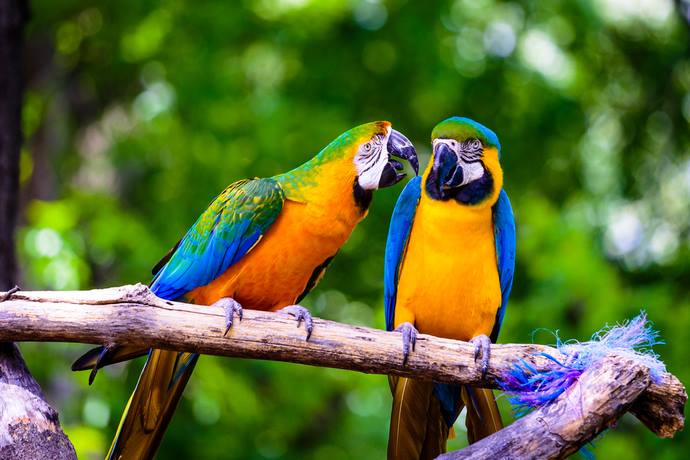
The experiment was designed in a simple but effective way. The researchers taught both species of parrots to use small tokens: by handing them to a human, the animals received a food reward in exchange, such as a nut or a particularly favored seed. Once the birds had learned the mechanism, the situation was changed: in a pair, only one of the two parrots received the tokens, while the other was the only one able to exchange them for food.
Inside the chamber built for the experiment, the two parrots were placed in separate but connected compartments: they could see each other through a transparent wall and interact through a small opening, large enough for them to pass their heads through. Both had visibility of the experimenter, but only one of the two, the one without tokens, could actually hand them over to obtain food.
The question was straightforward: would the parrot with the tokens help its partner, even without receiving anything immediately in return?
In the case of the African grey parrots, the answer was surprising. In seven out of eight cases, the individuals spontaneously passed the tokens to their partner, allowing it to obtain food. This is a behavior that provides no immediate benefit to the individual performing it, and therefore falls within the definition of altruism. Even more interestingly, when the roles were reversed, the individuals that had previously been helped also tended to return the favor, suggesting a form of reciprocity and social memory.
By contrast, the blue-headed macaws (Primolius couloni) showed little interest in helping one another, carrying out very few transfers.
The difference between the two species suggests that altruism does not depend solely on intelligence, but also on the type of social organization.
As mentioned earlier, African grey parrots (Psittacus erithacus) live in large flocks whose members constantly change. They are therefore often in contact with individuals they do not know, and it benefits everyone to help one another: today I help you, tomorrow perhaps you help me. In more closed and stable social environments, as in the case of blue-headed macaws (Primolius couloni), where interactions always take place with the same individuals, this evolutionary pressure may be weaker.
A particularly relevant aspect is that the African grey parrots shared the tokens even in the absence of immediate rewards and without kinship ties. This strengthens the idea that their behavior is driven by a form of reciprocal altruism, based on the expectation of future interactions rather than on an immediate advantage. In other words, helping today could increase the chances of being helped tomorrow.
The implications of the study are broad. They show that advanced forms of cooperation can emerge in species that are very distant from one another in evolutionary terms, suggesting that altruism is not exclusively human. Rather, it may be a strategy that develops whenever ecological and social conditions make it advantageous.
Ultimately, these findings help redraw the boundary between human and animal behavior. If even a bird is capable of recognizing another individual’s need and acting accordingly, then the foundations of cooperation are more widespread in the natural world than previously thought.
More than a curiosity, this discovery is an invitation to reconsider how we interpret animal behavior. Parrots, often known for their ability to imitate the human voice, here reveal a much deeper form of social intelligence: one that allows them to build relationships, remember past interactions and, in some cases, consciously choose to help others.
Alessia Mircoli