


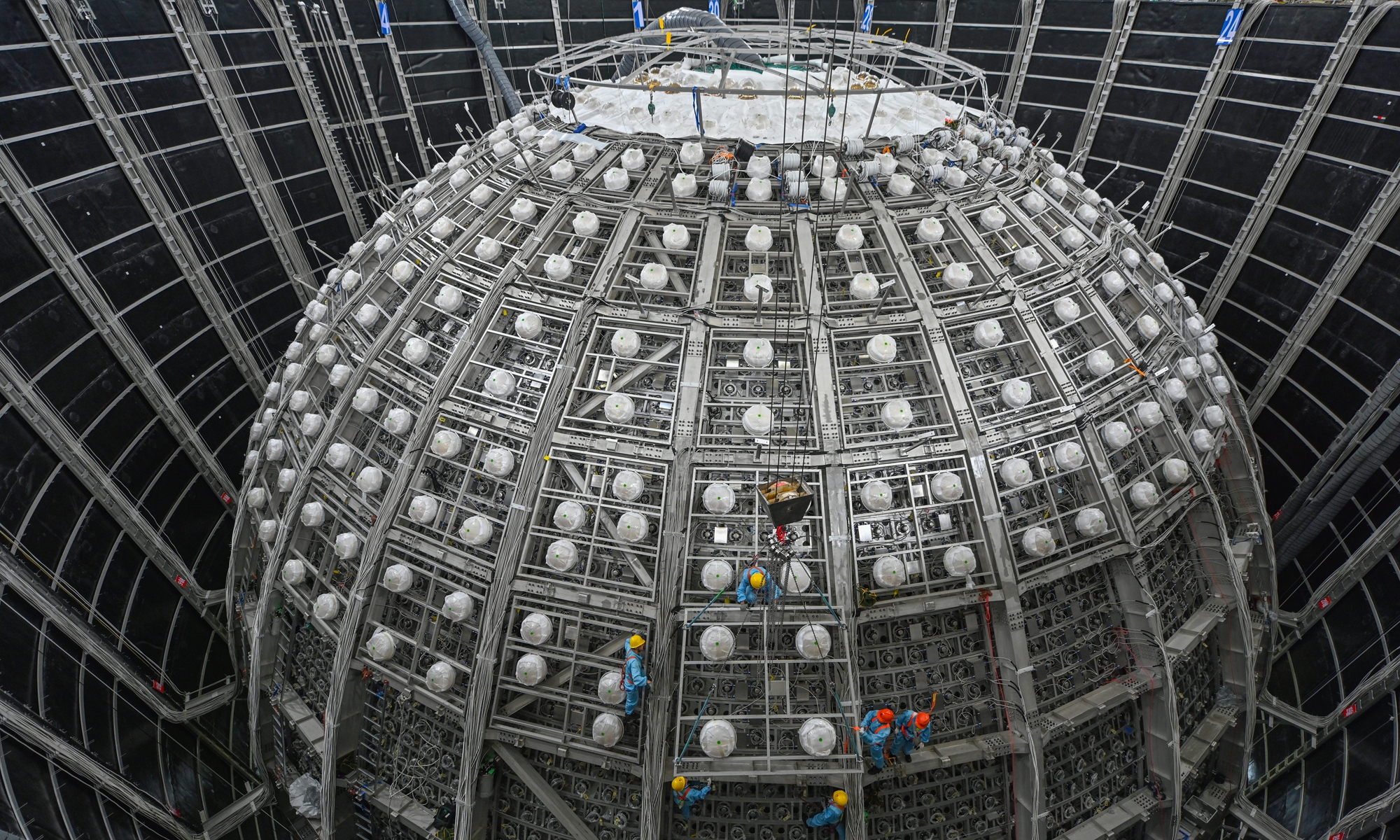
It was the winter of 2015 when construction began in the Chinese province of Guangdong on an experiment that promised to revolutionise physics. An enormous sphere, as large as a building, located almost a kilometre underground. Its goal was to capture neutrinos, ghost particles that are found everywhere yet remain elusive and extremely difficult to study. Today, with the publication of its first results, that revolution has begun.
The Jiangmen Underground Neutrino Observatory, better known as JUNO, is the world’s largest spherical neutrino detector. Its central detector is a sphere measuring 35.4 metres in diameter. With 750 members from 17 countries and a cost of almost $400 million, it is the product of the largest international scientific collaboration ever established on Chinese soil.
Neutrinos are among the most abundant elementary particles in the Universe, but they are also extraordinarily elusive. They are tiny and carry no electric charge, meaning that they interact with other matter only very rarely. Even at this very moment, an enormous number of these particles are passing through your body without you noticing.
One of their most remarkable properties is their ability to change “flavour”. As they travel, they change identity, oscillating between slightly different types of neutrino. Fully understanding this phenomenon requires extremely precise and sophisticated detectors, just like JUNO.
Neutrinos are produced by many different astrophysical processes, including supernovae, but they are also generated inside nuclear power plants. JUNO focuses on the latter. Its purpose is to detect and count neutrinos emitted by the Taishan and Yangjiang nuclear power plants, located around 50 kilometres away, and in doing so shed light on some of the mysteries that still surround these particles.
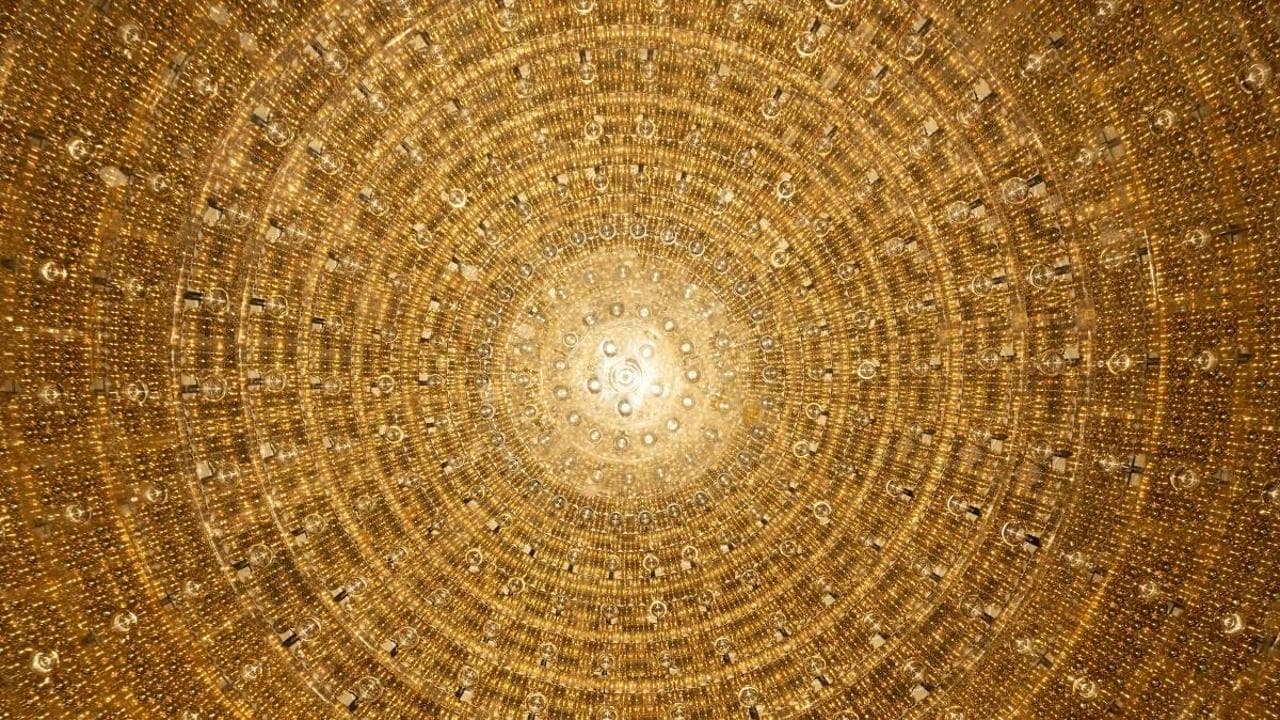
Neutrinos can pass through matter almost without interacting with it. They can travel through entire celestial bodies and even pass straight through scientific instruments and their sensors, which makes them extraordinarily difficult to measure. This is precisely why JUNO needs such an enormous sphere.
The sphere is made of transparent acrylic and filled with 20,000 tonnes of liquid scintillator. In most cases, neutrinos pass through the liquid without leaving any trace, but scientists estimate that around 50 of them interact with it each day. When a neutrino strikes a particle in the liquid, the interaction produces a flash of light that can be measured by photomultiplier tubes, sensors positioned all around the sphere. This is how the neutrinos are detected, allowing researchers to measure both their number and their properties.
On 26 August 2025, after ten years of construction, the instrument became operational and began collecting data. Now, one year later, a paper published in Nature has reported its first results.
The study is primarily a demonstration of the instrument’s capabilities, presenting data on neutrinos collected during JUNO’s first 59 days of operation. Despite the short observation period, JUNO was able to measure the parameters governing oscillation between two types of neutrino, improving our understanding of the phenomenon. Its measurements are 1.6 times more precise than those produced by any previous instrument.
This means that the results from those first 59 days are not revolutionary in themselves, but they signal the beginning of a revolution. By collecting data over the coming years, this underground sphere could permanently transform what we know about these elusive ghost particles.
One of JUNO’s main future objectives will be to determine the masses of the different neutrino states with ever greater precision, filling in one of the most important missing pieces in the Standard Model of particle physics.
Luca Nardi