


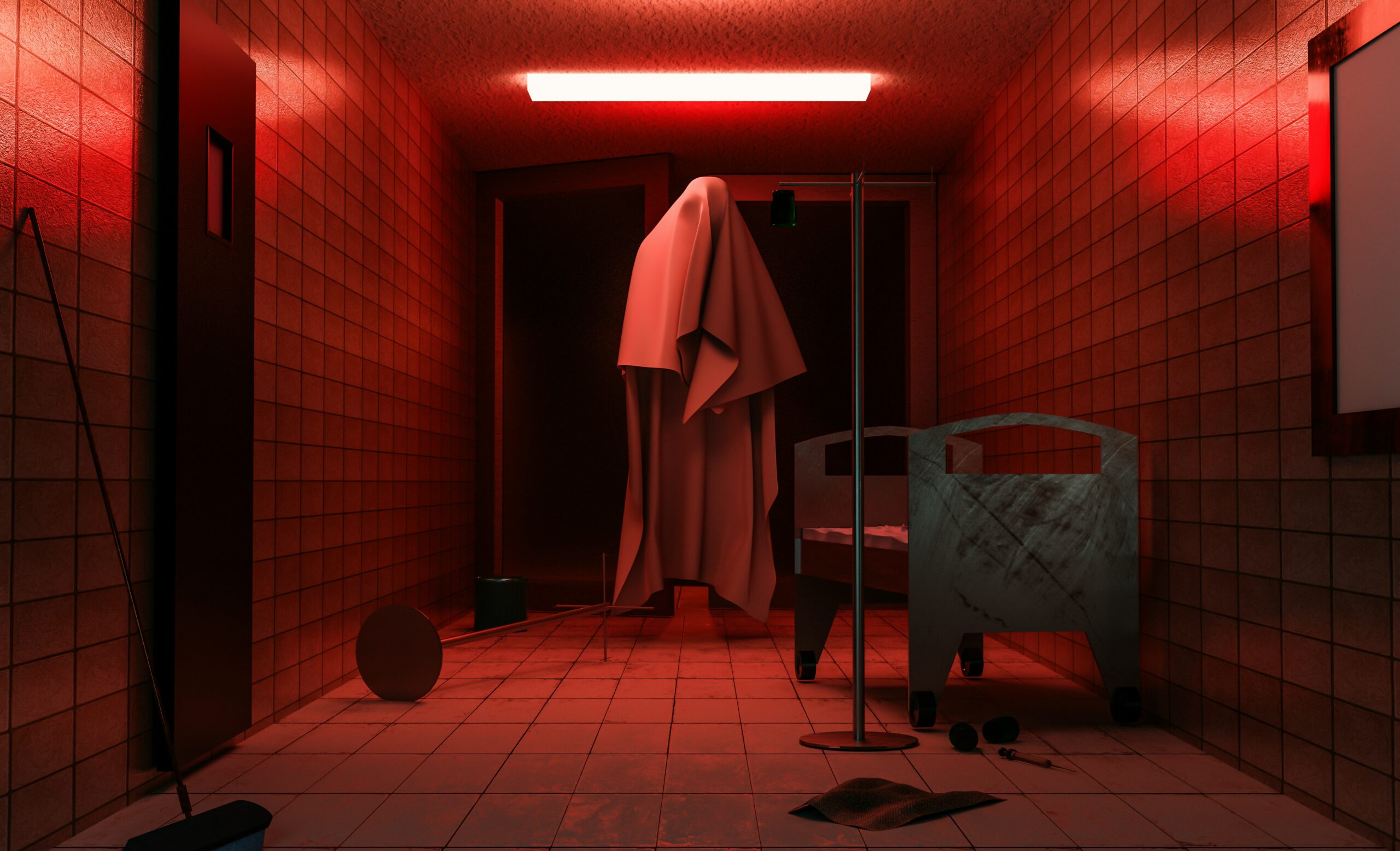
For almost its entire history, cinematic horror has needed a place in which to happen. The darkened theater, the illuminated screen, and the spectator’s position before the image formed an architecture of fear, a device through which cinema organized the uncanny and separated, however precariously, reality from fiction.
Entering a theater to watch a horror film meant accepting that separation, allowing another space to temporarily replace the ordinary world. Today, that distance is becoming increasingly difficult to locate. Horror continues to exist in cinema, but the grammar developed over more than a century has spread into video games, forums, social networks, vertical videos, and digital archives, eventually reaching the smartphone and the very center of the viewer’s everyday life.
This is not simply a matter of watching a horror film on a phone instead of in a theater. The shift can be understood through Jay David Bolter and Richard Grusin’s concept of remediation, according to which new media absorb and transform the forms of older ones. Found footage, point-of-view shots, off-screen space, amateur VHS imagery, accidental recordings, documents that appear to have escaped the author’s control, and uncanny environments all return today, often almost unrecognizably, within Internet culture.
This is where the device becomes as important as what it represents. Marshall McLuhan observed that media function as extensions of the body and the senses, capable of altering the conditions through which we perceive the world. The smartphone is a radical manifestation of this idea: not merely a screen, but a techno-surgical prosthesis that records, stores, organizes relationships, recommends content, and decides what enters our field of vision.
Digital horror emerges from this collapse of the frame. Creepypasta, SCP, Slender Man, the Backrooms, and analog horror are not simply new subgenres, but expressions of a broader transformation in the way images are produced and circulated. The Internet has brought authors and audiences closer together: a story can begin with a single user, be expanded and discussed on a forum, as happened with the Backrooms, reassembled through video, as with Slender Man, reinterpreted in works such as The Mandela Catalogue, and eventually returned to the network in an entirely different form.
Henry Jenkins described this audience participation in the production and circulation of content as participatory culture. In digital horror, the spectator becomes first an interpreter, then an investigator, and finally an author.
Folklore does not disappear with technology either: it simply changes infrastructure. A legend can take the form of a thread, a screenshot, a vertical video, a comment, an anonymous photograph, or an account stripped of context. The Internet becomes an environment of narrative sedimentation, in which an image gradually acquires new meanings.
With TikTok, the process changes again, because participation is joined by the algorithm. Reddit generally requires users to search for content and enter a community; TikTok instead organizes a stream in which content comes directly to the viewer. Horror no longer needs to be sought out: you only have to scroll. An unsettling video can appear between a song, an advertisement, and a joke, with no threshold separating fear from the rest of the world’s images.

Once it enters the feed, horror therefore loses the advance declaration of its own nature. A title or a genre normally warns us about what we are about to see; the feed mixes everything together. The uncanny can operate precisely through uncertainty: am I watching a story, or something that actually happened?
Within this gray area, the case of Ann Douglas becomes significant. Douglas is an elderly woman who, through her TikTok account, @anndouglas4, has developed an online presence far removed from the traditional logic of horror production. Her videos show everyday life and domestic environments through simple footage, far from professional aesthetics. At their center is also the memory of her son Fred, who died in the September 11, 2001 attacks. The case goes beyond simple virality: what we are seeing was not necessarily created as a horror project, but it is being viewed through the interpretive tools of the genre.
Her house is where this transformation becomes most visible. Corridors, rooms, mirrors, photographs, and personal objects are observed as potential elements of a narrative. The background becomes as important as the subject, an object becomes a clue, a reflection is examined frame by frame, and a photograph enters a new network of meanings. The house becomes an archive to be interrogated, a contemporary gothic dwelling.
The grammar is that of found footage: look toward the edges, search for what the video does not show, suspect that meaning lies somewhere in the background. Yet here there is not necessarily a director who deliberately constructed that ambiguity. It is the online community that produces it.
The issue recalls Freud’s concept of the uncanny, the unheimliche, in which the familiar becomes strange. The home, a space of intimacy, becomes disturbing when something within it can no longer be deciphered. Douglas’s videos do not need a ghost or a monster: it is enough to look at an ordinary room as though it contained something we are unable to see.
Ann Douglas is especially interesting for what her account reveals about the relationship between reality and fiction. There is no need to interpret her as a horror performer or the creator of an alternate-reality narrative: the significance lies in the uncertainty surrounding what the audience is watching. A real person, a real house, and a real memory enter an ecosystem of hidden narratives, subjecting reality to the same interpretive machinery usually applied to fiction.
Here, Mark Fisher’s concept of hauntology adds another layer. Digital culture retrieves, archives, and brings photographs, old videos, accounts, and recordings back into the present. The past is no longer simply something we remember, but something that continues to circulate. A piece of content can be forgotten and then return years later through an algorithm or a community, carrying an entirely different meaning.
The Internet does not forget in the way previous media did: it preserves, reactivates, recontextualizes, and recirculates. An image can be extracted from one context and inserted into another, where its meaning changes along with the community that encounters it. The digital archive thus becomes a device of horror in itself: it preserves images long enough for them to return after their original context has disappeared.
Horror has not abandoned cinema. It has radiated beyond it, transforming its forms through contemporary technologies. Cinema taught us to enter the darkness in order to be afraid; digital media allow the darkness to reach us while we stare at a screen beneath the covers.
And perhaps the real novelty of contemporary horror does not lie in the fact that the monster has become digital, nor simply in our ability to tell horror stories through new tools, but in the fact that the device through which we look at the world has itself become one of the forms in which horror can appear.
Francesco Guerriero