


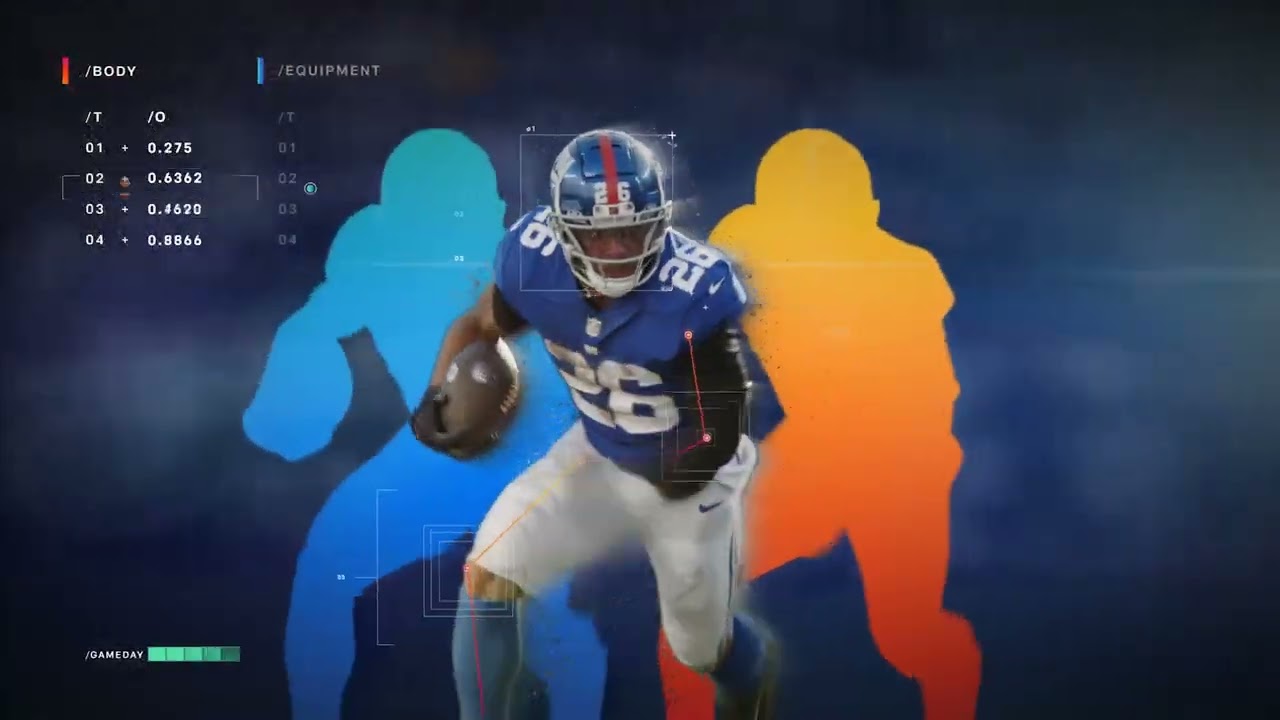
In 2019, on the stage of AWS re in Las Vegas, NFL Commissioner Roger Goodell joined Andy Jassy, then CEO of Amazon Web Services, to announce a project that, at the time, sounded like science fiction: the NFL, the world’s leading professional American football league, would build a “digital athlete.” A virtual twin of every player, capable of simulating game scenarios endlessly without putting athletes’ health at risk. Seven years later, that promise has become an infrastructure that helps determine who takes the field, who stays on the bench, and who is ruled out of the game.
American football is, by its very nature, one of the most physically demanding sports. High-speed contact, cumulative stress from repeated collisions, and an injury rate structurally higher than that of virtually any other team sport. This is why the innovation rolled out by the league throughout 2026 carries such significance. Available data now points to a reduction of up to 25% in lower-extremity injuries. A remarkable figure for a league that loses hundreds of player-games every season to damaged ligaments, ankles, and knees.
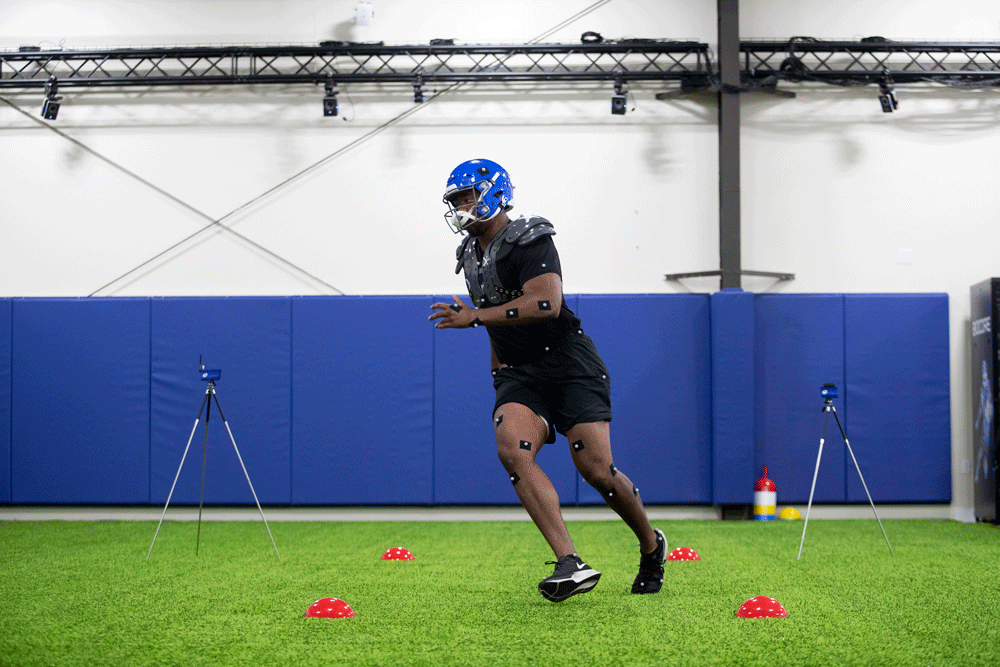
Digital Athlete, as the system is called, was developed through a partnership between the NFL and Amazon Web Services. What began as a pilot project has evolved into an ecosystem now involving all 32 franchises. The technology works in a straightforward way: 38 ultra-high-definition cameras surround each stadium, triangulating players’ positions with millimeter-level precision. These are complemented by sensors embedded in shoulder pads, measuring acceleration, deceleration, and impact loads during every tackle, along with a tracking system that monitors 29 points on the body 60 times per second. The result is a digital twin updated in real time, capable of detecting subtle changes in stride, rotational instability during changes of direction, and asymmetries that even a strength and conditioning coach watching from the sidelines would struggle to identify.
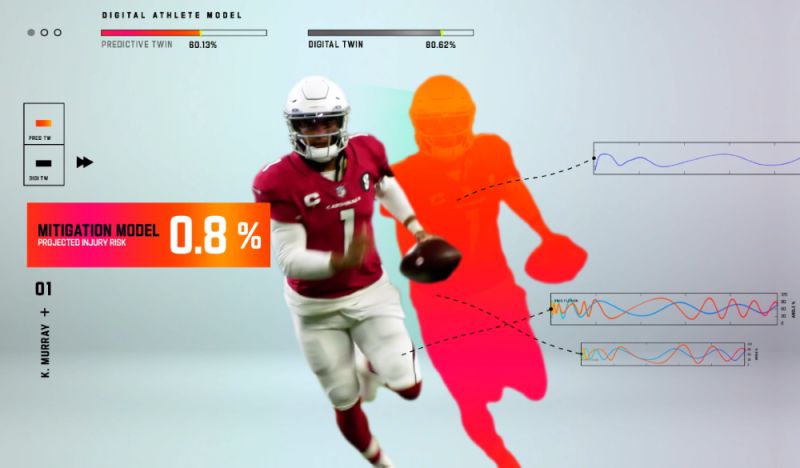
This is predictive modeling on an industrial scale. The league processes approximately 500 million data points every week, compared with the 500 million per season collected by its predecessor, Next Gen Stats. The leap is qualitative as well as quantitative: from descriptive statistics to a diagnostic tool. Algorithms trained on this vast volume of information identify high-risk patterns before they result in a muscle tear or a ruptured anterior cruciate ligament. Teams and medical staff can then intervene by reducing training loads or introducing targeted recovery protocols, while the damage remains a statistical probability rather than a medical diagnosis.
The most radical development, however, concerns the rules of the game themselves. The NFL has used AWS infrastructure to simulate 10,000 virtual seasons, cross-referencing impact frequency, contact angles, collision speeds, and cumulative stress on the lower limbs. These simulations helped inform two regulatory decisions that have reshaped the game: the Dynamic Kickoff, a new kickoff formation introduced in 2024 to reduce high-speed collisions, and the ban on the hip-drop tackle, a maneuver in which a defender drops their body weight onto an opponent’s trapped leg, identified by the models as a recurring source of rotational stress. Rather than emerging primarily from intuition or media pressure, these rules were shaped by statistical models tested thousands of times before being translated onto the field. The league’s rulebook is increasingly being written in AWS data centers rather than in the meeting rooms of its officiating committee.
The figures appear to support the project. Beyond the previously mentioned 25% reduction in lower-extremity injuries, the league estimates that its first data-driven rule changes have reduced kickoff-related concussions by nearly 38%. Meanwhile, in 2023 alone, AI-guided interventions reportedly prevented the loss of approximately 700 player-games to injury, a figure that translates directly into economic value in a league governed by salary caps. Behind the initiative lies a reported investment of roughly $60 million in a multiyear engineering effort, supported by biomechanics researchers.
The comparison with other sports is immediate. In tennis and baseball, artificial intelligence has been introduced primarily to officiate: Hawk-Eye determines whether a ball lands in or out, while automated ball-strike systems define a geometric strike zone. The NBA has also recently announced the adoption of a similar system for objective officiating decisions. In the NFL, by contrast, AI focuses on the body: it assesses the risks facing a player’s knee while leaving judgments about fouls to others. This represents a fundamental paradigm shift. Elsewhere, technology is used to settle disputes on the field; here, its purpose is to keep the protagonists on that field for as long as possible.
If the NFL’s model delivers on its promises, it could change the trajectory of entire careers. A running back whose body might currently wear down after three or four seasons could, in theory, extend their playing career. A franchise investing hundreds of millions of dollars in a quarterback could protect that investment for longer, with fewer unpredictable variables. And fans could continue watching their favorite stars at their best instead of following their rehabilitation through weekly injury reports. A benefit that, as Goodell emphasized from the beginning, extends “from players to clubs to fans.”
Yet one question remains, and it is one the league seems reluctant to bring into the spotlight. If an algorithm can predict weeks in advance when a player’s body is approaching its breaking point, who ultimately decides whether that player takes the field anyway? Injury risk becomes a number on a dashboard, accessible to coaches, general managers, and marketing departments. The same infrastructure that protects an athlete from a torn ligament also transforms their physiology into a collection of data managed by third parties, in a league where a player’s availability is already a negotiable competitive asset.
For a century, American football has been built around the unpredictability of the human body under physical contact. Now it is learning to treat that same body as a mechanical system with calculable breaking points, several years behind other sports in some respects, but backed by vastly greater investment. What remains to be seen is whether this genuinely makes the game safer or simply moves an old question further upstream, into the workings of an algorithm: how much risk is an athlete willing to accept to stay on the field?
Paolo Lazzari