


The internet is notoriously full of bizarre conspiracy theories. Some, such as the racist “Great Replacement” theory, which claims that elites are encouraging immigration to replace white populations, or the ever-popular denial of climate change, have well-documented, dangerous consequences in the real world. Others are far more ridiculous and seemingly harmless: some people believe the Earth is flat, that Finland doesn’t exist, or that Avril Lavigne died in 2003 and was replaced by a lookalike. And then there are those who firmly believe that gigantic human beings really did inhabit the Earth in the distant past, and that scientists and archaeologists are conspiring to conceal the evidence from the public.
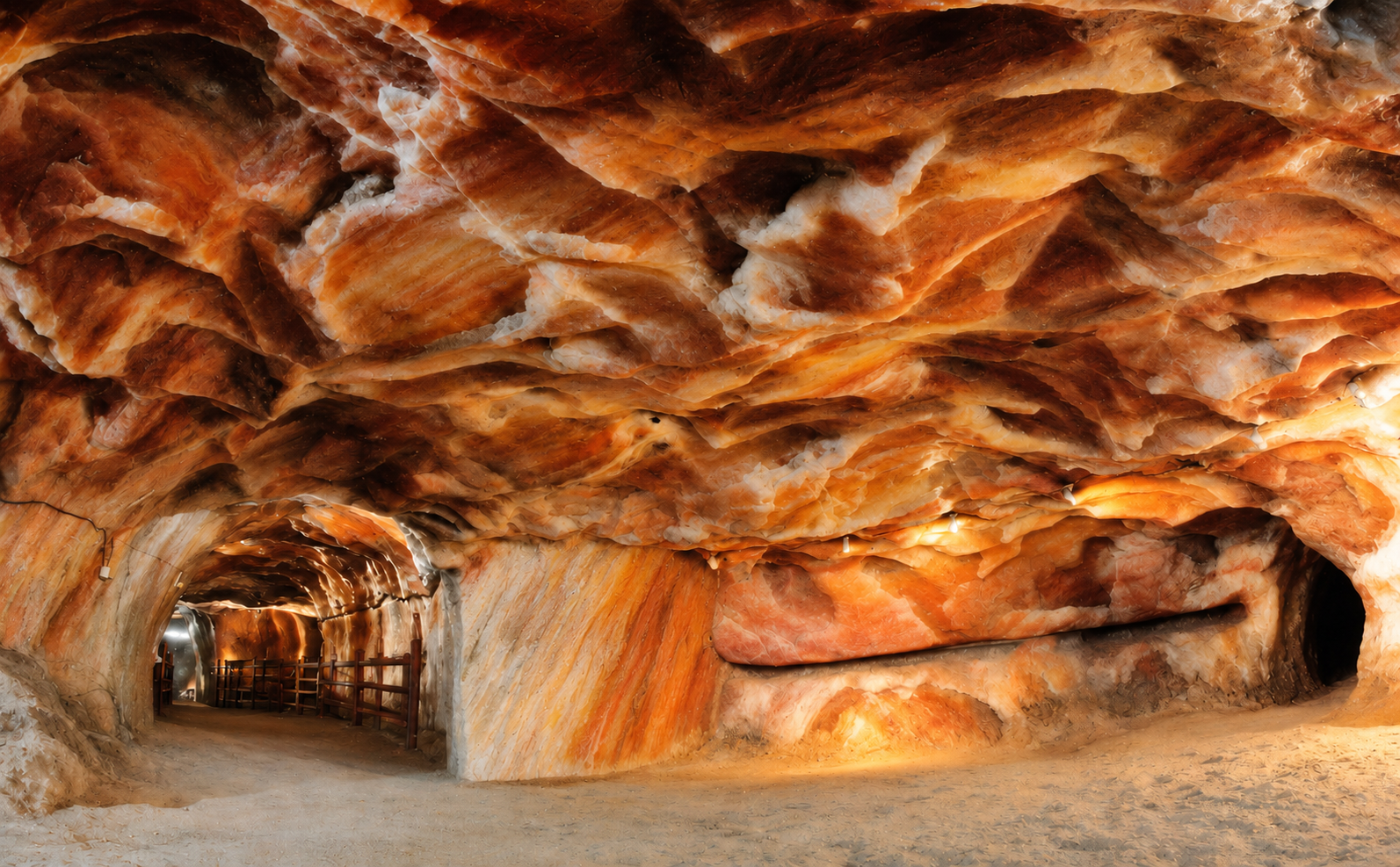
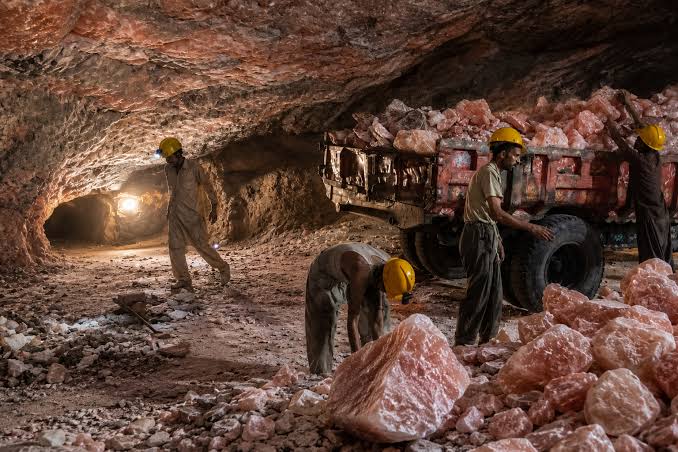
You may have come across this theory yourself, if your TikTok algorithm considers you sufficiently weird. Over the past few months, videos have been multiplying in certain corners of that vast, sprawling app, claiming that pink salt, the kind restaurants use to make themselves look sophisticated, produced mainly at the Khewra mine in Pakistan’s Punjab region, is actually made from the petrified flesh and blood of ancient giants. According to proponents of the theory, the evidence lies in the salt’s reddish veins, which supposedly resemble those found in meat, and in the shapes of certain rocks inside the mine, where they claim to recognize faces, legs, and even the texture of human skin.
This is, of course, a case of pareidolia, the tendency to perceive familiar shapes in random objects. Pink salt formed approximately 545 million years ago through the evaporation of ancient seas, and its color comes from the presence of minerals such as iron, magnesium, and potassium. Nevertheless, the theory had already been circulating on other social media platforms for several years. According to the scientific fact-checking website Science Feedback, a video promoting the theory in 2022 received more than 12 million views, while another video, reposted on Facebook in May 2024, attracted 385,000 views.
The pink salt theory, moreover, is merely the latest variation on a story that, in its modern form, dates back at least to the nineteenth century. It is usually associated with Christian fundamentalism, particularly groups of believers, most commonly found among American evangelicals, who interpret the Bible literally, as an accurate historical account. Giants appear several times in the Old Testament, from the mysterious Nephilim of Genesis to Goliath, who was defeated by David. For those who read these texts literally, finding their bones would constitute proof that the Bible tells the truth, even in defiance of the theory of evolution. Historically, however, a substantial proportion of people who believe in giants are not religious. Over time, the idea has circulated among very different communities, from enthusiasts of the ancient astronaut theory, according to which extraterrestrials visited Earth in the distant past, to followers of alternative history, who believe that entire civilizations have been erased from the historical record.
Today, one of the most widespread versions of the theory online is connected to Tartaria. For centuries, European cartographers used the name “Tartary” to describe the vast, then little-known region stretching between the Caspian Sea, Siberia, and China, inhabited by peoples Europeans generically referred to as Tartars. According to proponents of the theory, which began spreading on YouTube around 2016, Tartaria was actually a technologically advanced global empire, capable of generating free energy, that built many of the world’s most imposing buildings. During the nineteenth century, it was supposedly wiped out by a catastrophe known as the “mud flood,” after which governments and historians erased its existence from collective memory, attributing its architectural achievements to other civilizations and replacing its technologies with more primitive ones. Nobody ever explains why the mud would have killed only the giants while sparing people of ordinary height.
Among other things, the theory maintains that the inhabitants of Tartaria were giants. The alleged evidence is almost always architectural. Believers focus particularly on the enormous buildings constructed in the United States between the nineteenth and early twentieth centuries, which they consider too monumental and elaborate to have been built during that period. According to the theory, they must therefore have been constructed by the Tartarians long before. One of the most frequently cited examples is the 1893 Chicago World’s Fair, for which an entire complex of enormous white buildings was erected in just a few months, only to be demolished after the exhibition ended. To Tartaria believers, those buildings had already existed: they were supposedly the ruins of an ancient capital that the authorities destroyed to erase all traces of it. In reality, they were temporary structures made from plaster, hemp, and straw over wooden and steel frameworks, as Bloomberg CityLab explained.
According to Tartaria believers, the double-height entrance halls, arched doorways, and extremely high ceilings of these buildings were designed for people much taller than us, while the windows opening at sidewalk level in many buildings from that period supposedly belonged to ground floors that had been buried by mud. In reality, we know that these street-level windows were intended to illuminate basements before electric lighting became widespread. Meanwhile, as supposed evidence that giants still existed in the early twentieth century, black-and-white photographs of Robert Wadlow, the tallest person ever reliably measured, continue to circulate online. Wadlow stood 2.72 meters tall and died in 1940 from complications related to gigantism, a medical condition caused by excessive production of growth hormone.
The origins of the Tartaria theory are generally traced to Russian nationalist pseudohistory, particularly the “New Chronology” developed by mathematician Anatoly Fomenko, who claimed that much of ancient and medieval history had been fabricated. According to an analysis by GNET, a research center studying online extremism, the hashtag #tartaria has accumulated almost 300 million views on TikTok, where those discussing the theory tend to portray themselves as independent thinkers asking uncomfortable questions. GNET also identifies several points of overlap between Tartaria and the “Great Reset” conspiracy theory, which claims that global elites are attempting to seize control of humanity, just as the Tartarians were supposedly erased from history to make the population easier to control.
Those who believe in giants because they believe in the Bible, on the other hand, mainly refer to passages in Genesis and the Book of Numbers that mention the Nephilim, mysterious creatures commonly translated as “giants” in Italian versions of the Bible. They appear in Genesis shortly before the account of the Great Flood, in a very brief passage: “There were giants on the earth in those days, and also afterward, when the sons of God went to the daughters of men and had children by them. These were the heroes of old, men of renown.” In the Book of Numbers, meanwhile, they are mentioned by the scouts Moses sends into the land of Canaan, who return claiming to have seen them and to have felt “like grasshoppers” by comparison.
The text says little else, and scholars still have few certainties about how it should be interpreted. It is unclear, for example, who the “sons of God” mentioned in Genesis actually were. Some believe they were angels who had relations with human women, while others interpret them simply as descendants of a particularly righteous lineage. It is not even clear whether the Nephilim were the offspring of those unions or a people who already existed. The name itself is uncertain: it is frequently connected to a Hebrew root meaning “to fall,” leading some to interpret it as “the fallen ones.” The most imaginative version comes from the Book of Enoch, an ancient Jewish text that is not part of the biblical canon recognized by Catholics, Protestants, or Jews. It tells of rebellious angels known as the “Watchers,” who descended to Earth to mate with women and father extremely violent giants, who were subsequently wiped out by the Flood.
Much of the modern mythology surrounding the Nephilim took shape in nineteenth-century America, when hundreds of newspapers published reports of enormous skeletons discovered in burial mounds across Ohio, Wisconsin, and West Virginia. In 1845, the Washington Telegraph reported the discovery of a skeleton in Tennessee that must have stood “nearly six meters tall with its shoes on (if it wore any).” At the time, however, excavations were almost always conducted by farmers and amateurs with no formal training, who were unable to distinguish human skeletons from those of other mammals with similar anatomical structures. As a result, they frequently mistook the bones of mammoths and mastodons, large extinct animals resembling elephants, for human remains. There were also no reliable methods for estimating a person’s height from their skeleton: the first formula was published only in 1888, while those used today date back to the 1950s. When professional archaeologists eventually began studying these sites, they discovered that the people buried in the mounds were of ordinary stature.
Those reports, however, also served a political purpose. The mounds were earthen monuments built over centuries by various Native American peoples in the Ohio and Mississippi valleys, and some were enormous. The base of the largest, Monks Mound at Cahokia, near St. Louis, covers an area comparable to that of the Great Pyramid of Giza, according to historian Jason Colavito. Many white settlers, however, refused to believe that Native Americans could have built them, preferring instead to attribute their construction to an earlier, supposedly more “civilized” people, variously identified as a vanished white race, the ancient Hebrews, or the Phoenicians, whom the Native Americans had allegedly exterminated.
This is what is now known as the Mound Builder Myth, which Colavito reconstructed in his book The Mound Builder Myth. According to Colavito, the myth also fulfilled a need for national identity: “Europe and Asia had their ancient peoples, and the United States needed peoples who could measure up to them,” he writes. Above all, though, it served to justify colonization. If Native Americans had themselves driven out an earlier people, then driving them from their own lands appeared more defensible. Giants fitted neatly into this narrative, while also allowing preachers to use the alleged skeletons to challenge Darwin’s theory of evolution, published in 1859.
The Smithsonian Institution, the most important network of public museums in the United States, was among the institutions that debunked these reports. In 1894, a research team led by Cyrus Thomas demonstrated that the mounds had been built by Native Americans. In 1934, anthropologist Aleš Hrdlička explained that the bones of “giants” sent to the museum by members of the public fell into three categories: improperly measured bones, bones misidentified because of ignorance of anatomy, and bones belonging to mammoths and mastodons.
For decades, therefore, some people have accused the Smithsonian of concealing the existence of giants. David Childress, an alternative archaeology author who would later become one of the faces of the television series Ancient Aliens, wrote that there were “disturbing indications” that the country’s most important archaeological institution had “actively suppressed some of the most interesting and important discoveries made in the Americas.” It was not until 2001 that writer Ross Hamilton explicitly connected the theory to evangelical creationism, arguing that the museum had hidden the bones of biblical giants to protect “Darwin’s troublesome theory.”
In the 1990s, as the internet began to spread, Childress’s theories also made their way online, soon accompanied by photographs supposedly showing the skeletons of giant human beings. The most famous depicts two tiny archaeologists working beside an enormous human skull buried in the sand. Many people believed it was genuine, forwarding it by email and publishing posts claiming that the skeleton had been discovered in India by a National Geographic research team working alongside the Indian army. In reality, the image had been created in 2002 by a Canadian illustrator for a competition organized by the website Worth1000, in which participants were asked to fabricate a fake archaeological discovery using photo-editing software. In 2007, National Geographic reconstructed the story and contacted the creator of the manipulated image, who said he had nothing to do with the hoax: “I laugh myself silly when someone says they know someone who was there, or even claims to have been there in person when they found the skeleton.”
The Smithsonian conspiracy theory, meanwhile, received its biggest boost in 2014. That year, World News Daily Report, a website that publishes fabricated stories for satirical purposes, claimed that the United States Supreme Court had forced the Smithsonian to admit it had destroyed thousands of giant skeletons in the early twentieth century. The article was shared by countless conspiracy theorists as though it were true, and it continues to circulate today. In 2022, when the fact-checking website Lead Stories asked a Smithsonian spokesperson about a post repeating the claim, the response was simply: “Definitely not.”
Viola Stefanello