


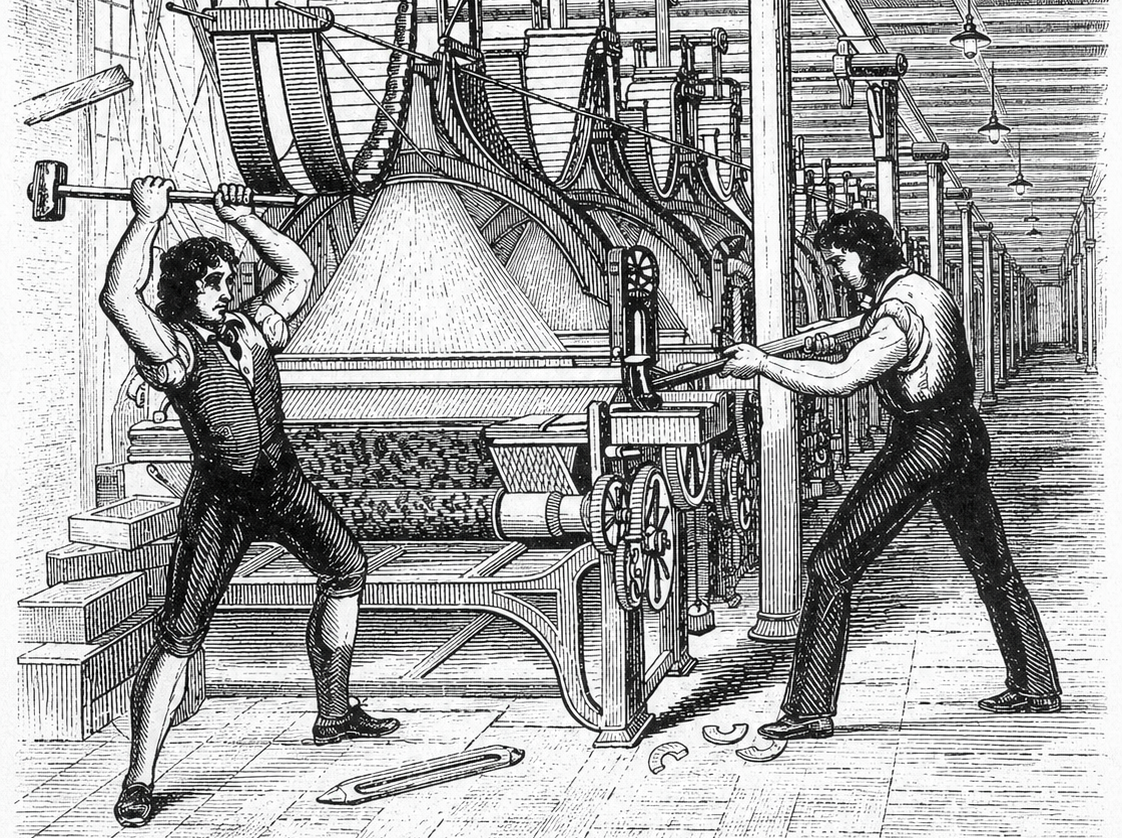
In a section of Capital entitled “The Struggle Between the Worker and the Machine,” Marx turns his attention to the Luddites, the textile workers who, in the early nineteenth century, would enter workshops and factories at night to smash weaving machines. In their fury, he sees the error of a working class still learning to identify its true adversary. “It took both time and experience,” he writes, “before the workpeople learnt to distinguish between machinery and its employment by capital, and to direct their attacks, not against the material instruments of production, but against the mode in which they are used.”
Several historians, from Eric Hobsbawm to E. P. Thompson, have since revised this portrait. The Luddites destroyed the machines belonging to employers who cut wages, hired untrained workers or flooded the market with shoddy stockings, while sparing those belonging to employers who paid fairly. In their letters, they threatened “all Machinery hurtful to Commonality,” which is quite different from “all machinery.” Hobsbawm described their tactics as “collective bargaining by riot.” In a country where the Combination Acts prohibited trade unions, smashing a loom was a way of forcing employers to the negotiating table. In other words, the distinction Marx wanted them to learn was one they had, to a considerable extent, already grasped.
Today, part of the left categorically rejects artificial intelligence, for different reasons that lead to similar conclusions: the machine must be boycotted because it is useless, because it is harmful, or for both reasons. As an artist and theorist who works with these tools every day, I often find myself arguing with people with whom I agree on many other issues, but who, on this particular point, regard me as something of a traitor to the people. After all, the left is notoriously more ferocious toward those closest to it than toward its opponents. And, to invoke yet another political stereotype, the left is never united, and fortunately for me, some people within it do share my position.
It is these voices I want to discuss, tracing the genealogy of a position that runs from Capital to this summer’s debate in Jacobin. Disagreement over machines, after all, has divided progressive movements for a very long time.
Let me begin by stating my position. Generative artificial intelligence systems are extraordinarily powerful machines, and they will become more powerful still. Their usefulness, which might reasonably have been disputed three or four years ago, now seems to me more a matter of fact than opinion. They are also machines born within the most accelerated phase of contemporary capitalism, financed by venture capital funds operating on short-term horizons, trained on a shared, global body of data, and owned by a handful of American and Chinese companies. Many of their design choices bear the marks of these origins. Evgeny Morozov has compiled a list: the conversational interface, designed to create the impression of an interlocutor and thus foster attachment; safety filters, which establish a particular conception of what may be said; usage-based access, which turns every question into a line item on a balance sheet. To these we can add the extraction of public data, sometimes without any compensation, the invisible labour of those who label and correct data, energy consumption, and so on. In my view, anyone who describes these machines as neutral tools that can simply be used well or badly is mistaken.
I do believe, however, that the origins of a technology do not exhaust its possible future, and that thinking otherwise amounts to a logical error known as the genetic fallacy, which consists of judging the value of something solely by its origins. This is particularly true of technologies that economists call general-purpose technologies: those that spread across every sector and generate applications far removed from their original purpose. The example I find most useful is electricity, which developed amid the patents and monopolies of Edison and Westinghouse, was produced in power stations no individual craftsman could have built, and within a few decades became an infrastructure supporting uses nobody had anticipated, eventually being nationalised in many countries, including Italy in 1962.
The most effective formulation of this position comes from the historian of technology Melvin Kranzberg, in the first of his laws: technology is neither good nor bad, nor is it neutral. Between the idea of neutrality, according to which technology is an inert means awaiting some particular application, and technological determinism, according to which technology shapes society rather than the other way around, lies a vast space of possibilities. Andrew Feenberg, a student of Marcuse, speaks of underdetermination: technical criteria alone are insufficient to determine the form of an artefact, and the space they leave open is occupied by social interests. One of his examples is the French Minitel, a terminal originally conceived by the state to distribute information from the top down, which users transformed within a few years into a messaging system. If this is true of a simple terminal, it must be even more true of a language model, which is simultaneously a tool, a medium, an agent, an archive and an interlocutor, and whose uses are almost always discovered after it has been released into the world.
To escape the false dichotomy between defending and rejecting generative AI, we need to examine more closely what deserves criticism and what deserves defending, knowing that in practice the two are constantly intertwined.
First, there is the form imposed on the machine by those who commissioned it: the design choices listed by Morozov bear their imprint. But this does not make everything the machine does “bad.” Much of what a language model offers millions of people every day, whether they are translating, studying or searching for information, is precisely what it was designed to do, and that is a good thing. The history of technology is full of comparable cases. Numerical weather forecasting began in 1950 on ENIAC, a computer funded by the American military, yet nobody, I hope, considers the weather forecast an instrument of capital. Someone treating an illness with an antibiotic manufactured by a multinational pharmaceutical company is using that product exactly as intended, and rightly so. When the intended use satisfies a desire we consider legitimate, such as reading a text in a foreign language or having a tedious task performed for us, the political question concerns ownership and access: who decides how these machines function, and who benefits from them. In such cases, the machine can largely remain as it is. It is its owner who needs to change.
The Ecuadorian-Mexican philosopher Bolívar Echeverría, whom Morozov has brought back to the centre of the debate, argued that every technology contains an infinity of possible actualisations of use-value. Capital selects some of them, while the others remain latent, available under different social conditions. Gilbert Simondon maintained that the perfection of a machine lies in its margin of indeterminacy, in its capacity to remain open to uses that have not been predetermined. Counterintuitively, Simondon argued that a fully automated machine is not perfect but impoverished: because every operation has been fixed in advance, it can no longer be adjusted, combined with other machines or adapted to new purposes.
A general-purpose model has a particularly wide margin of possibility. I can use a model produced by a major technology company to research, write and translate into twenty languages a pamphlet attacking major technology companies, to give a deliberately obvious example of a use that exceeds those anticipated by its owner. Again, not all positive uses are excessive in this sense: as I said, most are simply desirable intended uses. Excess concerns those applications that the business model has not selected, or that run counter to the interests of the company selling the model. Its theoretical significance lies in demonstrating that the machine’s current form is only one among many possible forms.
At this point, those concerned with purity will object that even a pamphlet against Big Tech, if written using a paid subscription, finances the very company it criticises. This is true, but the same applies to a book printed on paper supplied by a multinational publishing company and sold through Amazon, and nobody concludes that the book should therefore not be written. The problem does not lie in any individual use, but in the fact that the profits always end up in the same hands. The answer is not abstention, but a struggle for control over the machines.
By now, few people openly argue that these machines should be rejected outright. Total refusal has a bad reputation: it smacks of nostalgia and Luddism in the pejorative sense of the term, and almost everyone begins by insisting that they are not opposed to technology itself. Then come the exceptions: anyone who generates images with AI is producing fascist aesthetics; models make too many mistakes to be useful; they should not be used for writing, translating, studying or illustrating an article. Taken together, these objections leave standing only applications that are useless to almost everyone or extremely niche. It is refusal by subtraction: never explicitly declared, but by excluding one field after another, it achieves the same result as an outright ban, with the added advantage of never having to defend one. This negative theology attempts to conceal an indefensible blanket rejection behind a series of smaller refusals that appear individually more reasonable.
This is not the place to dismantle every objection individually, but I will describe the two broad groups into which they fall. The first consists of those who reject these machines because they consider them useless. The best-known version of this argument can be found in The AI Con by Emily Bender and Alex Hanna, published in Italian translation this year by Fazi. For the authors, “artificial intelligence” is purely a marketing label: language models merely calculate the statistically most probable word to follow the preceding ones, without understanding anything they write, and the industry promoting them is essentially a scam built on hype. This develops the metaphor of “stochastic parrots” that Bender introduced in 2021 with Timnit Gebru and other researchers. I also believe these machines do not do what the advertising promises, but only because advertising is, as always, exaggerated. The book’s limitation lies elsewhere: it treats a diagnosis made in 2021 as immutable, without acknowledging the enormous advances models have made since that criticism first emerged, while documenting a long catalogue of harms that, strictly speaking, presuppose a certain degree of effectiveness. A publisher who dismisses a translator and replaces them with a machine does so because the machine works well: sometimes worse than a human, sometimes better, and above all at one-tenth of the cost and much greater speed. The publisher simply wants to save money, and one can certainly argue that these tools work at an unacceptable social cost and to the benefit of the wrong people. But to maintain that they do not work, or that they invariably perform worse than people working without them, is now patently false, as recent successes in mathematics and programming demonstrate.
Bender and Hanna propose a form of “strategic refusal” accompanied by regulation and trade-union resistance, but the question of reclaiming these technologies remains marginal to the book. The authors mention community projects such as Te Hiku Media, which develops speech technologies for the Māori language under community control, and call for a “transfer of power (and capital)” from corporations to those affected. Yet they restrict this possibility to small models designed for specific tasks, rather than general-purpose ones.
The position of those who reject these technologies because they consider them dangerous is more defensible. Kate Crawford has described the AI industry as an extractive apparatus that devours lithium, water, underpaid labour and culture, and has recently characterised its products as waste that, in turn, becomes fuel.
Crawford’s material criticisms are well founded, but before they can justify outright rejection, they must be compared with what we routinely tolerate in other industries. According to the International Energy Agency, in 2024 data centres of every kind, not only those dedicated to AI, consumed approximately 1.5% of the world’s electricity. By 2030, the agency expects that figure to double, although with considerable uncertainty in either direction, bringing it to around 3% of electricity consumption and less than 1% of global CO₂ emissions. In 2025, data centres dedicated exclusively to AI accounted for roughly half a percentage point of electricity consumption. Cement production alone generates approximately 8% of global CO₂ emissions; tourism, including air travel, accounts for around 8% of greenhouse gases. Video games alone consume approximately 2.4% of household electricity in the United States. Mining, water consumption and underpaid labour were not invented by AI: they run through steelmaking, electronics, industrial agriculture and clothing manufacturing. Yet nobody on the left proposes rejecting tourism, streaming or video games outright, even though they pollute and are not essential goods. At most, people demand that they be regulated and made more sustainable. Demanding rejection only in the case of AI is a double standard. The problem identified by the International Energy Agency itself is different: data-centre growth is extremely rapid and concentrated in a handful of locations, to the point that in Ireland they now account for more than one-fifth of national electricity consumption, while in the United States much of the additional energy they require still comes from fossil fuels. This is a question of resource management: where data centres are built, what energy powers them and who gets to decide. The sensible response is to make these machines, indeed all machines, more sustainable, not to reject them.
Many critics, including Crawford and Steyerl to varying degrees, seem to recognise only one legitimate use of these technologies: using them to dismantle and expose their underlying logic. Turning the machine against itself can often be illuminating, but reducing every use to criticism is limiting when so many highly valuable intended uses simply need to be freed from the exclusive control of those who sell them. What I cannot accept is the leap from specific harm to general refusal: AI has problems, and from this it is concluded that it should largely be obstructed and rejected. This is quite apart from the fact that some of the things presented as harms are, in my view, not harms at all. I am not referring here to environmental damage, which is unfortunately real, but, for example, to the supposed damage to our minds, on which there is no clear and settled scientific consensus.
In practice, then, refusal amounts to a boycott, and boycotting strikes me as both impracticable and self-defeating. The Luddites were skilled workers who controlled a crucial stage of production and could exert pressure on a limited number of employers. A consumer boycott by dispersed individuals against a tool that millions of people use every day to work, study and manage ordinary tasks, by contrast, runs into every limitation of collective action. And those who forgo technical expertise leave the field open to people with no interest whatsoever in changing the technology’s form. The case of illustrators, translators and voice actors is closer to that of the Luddites. Even there, however, refusal risks becoming a war among the poor, since many of these workers already use these tools and have no intention of giving them up.
In Blood in the Machine, Brian Merchant drew precisely on Hobsbawm and Thompson to reclaim the Luddites as a model for workers threatened by large technology companies, from Uber drivers to illustrators confronting generative AI. But Merchant himself emphasises that the Luddites were not opposed to machines as such: they opposed the way those machines were introduced, without workers having any say in the matter. The question remains what, exactly, we should demand. A ban on use seems sterile to me. Instead, we should develop a social system capable of accommodating these machines while reducing inequalities rather than increasing them. On one point, I disagree with Merchant: he compares AI-generated images with those produced by an experienced artist and concludes that companies adopt the former only because they cost less. This is often true, but only because he fails to consider what an experienced artist can do with AI. He mistakes a limitation of the social context for a limitation of the technology.
In 2023, American screenwriters went on strike for almost five months and secured an agreement that, importantly, does not ban AI, but establishes that screenwriters may choose to use it without anyone being allowed to force them to do so. They did what the actual Luddites did: they put pressure on the system, while leaving workers free to decide whether to use the tool. Individual choice protected by a collective framework avoids a war among the poor and acknowledges that those who refuse AI face competition from those who use it, while a moral prohibition binds only those willing to accept it, leaving everyone else with a competitive advantage. Effective refusal, in other words, meant refusing to work, not refusing the tool. Yet this was a limited and local victory: it applies to a single union, in a single country, in an industry where workers still had the power to halt production, and above all it changes neither the ownership of the models nor their form.
The passage from Marx with which I began opens onto a long tradition of debate. In 1961, in the first issue of Quaderni Rossi, Raniero Panzieri attacked the faith in technological progress prevalent within the Italian Communist Party and the trade unions, arguing that the capitalist use of machines determines technological development itself, and that the relations of production are embedded within the productive forces. About a decade later, Claudio Napoleoni considered the Marxian distinction between the machine and its use untenable, because a machine used in a non-capitalist way would, in effect, be a different machine. Many arguments underpinning today’s refusal come from this side of the debate, even though Panzieri did not advocate abandoning machines, but contesting their form through workers’ control. These are objections I partly accept, and their conclusion is closer to my own than it might appear: precisely because machine and use cannot be cleanly separated, we must distinguish, case by case, what needs to change from what deserves defending.
On the other side, Lenin saw in Taylorism both the refinement of bourgeois exploitation and scientific achievements worth appropriating, and repeatedly argued that socialism had to be built using all the culture, science and technology inherited from capitalism. More than a decade later, Walter Benjamin, in “The Author as Producer,” argued that the task of the progressive intellectual is not to supply the apparatus of production for which they work, but to transform it.
Hans Magnus Enzensberger distinguished between a repressive use of media, with a central authority broadcasting to a mass of isolated consumers, and an emancipatory use in which every receiver is also a transmitter. He reproached the New Left for its “cultural archaism,” accusing it of reducing the development of media to a single concept: manipulation. The same line of thought reappears in Donna Haraway’s A Cyborg Manifesto, which urged socialist feminism to take responsibility for machines rather than retreat into an innocent nature that had never existed; in Laboria Cuboniks’ Xenofeminist Manifesto; and in Assembly by Michael Hardt and Antonio Negri, who made the appropriation of fixed capital one of their central themes. The most frequently cited historical precedent remains Allende’s Chile, where, between 1971 and 1973, the British cybernetician Stafford Beer and Fernando Flores developed Cybersyn, a network of telex machines and statistical models designed to coordinate nationalised industries with workers’ participation.
The most interesting case in recent months is Morozov, who built his reputation by dismantling cyber-utopianism and who, as recently as 2023, regarded the ideology of artificial general intelligence as an illegitimate offspring of neoliberalism. In December 2024, writing in Boston Review, he changed his approach, rejecting both the realists who demand nothing more than regulation and the refuseniks who reject everything. A year later, in “Socialism After AI,” he criticised socialists for treating AI as a neutral instrument that could simply be redirected, and for having little more than defensive reflexes, such as regulating, taxing or nationalising it. His proposal is a socialism capable of experimentation: municipal models trained on a city’s public documents, networks of artists and archivists building models for endangered languages, institutions that make it possible to test different configurations and abandon them. In his response to critics, the formulation became even more explicit: the objective is to appropriate AI as an infrastructure for collective experimentation. I share Morozov’s suspicion of the Marxian distinction with which I began, but we differ in other respects. He emphasises the crystallisation of capitalist relations within the model, whereas I emphasise the possibilities that exceed what those relations can contain.
The debate that followed in The Ideas Letter deserves attention. Aaron Benanav objected to Morozov that no experimentation is free of political choices, since every investment decision favours certain futures at the expense of others. The same applies to the excess of possibility I have described, which requires funding if it is to be cultivated. Leif Weatherby, in an essay entitled “Automate the C-Suite,” argued that AI should be understood as the materialisation of capitalism’s decision-making rationality, the product of a century of optimisation theory, neoliberal economics and computer science, a formation in which technology and ideology cannot be separated. If he is right, changing the machine’s owner would leave intact the rationality inscribed within it.
I believe Weatherby identifies a genuine genealogy but draws too rigid an identification from it. Linear programming, which he traces back to George Dantzig and places at the heart of that rationality, was independently invented by Leonid Kantorovich in the Soviet Union, precisely to plan production. This suggests that its association with Western neoliberalism is a historical fact, contingent like all historical facts. Everything, after all, is optimised for someone and according to some criterion, and what distinguishes capitalism is its criterion of selection: profit. Weatherby himself, moreover, observes that language models depart from the history that produced them, because much of the tradition of optimisation sought to strip away the excesses of human culture, whereas these models produce more culture. And it is curious that his conclusion is far less bleak than his premises: the logic of these machines, he writes, tends to render the managerial and executive class superfluous, precisely the people who own them. This is excess viewed from above, a machine that threatens those who wanted it built. The fact that a particular rationality is inscribed within a machine does not mean that it must necessarily be negative, nor that it exhausts the machine’s possible uses. To infer from the capitalist imprint of a model that every use of it is capitalist is, once again, a genetic fallacy.
The political scientist Langdon Winner distinguished between technologies that require a particular social arrangement and those that are merely compatible with it, using energy as an example: nuclear power, he argued, requires a centralised and hierarchical organisation, whereas solar energy lends itself to decentralised forms. Look closely, and a language model is both at once, depending on the level under consideration. The pretraining of a frontier model resembles a nuclear power station, requiring immense computing power, data centres the size of city districts, and capital that few states could mobilise. Adapting an open model to a specific task, distilling it into smaller models, or running it locally on a personal computer is more like installing solar panels on the roof of a house. The centralising tendency lies at the top, the excess of possibility at the bottom, and for several years now distillation has been transferring capabilities from the top down, even if this means that the bottom remains dependent on what happens at the top.
This suggests a more complex strategy. Pretraining could be financed through public computing infrastructure, as has already happened on a small and purely experimental scale with the Swiss model Apertus, developed by the federal institutes of technology in Lausanne and Zurich, or with Minerva, trained by Sapienza University on CINECA’s Leonardo supercomputer. Adaptation could take place in a decentralised manner, within communities, institutions and trade unions. Of course, public infrastructure still buys its chips from an oligopoly of manufacturers, and the semiconductor supply chain remains the point at which appropriation has so far failed to reach. But leaving the entire production chain in the hands of a handful of companies would be far worse.
Recognising that not everything born under capitalism deserves to be discarded requires no political justification, just as switching on a light requires none. The moralism of the purist who demands abstention leaves the power of those producing these machines untouched, while impoverishing those who might use them. One could object, with Audre Lorde, that the master’s tools will never dismantle the master’s house. But Lorde was speaking of the conceptual and institutional tools through which white academic feminism ignored differences of race and class, while her own work circulated through the master’s language, publishing industry and universities. No movement has ever transformed a society using tools entirely foreign to that society. Demanding that we reject them all is impossible before it is even useless.
Use alone, however, is not enough unless it is accompanied by a struggle for control. That does not mean fighting for stricter copyright laws, which might appear to protect illustrators and translators but would direct most compensation toward publishers and large archives, while leaving only companies able to afford licensing fees in the market and excluding open and public models. Instead, we must fight for models to be open, with code and weights that can be inspected and modified collectively. And the discussion cannot stop at national borders: as Cecilia Rikap has pointed out, models are trained on the creative output of the entire world, and American nationalisation would amount to appropriation for the benefit of only a few.
Rikap’s contribution is part of a debate that I consider the most interesting development of recent months. At the beginning of the summer, Bernie Sanders proposed a one-off 50% tax on major AI companies, payable in shares, to establish a public fund. I am rather sceptical of the proposal itself: it would transfer half the shares to the state, but it addresses only ownership and dividends without changing the form of the models, and it concerns only the United States. The fact that similar ideas are circulating even at the highest levels of the technology industry, from Sam Altman to Dario Amodei, should make us cautious. The step forward lies in the debate that followed in Jacobin. Michael McCarthy argued that decision-making power should rest above all with the workers whose professions are being reshaped. Nuno Teles wrote that the left must reject both prophecies of an employment apocalypse and the temptation of Luddism, in the contemporary rather than historical sense of the term, because under public control these machines could reduce the burden of work instead of driving down wages. At last, the debate is about who should control the models, whereas until recently, and partly still today, it revolved primarily around their supposed uselessness.
Marx urged workers to learn to distinguish the machine from its capitalist use, and the tradition running from Panzieri through Napoleoni to Morozov has replied that this distinction does not hold, because the machine embodies the choices of those who brought it into being. I believe that this answer repeats the error of the original question. Marx separated the two too sharply; his critics tend to fuse them with equal rigidity. Neither account can adequately describe a machine that is neither neutral nor predetermined. These machines already do many good things every day, precisely in the way they were designed to do them. They also do other things that nobody anticipated and that those selling them have no interest in developing. We do not have to choose between defence and refusal. We must preserve what is already good, expand the margin of indeterminacy that Simondon described, and fight to ensure that those who use these machines also have a say in determining their form. The Luddites, who distinguished one loom from another and one employer from another, understood this two centuries ago. The time and experience Marx demanded of them are needed today, above all, by us.
Francesco D’Isa