


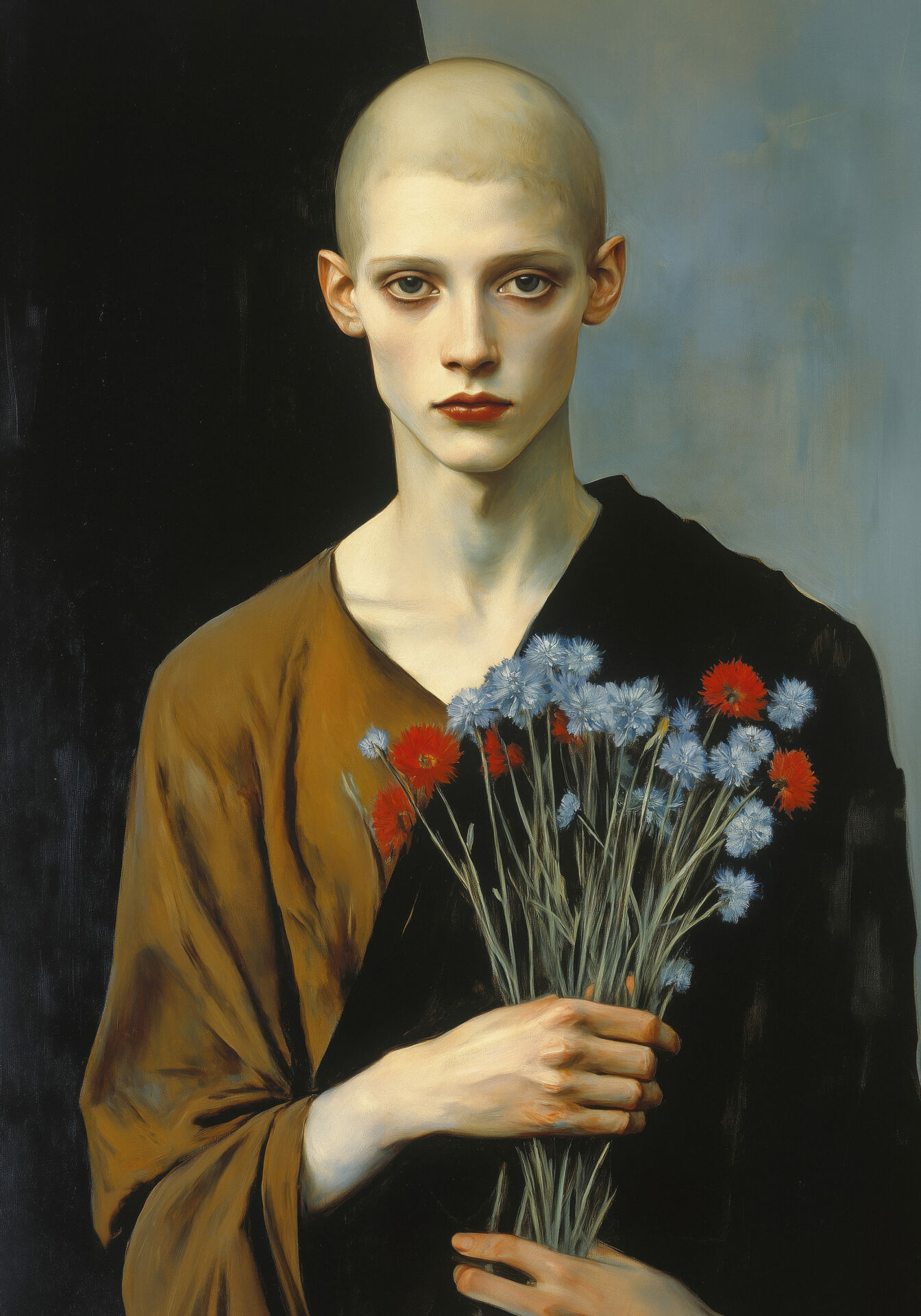
In his new project The Possible Bodies. A Plausible Authenticity, he takes AI beyond the misunderstanding of digital virtuosity and brings it back into the territory of art where authorship, vision, and responsibility matter. A philosopher by training, television author, and communication professional, DellAcqua moves on the thin line between writing and image: the word as origin, technology as extension, painting as horizon.
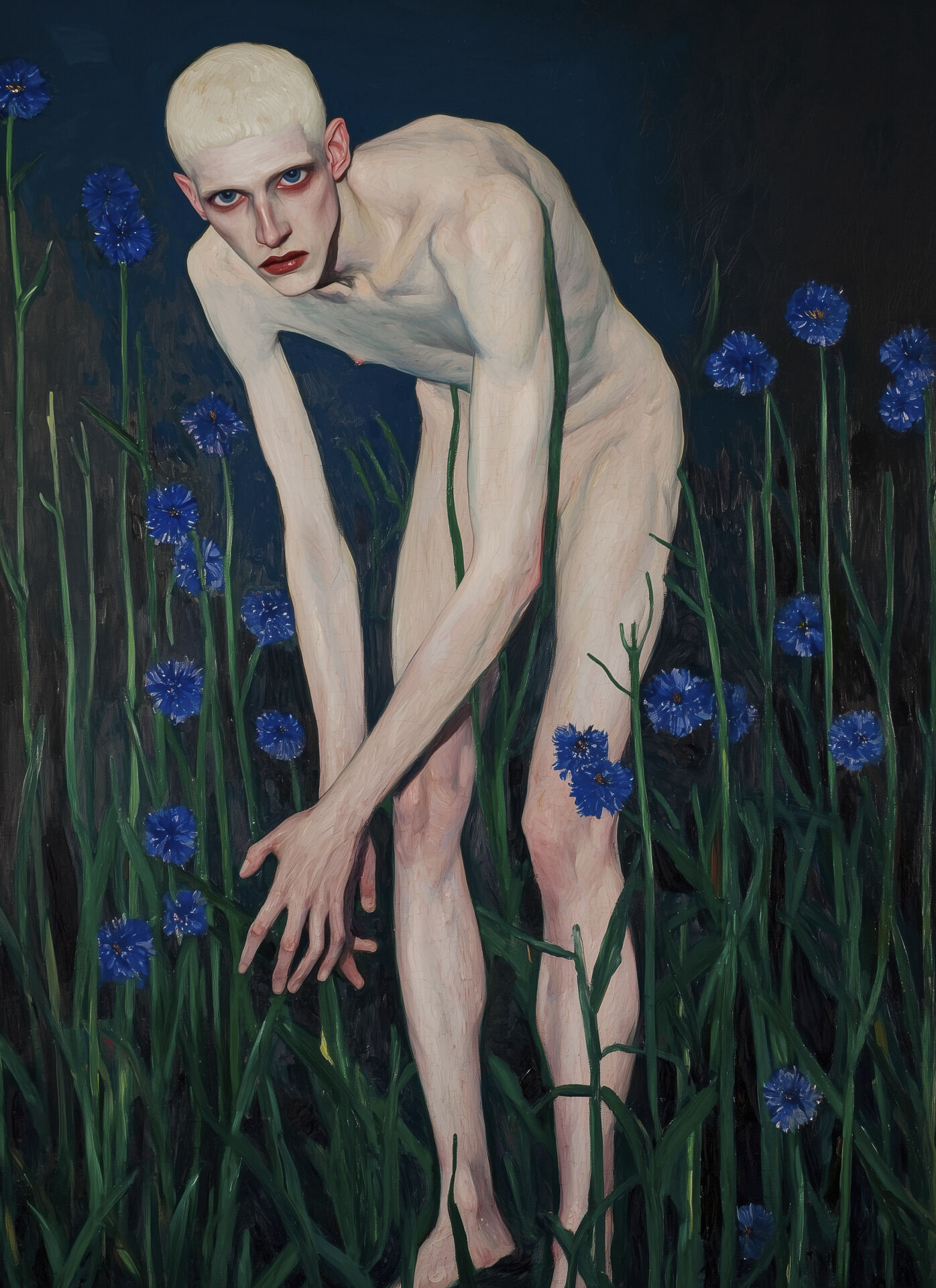
His research does not proclaim the machine as the protagonist, but as a tool to be tamed and integrated. In the titles of his works from Ecce Synth to Bye Bye Terra, from Il santo to Le farfalle non sono innocenti there is already a narrative tension, a story that refuses to remain on the surface. His work arises from concrete experiences, from photographs taken in the underground or in his living room, from intimate suggestions that AI amplifies until they become visions.
It is in this space that the following conversation takes shape, where the artist tells The Bunker about his practice, the shift from television writing to prompting, the author’s responsibility in front of AI, and the meaning of a search that is never only technological, but profoundly human.
Television writing is my profession and my job. It is a form of writing that adapts to different formats and genres, but it always has one constant: it must be precise, punctual, anchored in time. It is a text that becomes speech, that must already contain a narrative horizon because writing a script means foreseeing where you are going. Television obliges you to build a clear line: there may be surprises when live on air, of course, but never at the writing stage. There, there is no room for improvisation you must think everything through in advance, as if drawing a map.
The writing I use with Artificial Intelligence to generate images moves in another direction. Here, words do not need to fit a presenter or hold together a running order: they become pure expressive matter. It is a much freer writing, almost a stream of consciousness. I compare it to Rorschach blots or shapes we seek in clouds: you throw words and then watch what they become. Often, I write by suggestion more than logic: it is not linear writing, it splashes, it explodes like a Pollock canvas. I roughly know where I want to go, but AI surprises my words by embodying them into something I had not yet seen. And that is where the artwork is born.
That is why I speak of a journey into the unforeseen: it has one direction, but it crosses possible worlds that open before me. The difference is this television demands rigour, control, the ability to hold a course; AI gives me the chance to lose myself, to follow dreams and nightmares, to be surprised. Still, critical attention is essential. The machine is not neutral: it brings back everything that constitutes its reference base. That is why I never just accept what it gives me I must choose, question, correct, delete. Otherwise, the risk is to stop at aesthetic surface and lose meaning.
In the end, what truly changes is the substance of the word. In television writing, it is voice, time, rhythm. In AI writing, it becomes image, colour, atmosphere. The prompt is not just a sentence it is a gesture that opens a space. And in that space, I find the most inner part of my work: the one that cannot be planned, but only discovered by living through the unforeseen.
Describing my creative process with AI is difficult, because it is not linear. I recall something a very experienced person in AI told me nearly two years ago: when you find your way of prompting, don’t tell anyone that’s where your uniqueness lies.
Its true. Everyone has their own language, their own method. What makes each AI artist different is precisely their way of writing, suggesting, throwing words against that wall I mentioned.
At first, I was in a hyper-descriptive phase. I wrote everything a sun setting behind low mountains, except one higher peak at the centre, light filtering through clouds, blurred contours. That writing produced linear images consistent with the description. Then I realised real expressiveness emerges when you break that logic when you start writing more paradoxically, less orderly. Thats when the result starts giving you back something that truly belongs to you.
Often, I dont start with writing alone. Its accompanied by photos I take myself, because I work a lot with portraits. Some of my dearest works Il Santo, Bye Bye Terra, Tutti i pomeriggi were born this way. A photo on the underground, a boy begging with dignity, my elderly mother abandoned on the sofa: captured moments, then transformed. Thats how I prompt the machine: start from here and then I let it enter my world. But its a dialogue: I take what AI gives me, rewrite it, modify it, feed it back in as a new reference, with a different prompt. Its a continuous back-and-forth.
There is no single logical process its a set of techniques shaped on oneself. Who you are counts enormously: your language, your background, the colours you seek, the images that shaped you, the things that move you, scare you, make you laugh, the traumas and joys you carry inside. All of this passes through the words you throw into the machine. Then theres the technical side. Each AI has its parameters, settings, algorithms. You must know and test them because the result never comes from words alone, but from their encounter with these variables.
Those who think they can simply type I want a yellow flower and expect a masterpiece are wrong. Behind each successful image is refinement, trial and adjustment, technical dialogue with the tool. The extraordinary thing about AI is that it multiplies possibilities before your eyes. Where a painter or sculptor must choose a single gesture, here you have hundreds, thousands of variations in which you can lose or rediscover yourself. I can generate seven or eight thousand images for a single work, working on it for months, leaving it aside and returning to it once Ive changed too. Because thats how it is when you return to a piece, you are no longer the same, and the work changes with you.
It is a creative act that is almost therapeutic: it confronts you with who you are, your possibilities and limits. Of course, theres a struggle with the machine too. You must tame it to a language thats not always yours, translate your references, adapt and at the same time impose your vision. Yet there are moments when you and the machine see the same thing and thats astonishing. Thats when you cross a real threshold. And when the image is ready, the work isnt over theres always a next phase: refinement, post-production, adding grain, retouching details, expanding format. Its a return to manual work to the tangible that closes the circle.
Thats why, for me, AI is not a game. It can be, of course and partly it must be, because you need that playful recklessness to master it. But for those who dive in fully, it becomes a material not physical, but still matter that forces you to face the infinite possibilities of creation. Its a journey that, if you go all the way, changes both you and your way of seeing the world.
To tame AI. Thats the word I often use perhaps educate sounds more elegant, but tame carries the truth of instinct. The machine tends to rebel against imposed direction; it often returns results reflecting its aesthetic repertoire more than your intention.
Thats why managing parameters, references, technical writing and defining details is not optional its the core of creating with AI. As I said, you cant just write I want a yellow flower and expect a mature result. Behind every successful image lie settings, seeds, scales, negative prompts (you describe not only what you want, but also what you dont want), reinserted references, and iterative edits. The first stages almost always yield a raw that must be reworked, corrected, treated like a fluid, until you find the form that truly belongs to you.
The boundary between using AI as a tool and letting it become the protagonist is clear to me: a work is mine if, when I look at it, I feel it is the outcome of my will not just the special effect of the tool. AI helps me externalise whats missing in me that light, that face, that emotional crack I couldnt achieve alone. When I reach a result that surprises me, yet matches what I sought, AI has served as an integrated means.
If, on the other hand, the result screams its technique if its all about excess, grotesque distortion, three eyes and four mouths then, for me, theres no artwork, only a tool showing off. My goal isnt to achieve hyperrealism. My work is digital, but it heads towards painting seeking brushstrokes, grain, materiality. Each work goes through a process echoing a painterly gesture: from initial elaboration to refinement, Im not after photographic perfection but that living imperfection that conveys the emotion of a painting.
This is where plausible authenticity enters: a work is authentic when it can be traced back to someone when you sense that behind it lies an author, a will that wanted that image in that way. For me, a work is mine when I can see myself in it.
In my view, AI should not proclaim itself aesthetically but conceptually. I have no problem saying I use it but it mustnt be the star of the scene. It should integrate with me, serve my vision, not replace it. Its material to be moulded and like all materials, it must be resisted, shaped, sometimes fought. There are moments when I must bend it to my language, and surprising moments when we both see the same thing. Thats where the work is born: when the medium neither dominates nor disappears, but integrates yielding something that belongs to both, and that wouldnt exist without that encounter.
In the beginning was the Word.
Thats how Id answer, because for me the word is the ultimate creative act. Even though Im not religious, the opening of the Gospel of John the most philosophical of the gospels has immense power, especially its continuation: and the Word was with God.
Even in Genesis, there is the creative will that names light: Let there be light, and it was so. In more secular terms, the word names things, and the world even our emotional world takes shape.
Bringing this to a much humbler scale: verbal narration is the womb from which everything is born, including ourselves (after all, dont we each have a name?). There is no true creative act that doesnt pass through language: its the word that separates, creates distance and meaning, that makes the world recognisable and inhabitable with awareness. Thats why it is the foundation of everything I am and do and that naturally includes how I use and understand AI.
The year-long Belleville writing school I attended in 2023 was crucial: it gave me back the technique of the word. I started again from scratch thinking about vocabulary, pauses, rhythm, the way a sentence can open an image inside the listener. I come from a philosophical education, with a hermeneutic imprint: my language is investigative more than descriptive. But I also needed to return to creative gesture to be, simply put, something other than myself and what I had been until then. That space allowed me to learn again how to use words as tools of invention.
At the same time, technology arrived allowing me to draw with words. I write because I cannot draw has always been my self-definition, and with AI that dream materialised: I can write flower and see a flower. But the hierarchy hasnt changed: the word remains the origin, because every image already contains within it an unspoken story that AI merely makes visible.
Sometimes, the reverse happens: an image I generate makes me want to write. A face, a light, an unexpected detail can open a story that didnt exist before. Its not automatic more of a dialogue: the image answers back, returning something you didnt expect. In such cases, the word remains central, because only it can transform that visual suggestion into a story others can read and understand.
Maybe one day Ill truly write stories starting from my images because they often end up telling their own stories, with a life of their own.
The lesson Ive learned is that writing is no joke: its effort, respect, responsibility. To entrust words to the world means giving away part of yourself shaping memories and feelings that were once only inner currents. That is the price you pay for your work to have value. When I think of my portraits, my pursuit of plausible authenticity, Im already paying that price too.
In the end, all my work with AI continues that first gesture: to name in order to create. Technology has expanded the ways I can do it, offering unprecedented possibilities but it doesnt replace my need, my hunger for words.
Answering questions about authorship and AI is the proverbial six-million-dollar question because were dealing with a new, astonishing, and also unsettling technology. Unsettling because its so humanised: it forces us to confront both the risk and the possibility of replacement, to look at ourselves in the mirror as a creative species.
Every technology, when it appears, produces its own ethics dictating new behaviours, distinguishing right from wrong, and inevitably generating a morality. But morality isnt enough: eventually, law must decide what can and cannot be done.
Thats why AI has already entered courtrooms and draft laws in Europe and the United States: we must define who the author is and how copyright works.
The right direction, to me, is this: assessing how much an artwork is determined by the person who made it. AI can generate images but what matters is how much I, as author, intervene, choose, direct, shape the result. Its the human, creative share that makes the difference. And thats precisely where legislation is heading: pressing a button isnt enough; human direction must be proven.
The analogy with photography makes it clear. We all have smartphones, we can all take pictures but between my filtered selfie and a Helmut Newton photograph theres an abyss. The camera is a medium, not the author. The difference, of course, is that a camera doesnt invent: it records what the author has chosen to frame. It extends the eye and hand deciding who looks, from where, in what light, at what moment.
Generative AI, on the other hand, has a different autonomy: it doesnt merely capture but reprocesses billions of data points to produce images that never existed before. Its a huge leap. Yet even in that autonomy, what remains decisive is who guides it, who conditions it, who selects. Without human choice, AIs results remain undifferentiated mass.
Just as photography didnt strip the author of value but opened a new language, AI in its own way doesnt erase the author; it forces them to redefine themselves.
That leads to something I consider crucial: theres nothing degrading about saying a work was created by me together with Artificial Intelligence. On the contrary, I like the word together. It doesnt diminish my authorship it describes it as it is today: no longer a solitary act, but a choral process.
Choral, because even when I work alone, a chorus of voices acts in my mind exhibitions Ive seen, films Ive loved, familiar faces, past loves, readings, stories. Everything intertwines in the creative moment. AI doesnt erase this chorus it amplifies it, connecting me to an even broader collective imagination.
Thats why I speak of plausible authenticity: not an absolute truth, but one that is constructed through recognisable choices. AI doesnt trivialise art if you know how to govern it, it enhances talent, as every major creative technology has throughout history.
If I had to explain this to a TV audience, Id say:
I created this work together with Artificial Intelligence. Theres nothing degrading in saying that its like saying a photograph is made with a camera. Having the tool isnt enough: what matters is who uses it, the choices they make, the gaze they put into it. Everyone can take pictures but that doesnt make everyone a photographer. And the same goes for AI: everyone can generate images, but not everyone becomes an artist. Art remains a matter of gaze and the gaze, inevitably, remains human.
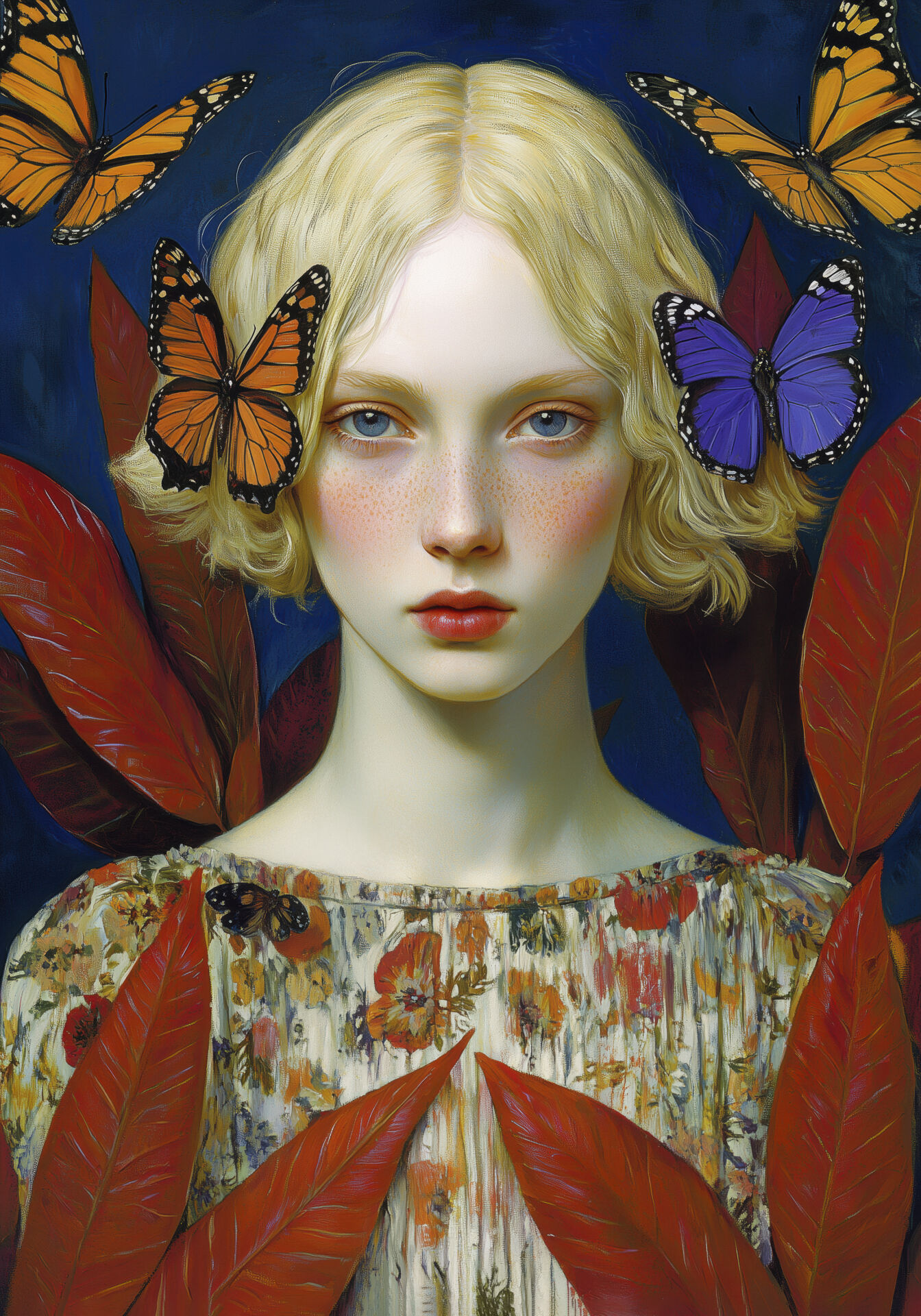
With a degree in Philosophy with a focus on hermeneutics, Francesco DellAcqua is a television writer and communications professional. His interest in artificial intelligence arose as a natural extension of writing: a way to transform words into images. Using AI as a conscious tool rather than an end in itself, he explores the creation of plausible visual realities, in which personal identity shapes what is possible.