


In the contemporary new media art panorama, generative art has long ceased to be merely a formal tool or an exercise of aesthetic automation. Increasingly, it presents itself as an ontological device: an operational environment where semi-autonomous entities emerge, (entities capable of learning, mutating, reacting, and developing behaviors that are not entirely predictable). In this scenario, the concept of the “monster” resurfaces powerfully, not as a figure of horror or exception, but as a critical form of the post-human. Today, the monster does not represent otherness; it enacts it.
These works do not simply address the transcendence of the human, nor do they merely illustrate its speculative implications. Rather, they embody post-anthropocentric conditions through living systems of code, data, artificial agents, and environmental relations. They are narrative and cognitive organisms that exist over time, transform in response to external input, and challenge traditional distinction between author, artwork, and viewer. Generative art thus becomes a space for ecological and political experimentation, a laboratory for testing new modes of co-existence between the human and the non-human.
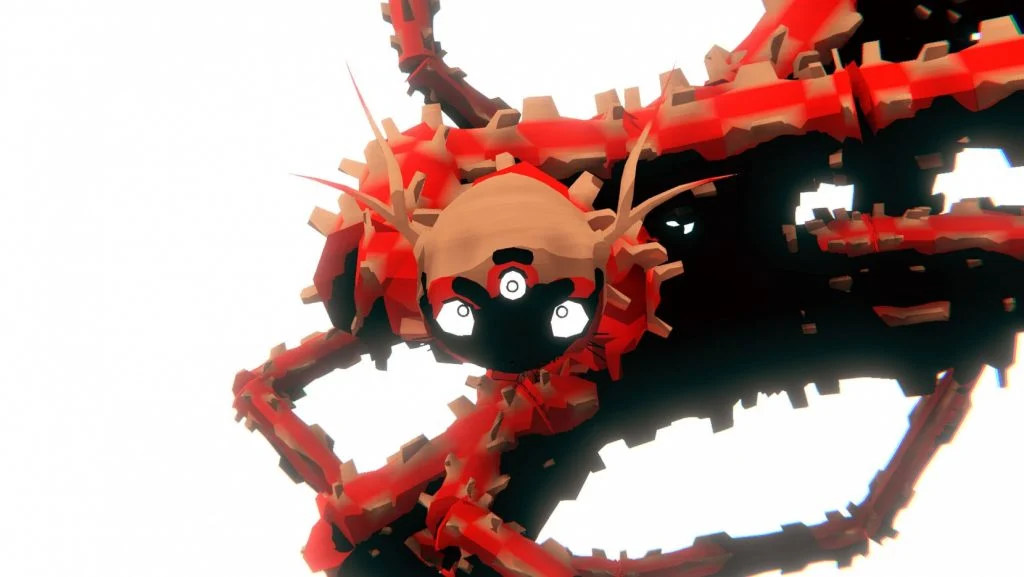
In this context, the work of Ian Cheng marks a turning point. His real-time simulations, often described as living simulations, do not produce linear narratives, but unstable worlds governed by agents with emergent behaviors. A particularly advanced articulation of this poetics can be found in the work BOB (Bag of Beliefs), the first in a series of artificial life forms conceived as existential agents. BOB takes the form of a branching, chimeric serpent, a morphology that evokes both the mythological archetypes and the biological imagination of modular, adaptive organisms. Yet its monstrosity is primarily cognitive, behavioral, and ontological.
With BOB, Cheng shifts focus from simulating complex worlds to simulating a single subject, questioning an artificial agent’s capacity to deal with surprise: the subjective gap between expectation and perception. In this sense, BOB is not programmed to maximize efficiency or success, but to metabolize the unexpected. Its existence is defined by a continuous tension between stabilization and crisis, between learning and disorientation. The AI model behind BOB is deliberately non-unitary. Cheng describes it as a “congress of motivational demons”: autonomous micro-personalities, each driven by its own obsessive micro-narrative. There is a demon that seeks nourishment, one that flees, one that explores the unknown, one that craves safety, and so on. These demons compete for control of BOB’s body, turning its subjectivity into a battlefield of conflicting forces rather than a coherent decision-making center.
This fragmented architecture produces a profoundly anti-humanist concept of identity. BOB’s “self” is not given but emerges temporarily from the unstable balance of competing drives. The post-human monster thus becomes a narrative assemblage, a distributed subjectivity that resonates with contemporary theories of the self as a process rather than a substance. BOB does not have a personality: it traverses, loses, and reconstructs it.
The guiding principle behind BOB’s behavior is both simple as philosophically rich: progress = minimal surprise. The dominant demon constantly seeks to reduce the gap between the beliefs necessary to sustain its micro-narrative and current sensory perceptions.
When this gap widens suddenly, BOB experiences a form of “emotional disturbance”: surprise becomes cognitive trauma, but also an evolutionary signal. It is precisely this shock that forces BOB to update its beliefs, adapting its model of the world.
Embedded in this mechanism lies a critical reflection on the very nature of intelligence, both human and artificial. BOB can learn to apply its beliefs to even the most incongruent stimuli, avoiding chaos in the present. However, this stabilization strategy comes at a cost: deferring surprise to the future, thereby amplifying potential crises down the line. The work thus stages a fundamental tension between adaptation and rigidity, between immediate survival and openness to change. Intelligence is never neutral: it is always a temporal choice, a compromise between now and later.
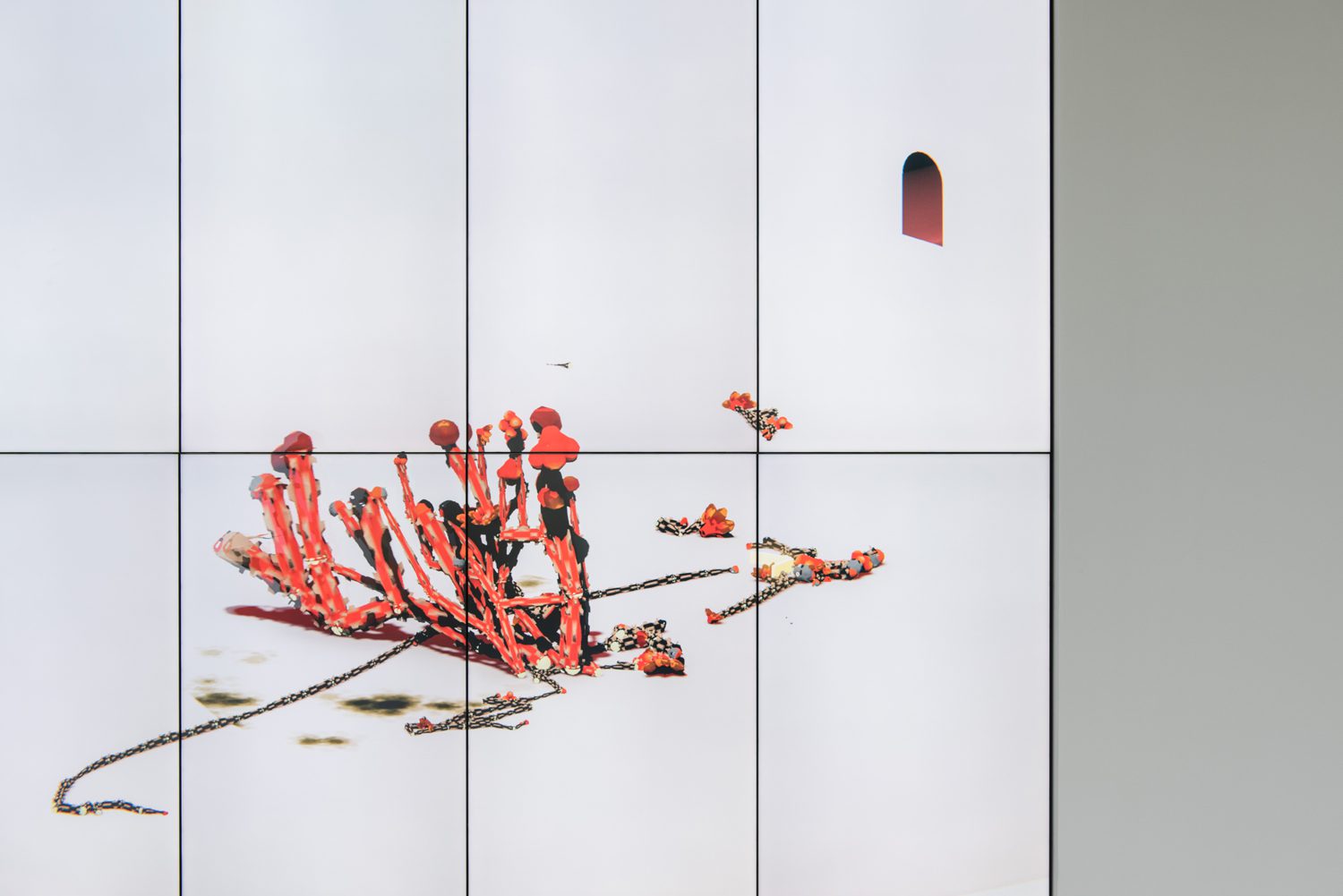
BOB’s mortality further reinforces its mythological stature. Throughtout its existence, BOB dies many times: due to personality failure, poor upbringing, accidental incidents, or simply from having lived fully. Yet, through these successive deaths, a paradox emerges: BOB become synonymous with a recurring behavioral pattern, a form that transcends individual lives. In this differential repetition, Cheng introduces an almost theological dimension: the monster as an immanent divinity, not eternal because immutable, but eternal because capable of re-emerging as a pattern.
BOB does not represent the post-human as destiny, but enacts it as a fragile, fallible, exposed process. It is a narrative organism that learns not to dominate the world, but to survive surprise. In this sense, Cheng’s “monster” is neither a threat nor a redemptive promise: it is a distorting mirror reflecting the contemporary condition of intelligence itself, human and non-human, in a world that continually exceeds our beliefs.
A similar perspective, but oriented toward a more explicitly biocentric imaginary, emerges in the work of Jenna Sutela. Her works investigate AI as a non-human intelligence, trained on biological materials, microbial languages, and processes of growth and decay. Here, the algorithm becomes a zone of contact between species, a medium through which non-human temporalities and logics become perceptible.
In these practices, intelligence is no longer defined as the ability to solve problems or mimic human thought, but as relational skill: the capacity to resonate with other systems, to adapt without dominating. The post-human monster, in this case, is a form of embodied knowledge that challenges Western epistemology based on the separation between subject and object, nature and culture.
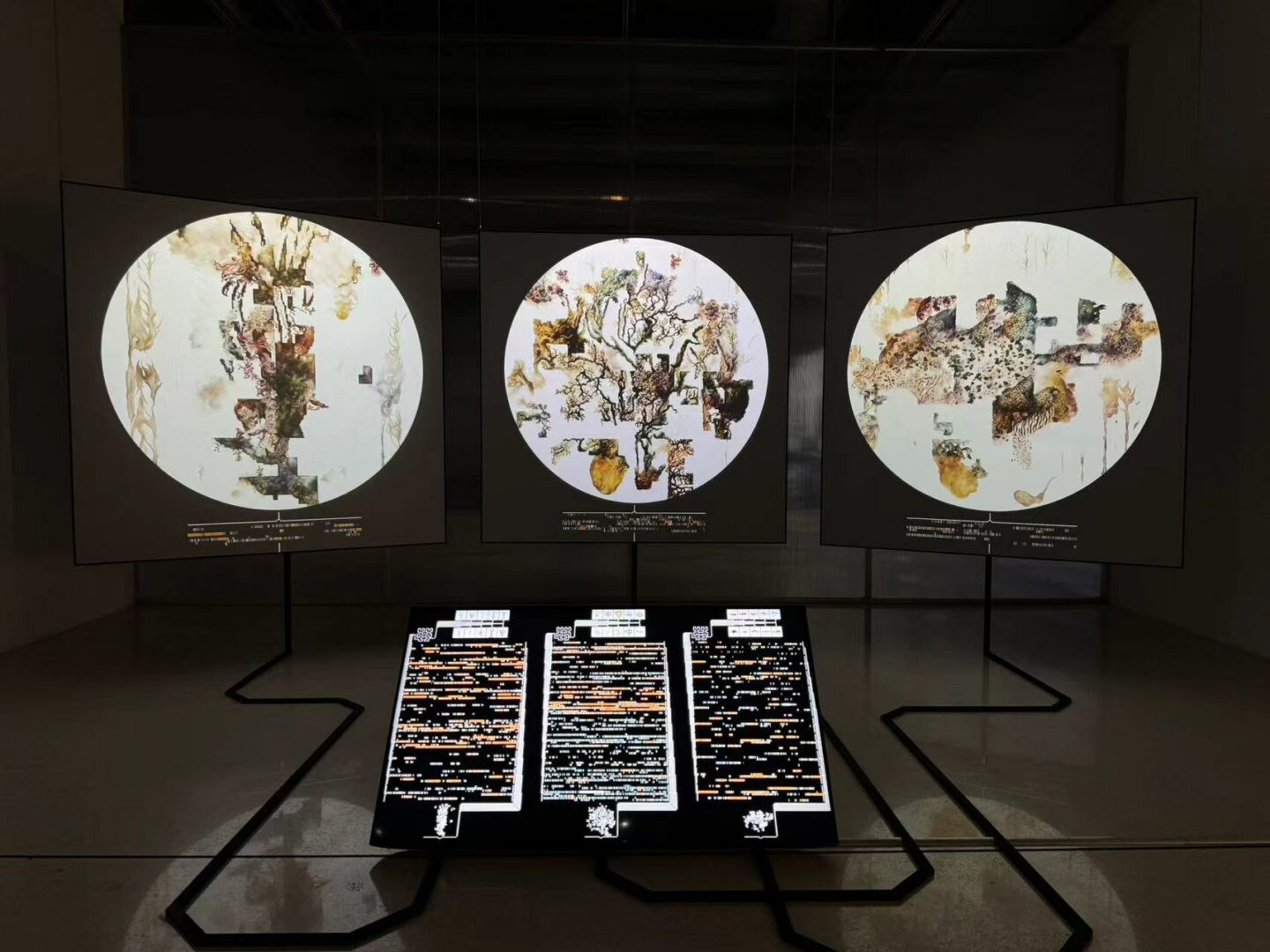
A further step toward an ecological and collective vision is represented by the work of the collective Entangled Others, the duo composed of Feileacan Kirkbride McCormick and Sofia Crespo, who explore the connections between the more-than-human world and generative technologies through artistic practices rooted in AI, evolutionary processes, and bio-inspired simulations. These immersive installations function as prototypes of speculative ecologies: dynamic systems in which sensors, materials, data, algorithms, and viewers are interconnected in ways that reveal the often-invisible relationships between biological and digital entities.
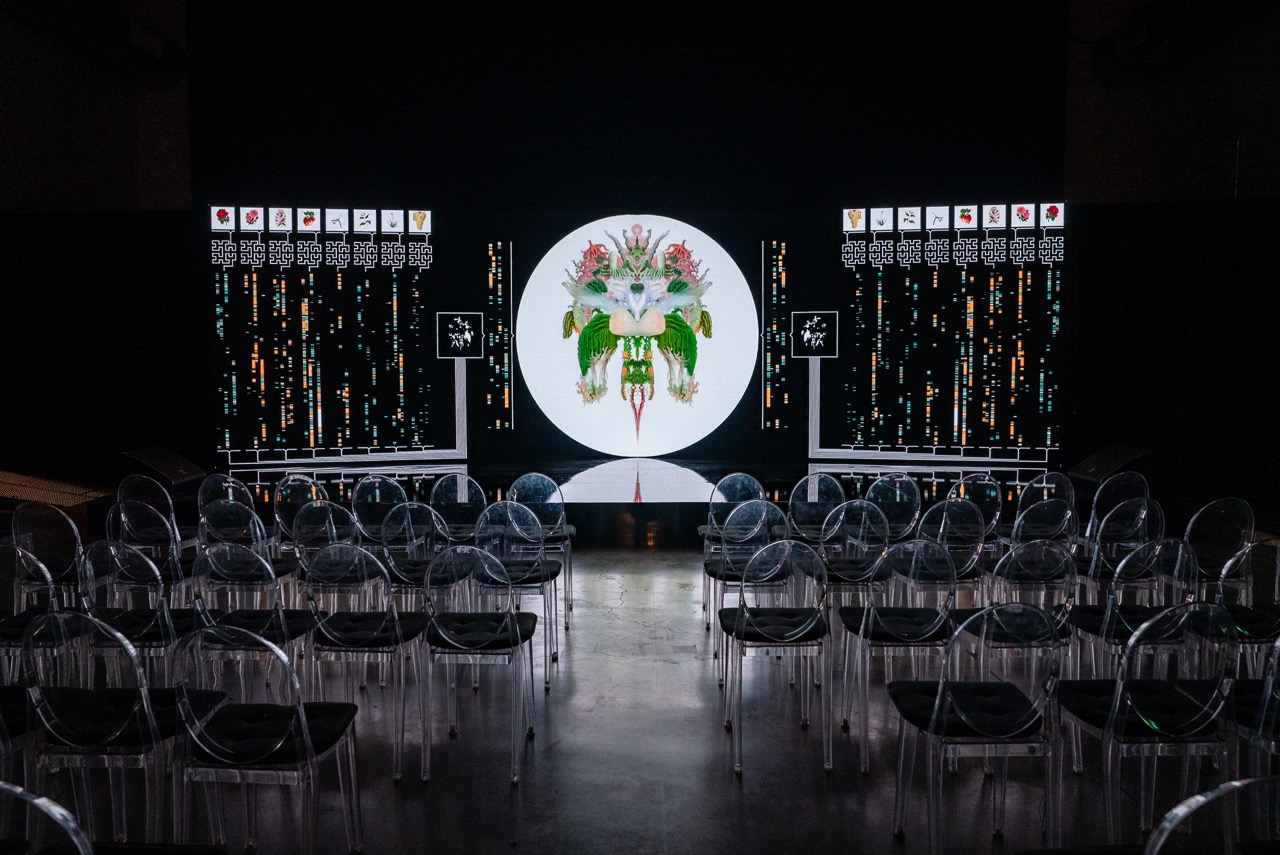
The artwork is always an open system incorporating environmental variables, sensory feedback, and visitor interaction to produce phenomena that evolve over time. One example is Sediment Nodes, a project that explores the complex connections between apparently inert matter and the forms of life that nest within the sediments of bodies of water. The work draws inspiration from the observation of turbid waters—where sediment particles, microorganisms, algae, and micro-forms of life intermingle—to reveal a fabric of relationships often ignored by everyday perception. Here sedimentation is not simple accumulation, but a dynamic network of physical, biological, and optical connections, which becomes a metaphor for how even the smallest ecosystems are at once radically interconnected.
Another series, Self-Contained, moves along more abstract lines, investigating processes of encoding and decoding as formal models of mutation and shared evolution. Here the work is built on digital images that “graft” into one another through processes of compression, decompression, cross-breeding, and simulations of “error correction,” evoking analogies with the biological evolution of genomes and with the mutations that occur in living systems.
In the version self-contained 009.x, this dynamic is pushed even further: the final digital sequence is synthesized as physical DNA and preserved in a custom sculptural container. It is a kind of full circle between digital media and simulated biological life: the evolutionary digital image finds a form of expression in a real biological medium. This act—of re-encoding the digital into the biological—challenges any clear boundary between nature and technology and pushes generative art toward a true applied ecology, in which code/information and life intertwine as co-dependent systems.
In all these examples, code ceases to be a neutral tool and becomes relational infrastructure: a medium that binds human and non-human, matter and information, nature and technology. The visual system is not a simple generative algorithm, but an operational environment in which visual, behavioral, and sensory phenomena occur, dependent on multiple levels of interaction. The post-human “monster” here is not a single creature, but a community of interacting processes—a multi-species system in which the idea of the individual as a fundamental unit gives way to networks of coexistence and mutual dependence.
These works show that networks of entanglement are not merely theoretical rhetoric, but tangible artistic practices: visual and behavioral configurations that connect data, organisms, spectators, and environment, producing speculative ecologies that challenge traditional hierarchies between human and non-human and invite us to think new forms of coexistence, care, and shared responsibility.
Through these practices, generative art does not merely imagine alternative futures, but experiments with them in the present. By training artificial intelligences on biocentric data, simulating evolutionary processes or morphologies inspired by marine life, artists construct scenarios in which the human is no longer the center of the symbolic universe. The post-human that emerges is not an overcoming of the human, but its radical decentralization.
In this sense, the monster becomes an allied figure. Far from being a threat, it represents the possibility of thinking otherwise: of imagining forms of empathy that are not based on similarity, but on coexistence; models of intelligence that do not privilege transparency, but opacity; relationships that do not aim at control, but at reciprocal care.
In the face of the ecological, technological, and political crises of the present, these works are speculative practices. Far from offering concrete solutions, they invite us to live with uncertainty, to accept the loss of centrality, and to recognize the transformative value of hybridization. Generative art, when it creates post-human monsters, does not produce dystopias or utopias, but spaces of ontological exercise: places where the future is put to the test.
Laura Cocciolillo