


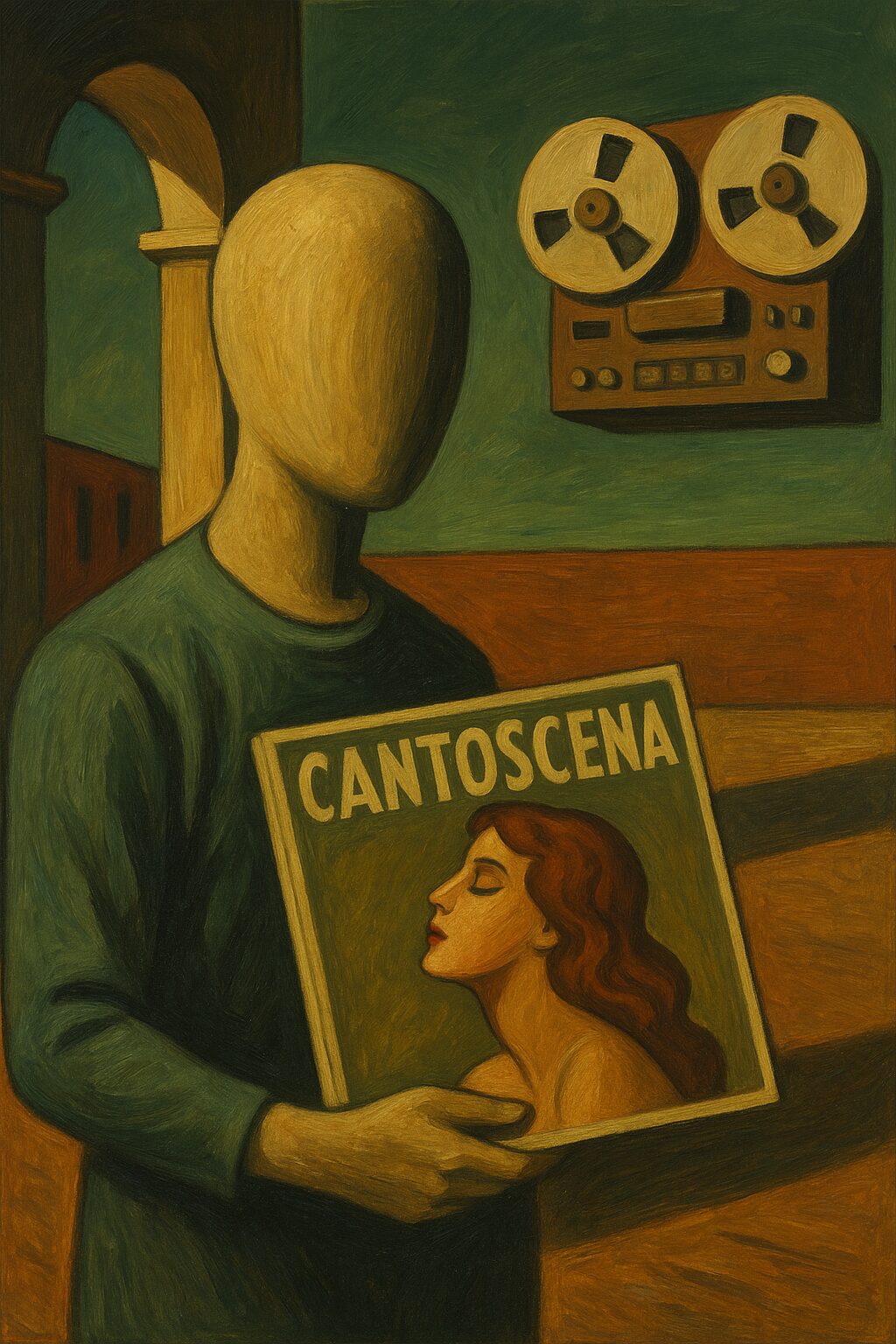
‘Two hours ago it was just a prompt, now it’s already in the charts.’ Is this the future of music? Yes, and you don’t even need to look too far ahead to realise it: it’s already happening today, with disarming ease. The real surprise, however, is when a prompt doesn’t just generate new songs, but goes so far as to invent a past that never existed.
This is what happens with Cantoscena, a curious musical project launched a few months ago (the Instagram page has been active since July 2025) and presented as the lucky discovery of an entire catalogue of erotic songs, recorded between 1937 and 1989. A corpus as rich as it is daring, which, according to the narrative, was hidden by the “powers that be” because of its immoral nature. Too bad it’s all fake. A historical forgery worthy of Manzoni, two hundred years later and with AI instead of inkwell. All the tracks are skilfully generated by software. In just a few days, the first single went viral on TikTok, Instagram and Spotify, garnering millions of views and plays, thanks to the fact that many believed it to be an authentic discovery. The taste for retro is undoubtedly an unmistakable feature of our time, as Simon Reynolds showed in Retromania: the present lives in constant dependence on the past, recycling and consuming it to the bone. Added to this is the fascination with lost media (which I discussed here): a mix that has made the fortune of true and skilled disseminators, such as the expert Giuseppe Savoni, aka DiscoBambino, and labels such as Disco Segreta. From their niche, they have brought songs from the past that were on the verge of oblivion back to the general public.
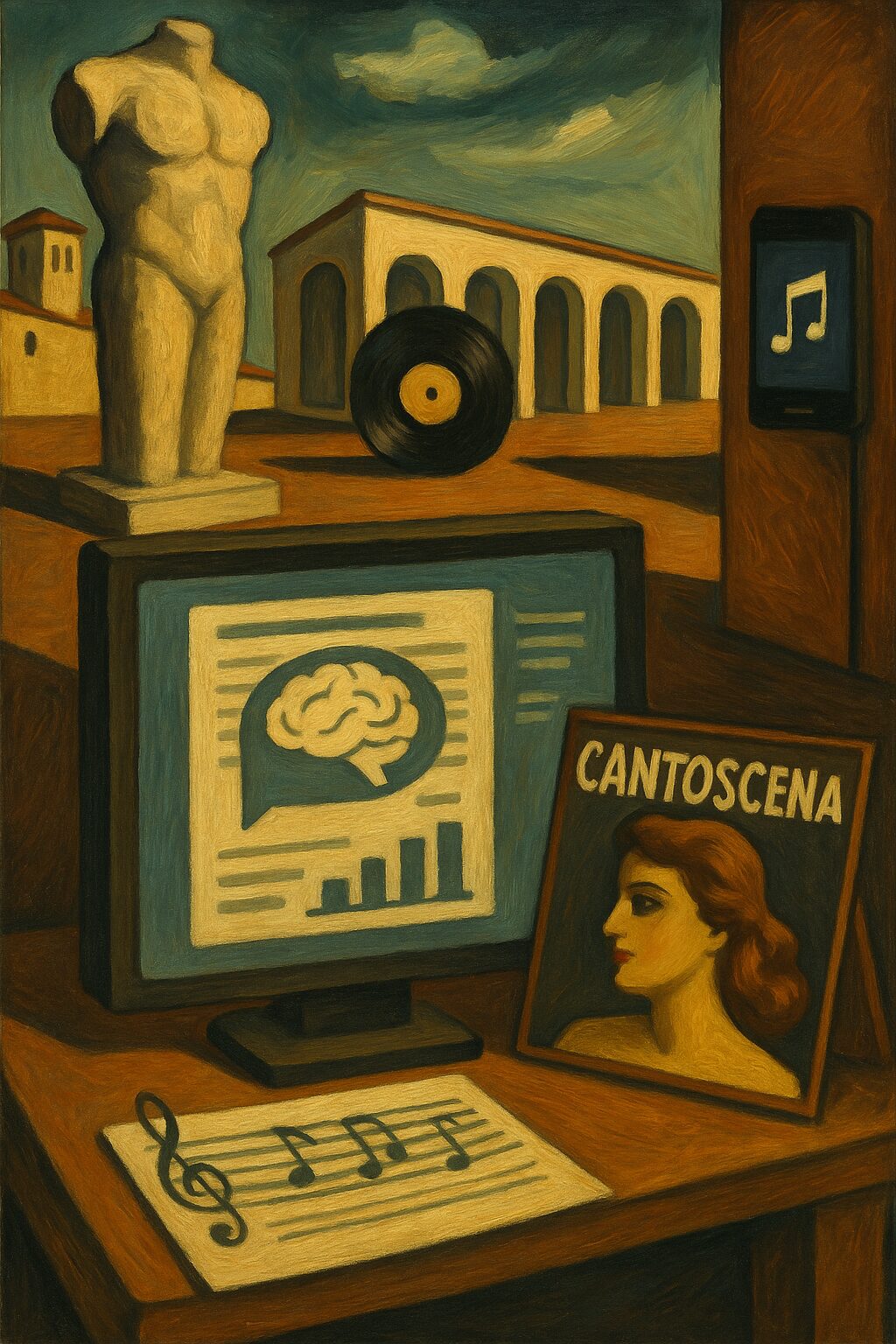
But Cantoscena is another matter entirely: here it is not just a question of nostalgia or recovery, but of a retromania reinvented and made plausible thanks to AI, which exploits the power of humorous memes to conquer editorial playlists and social feeds.
Cantoscena shows us a future of generative AI in music that is more multifaceted and unpredictable than we could have imagined. It is not just a production tool, but also a tool for cultural invention, for rewriting memory and for humorous play, to which is added the ease with which an imaginary world can be constructed: fake vintage photos, fake retro covers. The question is no longer whether artificial intelligence will change music, but in how many different ways it will do so. Perhaps it is up to us to decide whether to remain spectators of this invented past, or whether it is more convenient to become authors of the next one.
Pierluigi Fantozzi, born in 1995, is a musician. He graduated from the National Jazz Academy in Siena and obtained his master’s degree at the Conservatory of Bologna. A clarinetist, he has played in jazz bands but has also cultivated an interest in electronic music, collaborating with Tempo Reale. In 2023, he joined the Controradio team, for which he has conducted interviews with important figures on the international music scene. As a radio presenter, he hosts his own programme, Passabanda.