


Over the past two decades, the discourse on the Anthropocene—and the consequent need to rethink the position of the human in relation to the living world—has found in the field of contemporary art a privileged laboratory for aesthetic, political, and sensory experimentation. At the center of this transformation lies the emergence of artistic practices oriented toward the construction of forms of trans-species empathy, that is, modes of perception and relation capable of surpassing the ontological hierarchy that separates the human species from nonhuman animals. Within the context of new media in particular, technology becomes a device of care and a vector of imagination: no longer a tool of distancing or control, but an interface for sensitive coexistence and for a profound revision of the anthropocentric paradigm.
The growing attention to nonhuman life is not an isolated phenomenon: it resonates with the posthumanist reflections of Donna Haraway, Rosi Braidotti, and Vinciane Despret, for whom subjectivity is always the result of a multispecies relational network, as well as with ecofeminist theories that deconstruct rhetorics of domination over nature. It is at this crossroads of theory, activism, and aesthetics that the research of numerous artists is situated—artists who, through performances, videos, sensory installations, and sound works, investigate the perceptual and cultural premises of the separation between human and nonhuman, proposing new forms of alliance.Marshmallow Laser Feast represents one of the most significant cases of this shift.
Their immersive VR works do not merely recreate spectacular natural environments; they aim instead to generate an experience of sensory transposition, inviting the viewer to perceive the world through perceptual apparatuses radically different from those of humans. In works such as In the Eyes of the Animal, visual subjectivity fragments and recomposes itself within the sensory systems of dragonflies, bats, and deer, translating into visual forms their modes of echolocation, their perception of movement, or their sensitivity to heat gradients. Here, VR functions as an epistemic prosthesis—a device that makes visible, albeit always through human mediation, the dimension of animal alterity, removing it from stereotypical naturalistic narratives. The technological dimension is not celebrated as digital virtuosity but placed at the service of an ecological imaginary founded on reciprocity: no longer observing the animal from the outside, but temporarily entering its sensory environment.
Such a perspective stands in tension with the traditional idea of empathy understood as projective identification. The trans-species empathy that emerges from these works does not imply “feeling like the other,” but rather recognizing the irreducible distance between forms of life. Technology thus becomes the medium of an ethical encounter, not of appropriation: what is offered to the observer is a partial, provisional access that preserves the difference and complexity of the nonhuman. From this point of view, the projects of Marshmallow Laser Feast reveal how new media can activate processes of care—where care, following Maria Puig de la Bellacasa, is understood as an affective and responsive disposition toward what is vulnerable.
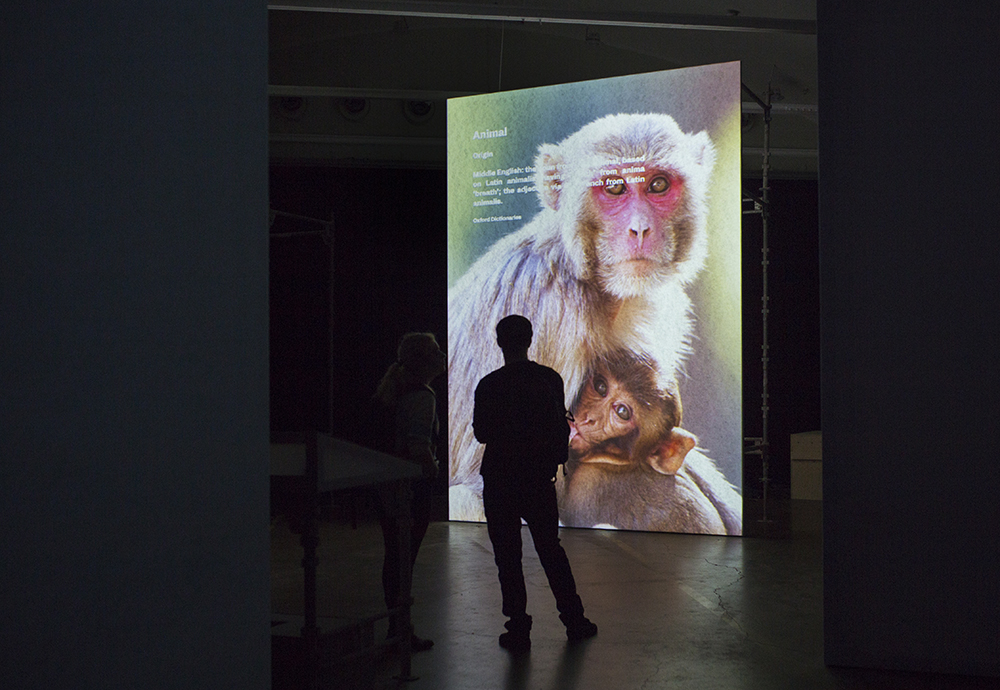
A parallel but more explicitly political trajectory is inaugurated by Terike Haapoja, often in collaboration with writer Laura Gustafsson. In works such as The Trial and The Museum of Nonhumanity, the artist constructs imaginary institutions—courts, museums, archives—that stage the failure of our legal and moral categories in relation to animals. Here, institutional imagination becomes a critical method: the aim is not to replace existing organisms, but to expose the symbolic architecture that underpins the distinction between lives that are worthy and lives that are disposable. While The Trial imagines a legal process in which animals are recognized as subjects of rights, The Museum of Nonhumanity parallels the history of dehumanization within the human species with the systematic “non-humanization” of animals. The operation is twofold: on the one hand, it demystifies the presumed universalism of humanism; on the other, it proposes a form of interspecies citizenship, an expanded political community that transcends the logic of possession, use, and separation.
The theoretical depth of Haapoja’s works does not exclude a strong sensory component. Her installations include videos, sounds, texts, and scenographic devices that involve the visitor’s body in a spatial and temporal experience of normative suspension. The visit to the imaginary museum does not produce simple information; it demands a rethinking of one’s place in the world. In this sense, the artist does not use digital media to simulate nonhuman life, but to show the social construction that makes its exclusion possible. Technology, once again, acts as a space of political negotiation.

If the immersive practices of Marshmallow Laser Feast operate on the redefinition of perception and if Haapoja’s fictive institutions aim to restructure political imaginaries, the work of Haroon Mirza occupies a further dimension, in which interspecies relations emerge through sound and vibration. Mirza explores the capacity of frequencies to influence human and nonhuman biological systems, suggesting a possible form of multispecies communication that precedes language. His installations are vibrating environments, technological ecosystems in which electrical materials, living organisms, light signals, and sound patterns coexist within a network of mutual interferences. The work is never a static object, but an energetic field that evolves in the presence of the audience and in the reaction of the nonhuman elements that compose it.
From this perspective, the notion of empathy is radically decentered: no longer a cognitive or emotional operation, but a shared rhythm, a vibrational experience that connects different entities through the oscillation of their systems. Mirza does not represent the animal, nor does he attempt to translate its experience; rather, he composes an environment in which humans and nonhumans are involved in a reciprocal “feeling-through,” a corporeal listening that escapes the anthropocentric categories of the aesthetic. His research, hybridizing sound art, physics, ecology, and cybernetics, illustrates how care can manifest as sensory co-presence, as responsiveness to the signals of the living.

These three trajectories—immersive, institutional, and “vibrational”—outline a complex landscape in which contemporary art and new media actively participate in redefining relations between species. Unlike traditional environmentalist narratives, which often rely on sentimentalizing or moralistic rhetoric, these practices propose a complex form of empathy that acknowledges difference and mediation. They do not aspire to represent the animal, but to destabilize the position from which we observe it; they do not intend to replace science, but to expand the epistemic regime through which we perceive the living.
Finally, it is important to emphasize that the “care” evoked by these practices is not an abstraction. It is a political, aesthetic, and affective gesture that invites a reconsideration of the very boundaries of community: who is included? who is listened to? who is rendered invisible? Through VR, the construction of speculative institutions, or sonic experimentation, these artists suggest that multispecies coexistence requires continuous imaginative labor, attention to conditions of vulnerability, and openness to non-dominant forms of communication. Care thus becomes a relational practice, a social technology that art can help to develop.
In conclusion, the aesthetics of new media, far from being a purely technological territory, reveals itself as fertile ground for the elaboration of new ethical and sensory paradigms. The works of Marshmallow Laser Feast, Terike Haapoja, and Haroon Mirza demonstrate how the relationship between humans and nonhuman animals can be rethought not only on a conceptual level, but through embodied experiences, symbolic spaces, and vibrational fields. They open up the possibility of an interspecies imagination in which art does not simply represent nature, but contributes to inventing radically new forms of coexistence.
Is an art historian specialising in art and new technologies and new media aesthetics. Since 2019 she has been collaborating with Artribune (for which she is currently in charge of new media content). In 2020 she founded Chiasmo Magazine, an independent and self-funded Contemporary Art magazine. From 2023 he is web editor for Sky Arte, and from the same year he takes care, for art-frame, of the column ‘New Media’, dedicated to digital art.