




A critical and philosophical look at artificial intelligence and its influence on society, culture and art. La Rivoluzione Algoritmica aims to explore the role of AI as a tool or co-creator, questioning its limits and potential in the transformation of cognitive and expressive processes.
Large language models like ChatGPT have entered the daily lives of millions of people. Every request they process passes through data centers packed with power-hungry GPUs, raising legitimate concerns about their climate impact. As a result, its not uncommon for people to criticize those working with AI by pointing to its environmental footprint. That footprint certainly exists but its also fair to ask whether critics avoid higher-impact actions themselves, or whether theres a double standard when it comes to artificial intelligence.
To place AIs ecological impact in a global context, we need a comparative analysis with everyday activities whose weight we often forget to avoid deluding ourselves that skipping a few prompts to ChatGPT will somehow fix the climate crisis.
All figures in the table below are operational estimates (usage phase only no hardware production included, for either AI or other tools) and should be read as orders of magnitude. The goal is to encourage verification and the search for ever more accurate data which, unfortunately, AI companies often obscure (a bad sign). Training is excluded here, since its considerable energy cost gets diluted across hundreds of millions of users and becomes negligible compared to everyday usage. Training GPT-4o, for example, consumed tens of GWh as much energy as an entire neighborhood uses in a year. But after just a few billion queries which ChatGPT processes in a matter of months training energy falls below 1% of the total. For the most popular models, the real impact lies in daily use, not training. Conversely, one-shot research projects or niche proprietary models may have a much higher training-to-usage ratio.
|
Activity (operational) |
kWh / unit |
g CO? / unit* |
Prompt equivalents** |
|
GPT-4o prompt |
0.0003*** |
0.073 |
1 |
|
AI image (SD-XL) |
0.0029 |
0.70 |
10 |
|
HD video streaming (1 h) |
0.077 – 0.15 |
18.6 |
257 |
|
PS5 gaming (1 h) |
0.20 |
48.4 |
667 |
|
ECO dishwasher (1 cycle) |
1.10 |
266.2 |
3,667 |
|
Electric oven (30 min) |
1.50 |
363 |
5,000 |
|
Electric shower (10 min, 10 kW) |
1.67 |
404 |
5,567 |
|
Dryer resistance (1 cycle) |
2.70 |
653 |
9,000 |
|
Gasoline car (10 km) |
|
2,390 |
32,900 |
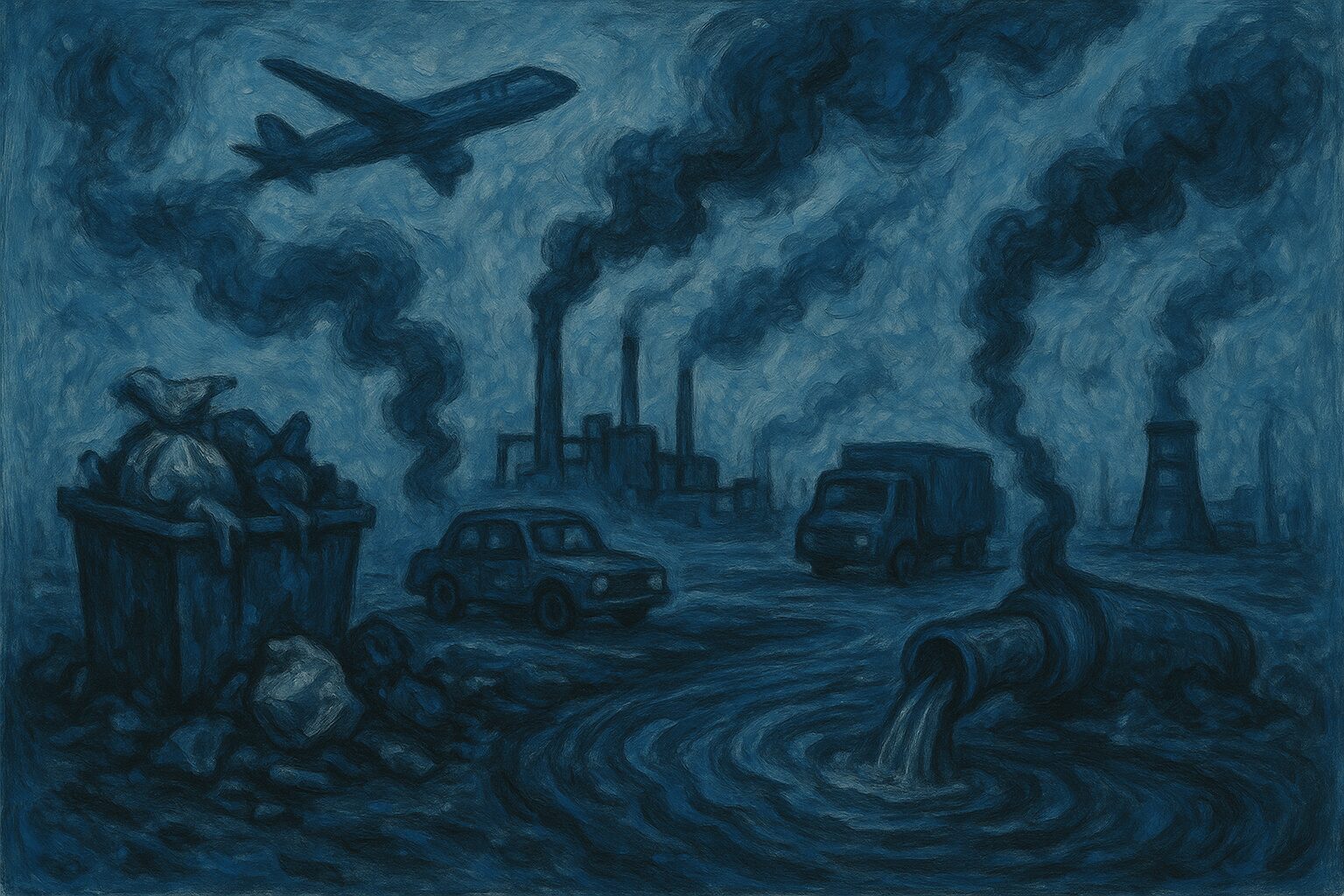
Comparing these operational figures using the EUs 2023 electricity mix (242 g CO?/kWh), we see that a GPT-4o prompt emits about 0.07 g CO? (based on an average prompt ? 500 tokens) a negligible amount compared to the 18 g from one hour of HD streaming or the 48 g from one hour of console gaming. Even a single image generated with Stable Diffusion XL while ten times more expensive than a prompt stays within the one-gram range. Just 30 minutes of using an electric oven surpasses 5 grams, while a full dryer cycle approaches 700 grams the equivalent of ten thousand prompts. The gap is even wider with fossil-fuel transport: driving 10 km in a gasoline car produces 2,390 grams of CO? equal to over 30,000 ChatGPT interactions.

Of course, electricity doesnt always equate to CO?: if a data center runs entirely on renewables, the impact of a prompt drops to nearly zero, whereas reliance on fossil fuels can dramatically raise it. The numbers also show how quickly AI is becoming more efficient: in just two years, energy consumption per prompt has dropped by an order of magnitude thanks to better chips, model quantization, and batching.
The message I want to convey isnt to absolve AIs ecological impact which remains a systemic issue, as this excellent MIT article notes but to contextualize its role within broader priorities. If we truly want to reduce our climate footprint, its infinitely more effective to skip a dryer cycle, shorten a shower, or give up cars and meat than to stop asking questions to a chatbot. If a non-vegan person thinks theyre helping the climate by avoiding AI, for example, theyre clearly a bit confused.
AIs climate impact is still real due to opaque data from companies, the potential for massive future use, and water consumption (which I havent addressed here, though that too should be compared to other activities, like a simple toilet flush). But blaming individual users who may need cars or AI for work is always ethically wrong, as it shifts attention away from those most responsible for the climate crisis: multinational corporations, governments, and the socioeconomic systems in which they operate. These should be the true focus of climate justice.

Complete Sources
AI energy use
Other digital activities
3. Kamiya (IEA) in Carbon Brief, Fact-check: carbon footprint of Netflix central estimate: 0.077 kWh/h for HD streaming
4. Sony Interactive Entertainment, EU Ecodesign Statement PS5 active gaming ? 200 W
Home appliances
5. Tewes et al., Use of Automatic Dishwashers
(ECO avg energy ? 1.1 kWh/cycle) MDPI
6. Hot topic: how many watts do electric ovens use?, A1 SolarStore Magazine avg 3 kW/h for home ovens
7. BasenGreen blog, How much energy does a 10 kW shower use? 1.67 kWh for 10 minutes
8. EU Commission, Product List Tumble Dryers: vented/condenser ? 2.7 kWh/cycle
Electricity and emissions factor
9. Ember, European Electricity Review 2024 avg EU 2023 = 242 g CO?/kWh
Transport
10. ICCT, Global LCA of passenger cars avg gasoline ICEV: 239 g CO?/km (real-world, EU lower-medium segment)
Francesco DIsa, trained as a philosopher and digital artist, has exhibited his works internationally in galleries and contemporary art centers. He debuted with the graphic novel I. (Nottetempo, 2011) and has since published essays and novels with renowned publishers such as Hoepli, effequ, Tunué, and Newton Compton. His notable works include the novel La Stanza di Therese (Tunué, 2017) and the philosophical essay Lassurda evidenza (Edizioni Tlon, 2022). Most recently, he released the graphic novel Sunyata with Eris Edizioni in 2023. Francesco serves as the editorial director for the cultural magazine LIndiscreto and contributes writings and illustrations to various magazines, both in Italy and abroad. He teaches Philosophy at the Lorenzo de Medici Institute (Florence) and Illustration and Contemporary Plastic Techniques at LABA (Brescia).?

















© COPYRIGHT THE BUNKER 2025. ALL RIGHTS RESERVED.
THE BUNKER MAGAZINE is a registered publisher at the Florence Court Register of Press, n.6214 / 03.03.2025