


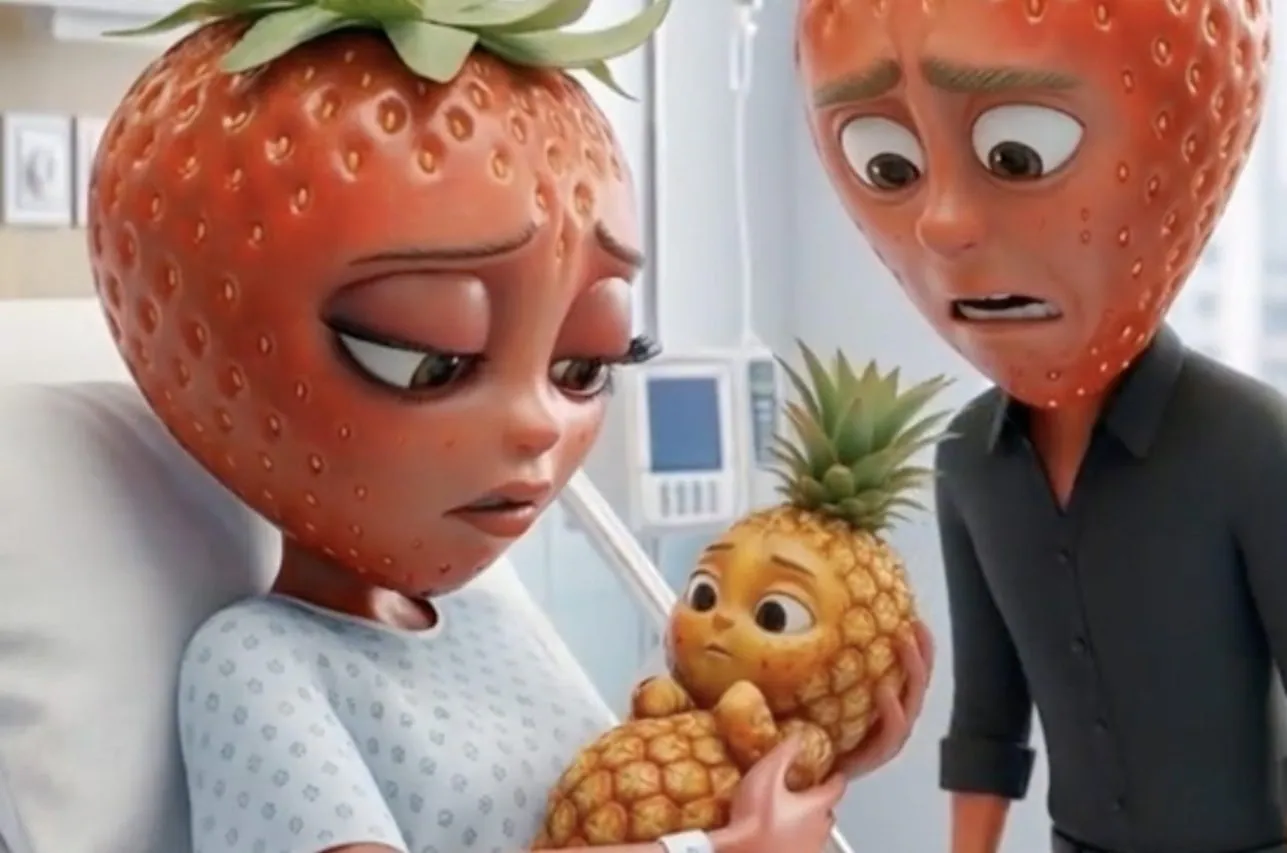
If, between one apathetic scroll and the next, you happened to come across an apricot in despair after just discovering her husband’s betrayal—a muscular pineapple—with a provocative strawberry, don’t call a neurologist. You’ve simply fallen into the tunnel of “fruit drama,” the latest surreal stronghold of what digital sociologists now bluntly define as brain rot. These are short soap operas generated entirely by artificial intelligence, in which anthropomorphic fruits perform scripts worthy of the worst B-grade television productions. And yet, behind the digital tears of a blueberry lies a layered set of meanings that deserves to be unpacked, because it reveals far more about our era than we might like to admit.
Technically, this content represents the peak of AI slop—that generative waste material that floods our feeds to capture the remaining attention of users now hypnotized by algorithms that reward quantity over quality. Many of these videos are the offspring of ultra-advanced generative models like Sora. But just in these very days, with timing that borders on tragic irony, came the news of the shutdown of the platform owned by OpenAI, which reportedly decided to redirect its resources toward more profitable tools such as coding and enterprise services, due to the unsustainable energy costs required to keep the toy alive.
This brain rot aesthetic, however, is not harmless: it acts like a solvent that dissolves the complexity of reality into a consequence-free sludge of pixels. Gender violence, racism, or betrayal suddenly become acceptable—even amusing—because the victim is a CGI strawberry with big, watery eyes. And yet, this phenomenon hides another side of the coin—one that should most unsettle the high priests of Silicon Valley and their dreams of glory. While figures like Jeff Bezos or Elon Musk invest billions to automate manufacturing labor and boost productivity through AI, the mass of users employs these tools for the exact opposite: non-remunerative nonsense.
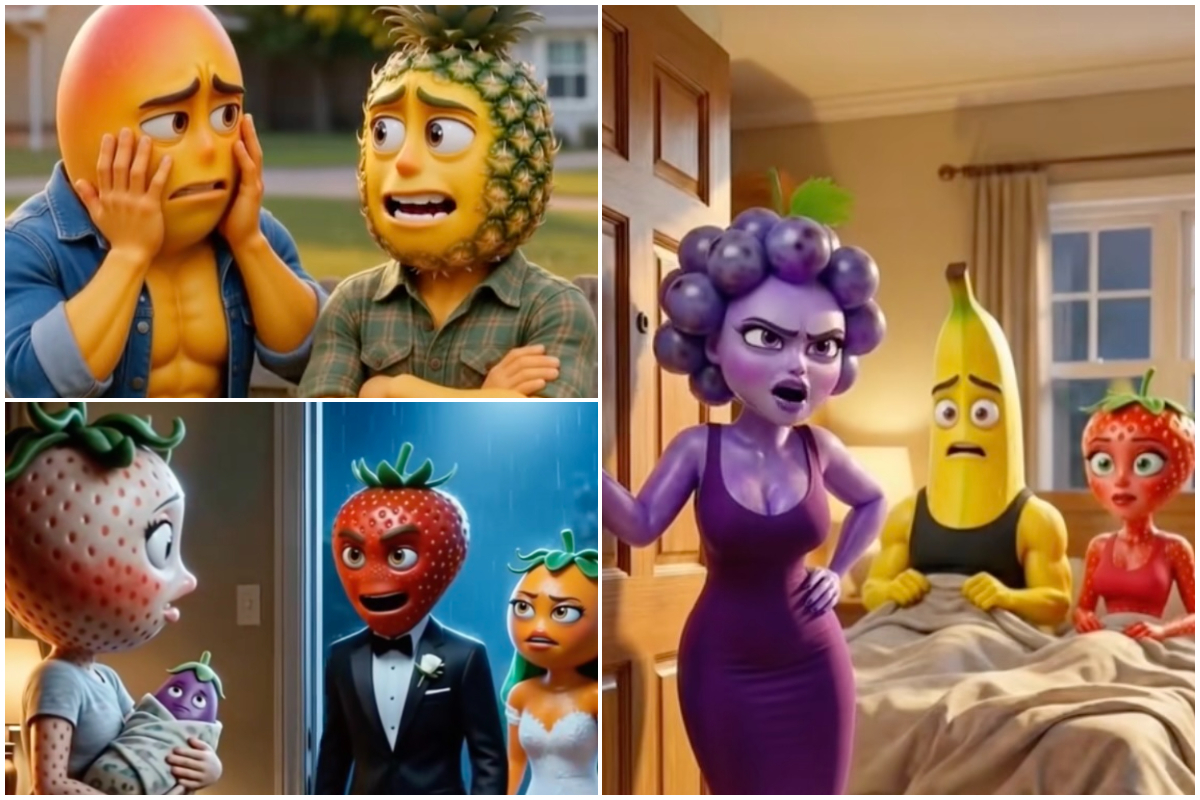
Capital pushes artificial intelligence toward value extraction, bureaucratic efficiency, and the replacement of human labor with obedient, tireless algorithms. The response of younger generations, consciously or not, is a form of playful, chaotic resistance. Creating or consuming a fruit drama does not help you build a career, generate revenue, optimize any business process, or enhance a résumé. It is an act of pure escapism in a world that wants us constantly connected, ready to perform and generate useful data to feed the machine. Perhaps the young user who spends hours watching an apple get divorced is not merely a victim of infantilizing regression, but is instead enacting an unconscious act of sabotage. They are using a trillion-dollar technology to produce something utterly devoid of market value—a digital waste product that cannot be easily converted into direct profit.
One cannot ignore the deep dissatisfaction that emanates from these grotesque animations. In an increasingly oppressive economic system—where precarity has become the only certainty and the future appears as an automated desert—the turn to the absurd becomes the only freely accessible outlet. Fruit drama tells us that users, especially younger ones, are tired of an AI that wants to be their personal assistant, their tutor, or their replacement in the workplace. They prefer it as a digital jester, a creator of acidic, distorted dreams that mirror the fragmentation of their own social reality. We are witnessing a silent revolt against capitalist realism: if reality is controlled from above and every interaction must be monetized, the only remaining escape is to retreat into irrationality.
In this sense, fruit drama, rather than proving the dangerous lowering of our attention span, demonstrates that—despite the system’s efforts to turn us into perfect cogs in a global productive machine—our desire not to take ourselves too seriously and to laugh at our fears remains the last stronghold of humanity.
In a world racing toward automation and total flattening, laughing at a desperate lemon might be the only thing that still distinguishes us, human beings, from a machine.
Alessandro Mancini