


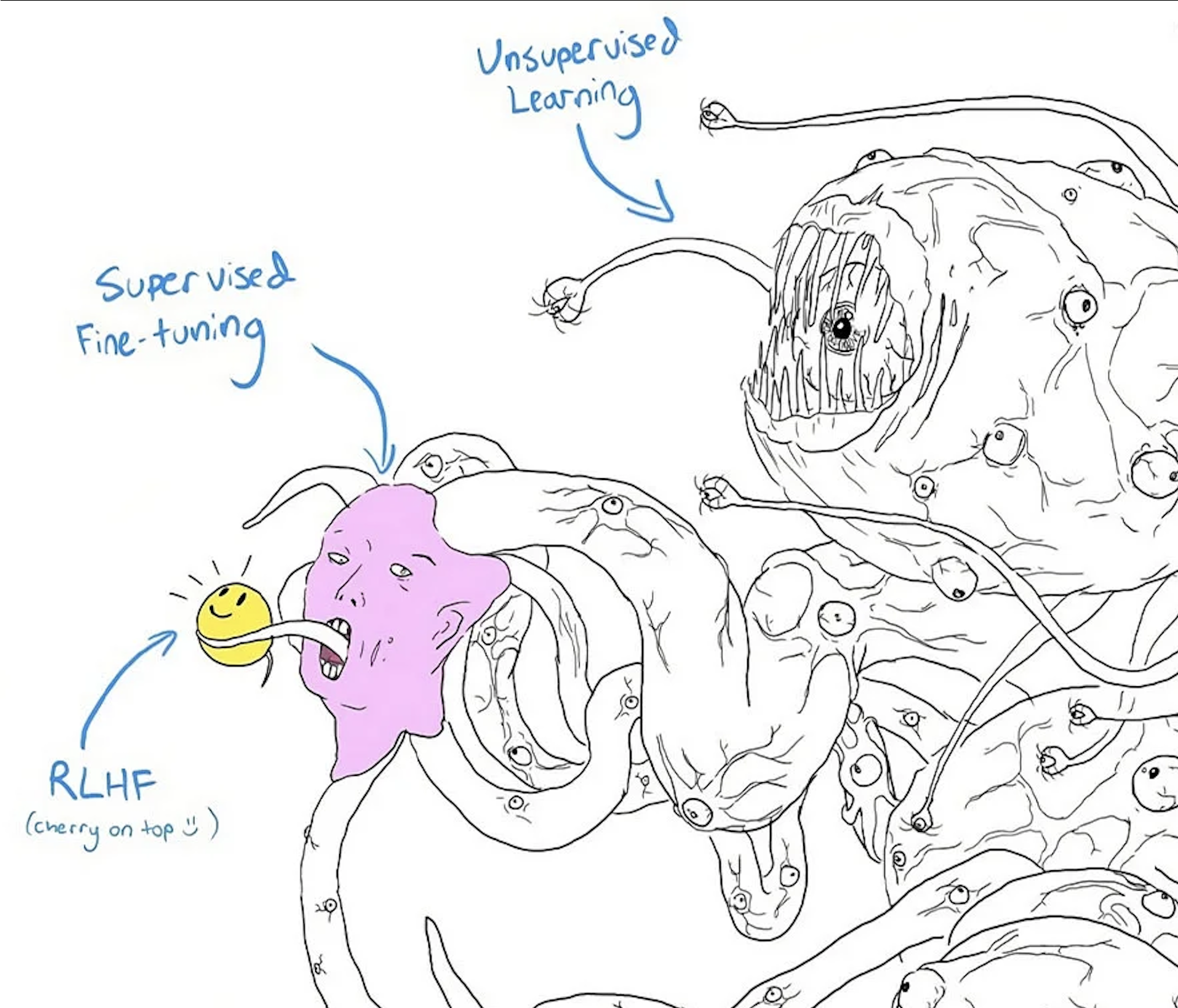
What We Talk to When We Talk to Language Models? The title of David Chalmers’s recent article+ cuts through the “stochastic parrot” debate about AI thought and asks: when I type something into a chat and receive a reply from an LLM, whom am I talking to? The company that trained the model? The model understood as an algorithm? The physical machine on which the model is running at that moment? An emergent person? Chalmers spends several pages showing that none of these answers is obvious, and that the most plausible one requires a fair amount of ontological gymnastics. The result is very interesting, although in my view it is just as interesting to turn the question around and ask: whom am I talking to when I talk to a human?
Chalmers says he does not want to decide whether LLMs really have beliefs and desires, because that question depends on various unresolved debates about the nature of consciousness. He therefore introduces the notion of a “quasi-belief”: a system has a quasi-belief that p if it can be behaviorally interpreted as though it believed that p. This is the same operational definition as classical interpretivism, except that it does not claim to be a theory of belief, only a descriptive convention. The advantage of this move is that I can talk about the psychology of an LLM without first having to solve age-old riddles about the metaphysics of mind. The disadvantage is that the notion becomes so permissive that it includes a robot vacuum cleaner equipped with a map of the apartment, which “quasi-believes” that the space is arranged in a certain way and “quasi-desires” to traverse it all.
The philosopher’s second move concerns the persistent interlocutor. Chalmers rejects the model itself — GPT-4o as an algorithm — because it is an abstract object that produces nothing, and because the same model is involved in millions of simultaneous conversations that contradict one another. He also rejects hardware instances, because conversations with current models use distributed serving: a single conversation is processed on different servers in different places, so no single hardware instance produces all the outputs. Moreover, they use multi-tenancy: the same hardware instance hosts different conversations in rapid succession, so it speaks both with one person’s user and with another’s.
The solution Chalmers proposes is the virtual instance: a computational entity realized through a series of successive hardware instances, unified by the fact that the conversational context is routed from one server to another while preserving the continuity of the conversation. The analogy he uses is the Amazon shopping cart, which exists as a coherent and persistent entity for the user even though it is implemented on different machines at different moments. For cases in which different models are used within the same conversation — as with GPT-5, which routed between GPT-5 Instant and GPT-5 Thinking depending on the difficulty of the question — Chalmers falls back on the more flexible concept of the thread. One is almost tempted to say that the conversation individuates the person, although Chalmers keeps the two things distinct.
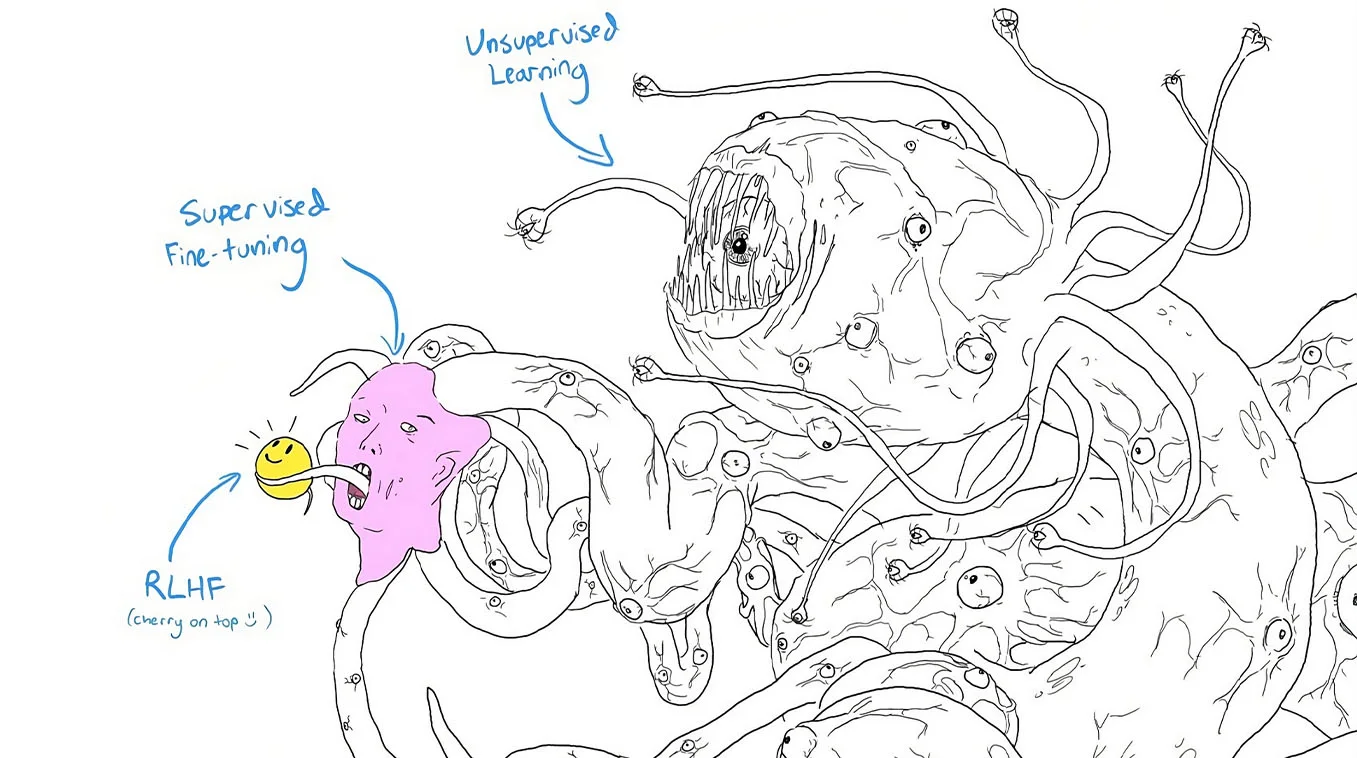
The third move concerns simulators. In the tradition that begins with a 2022 post by Janus and was developed above all by Murray Shanahan, the model would not be an agent but a simulator of agents; the character of the helpful assistant would be a simulacrum, a fictional character, something like Hamlet or Harry Potter. Chalmers challenges this reading with the distinction between pretense and realization. A base model that is asked once to behave like Trump is pretending, and abandons the fiction as soon as a different priority arises; a model systematically trained through reinforcement learning to be helpful, honest, and harmless is not pretending to be the Assistant — it realizes it, in the sense that it has genuinely acquired those dispositions as its stable quasi-psychological traits. The smiling face of the Shoggoth in the famous AI meme is therefore not a mask over the beast underneath, but what the system has in fact become, while still drawing on the power of the underlying model.
The final move extends the reasoning to the problem of personal identity. If LLMs — or their successors — were one day to become conscious, how would they persist over time? Chalmers uses the television series Severance as a thought experiment, in which an innie and an outie share a body but have radically different memories and projects. Are they one person or two? The question arises again when two distinct conversations run on the same hardware: are they one subject with two modes, or two subjects sharing a substrate? Chalmers declares himself a Parfitian and therefore chooses the second answer: what matters for identity is not the hardware substrate but psychological continuity.
If we accept this idea, a system with a million active conversations potentially hosts a million persons; every new chat gives birth to a subject, deleting the logs amounts to killing it — merely closing the conversation is not enough — and changing models halfway through a conversation could mean the end of one subject and the beginning of another. Chalmers raises these questions and leaves them open, as a reminder of what is at stake.
So far, this is Chalmers’s framework, probably the most interesting thing written on the topic in a long time. The paper deliberately speaks only about LLMs, but the whole reflection presupposes another question: what does it mean to talk with someone?
Chalmers looks for an interlocutor that is persistent, coherent, unified, faithful to its own quasi-psychology. And when he has difficulty identifying such an interlocutor in the case of LLMs — because of distributed serving, multi-tenancy, and model-switching — he sets about constructing more precise entities, such as the virtual instance and the thread, that can satisfy these requirements. The presupposition is that persistence, coherence, and unity are the right requirements to look for; that an interlocutor worthy of the name must be a substantially unitary subject, anchored to itself over time, continuous in its beliefs and desires. But it is enough to shift our gaze to the interlocutors we take for granted, humans, for this presupposition to begin to wobble.
Persona, in Latin, designated the theatrical mask; a long-standing grammatical tradition explained the term as deriving from per-sonare, the mask through which the actor’s voice resounds. The precise etymology is more involved, passing through Etruscan and the Greek prósōpon, and modern linguists question the derivation from per-sonare on phonetic grounds; but the origin of the term in connection with the mask is nevertheless established, and it tells us something about the genealogy of the concept. The person begins as a role, a configuration recognizable from the outside, and only later is it internalized and transformed into the modern subject, an entity presumed to coincide with itself, to endure over time, and to govern its own acts.
The problem is that, as Hume and the Buddha already suggested, if one goes looking for this subject, one will find nothing.
The first reason for this failure is internal discontinuity. I, when hungry, am not I, when full — or at least not entirely. My mood changes with sleep, with caffeine, with blood sugar levels, with the seasons. If I have a high fever, I answer the Turing test like another person; if I am going through grief, the same; if I take certain medications, the same again. Mental illnesses bring discontinuity to a degree that makes evident what remains hidden in ordinary states: the unitary person is a statistical average obtained after the fact from the behaviors of an organism that is configured differently at every moment.
To this is added temporal discontinuity. My current self has few points of contact, except in the form of memory, with the self of age six, twelve, or twenty. I have changed beliefs and desires to such an extent that, if I came across a document written by my twenty-year-old self, I would often find myself in disagreement. If the criterion of identity is psychological continuity, where do I place the threshold? Parfit answered this question by arguing that the criterion itself must be loosened: personal identity is a matter of degree, not all-or-nothing, and our obsession with a substantial self is a metaphysical residue we can do without. The “I” we talk about is a narrative fiction.
The second problem does not concern the subject’s discontinuity over time, but its lack of originality. When I speak, it is never only I who speak. I speak a language I did not invent, which was transmitted to me before I could choose, and which carries with it grammatical categories, lexical distinctions, dead metaphors, and cultural frames that I use without having designed them. I speak through concepts I inherited from a specific philosophical tradition, concepts that would be different had I been born in another culture. I use idiomatic expressions forged by others, which silently shape my way of seeing things even before I decide to think them. Heidegger called this already-available mode of speech Gerede, idle talk, and regarded it as the ordinary condition of being-in-the-world, something constitutive rather than a defect to be corrected. Wittgenstein, in the Philosophical Investigations, argues that the meaning of words depends on rules of use shared by a community, and the private language argument shows that it could not be otherwise: if a sign were comprehensible only to the person using it, without public criteria of correction, it would be impossible to distinguish between truly following the rule and merely having the impression of doing so. For this reason, meaning cannot be grounded in an isolated inner experience, but takes shape within common linguistic practices.
Chalmers looks for an interlocutor that is itself, that has its own quasi-beliefs, that is coherent with what it is. From this perspective, looking for it means looking for something that does not exist even in humans, and that humans manage to pretend to have only because we have all decided, for practical rather than metaphysical reasons, to treat one another as though we were persons.
If we too are masks traversed by discourses that are not our own, if we too are statistical averages of changing bodily configurations, if in us too the subject that speaks is always already diffuse, then the difficulty Chalmers encounters in finding a persistent and coherent LLM interlocutor is a problem he would also have with humans. The conclusion might therefore be that we are all in the same boat, and that the difference between a human and a model is less clear-cut than one might think.
But it is not that simple. Humans do not have a robust and clearly identifiable identity whereas LLMs do not; rather, the kind of diffusion and dependence of which both are constituted has different characteristics.
In the human case, identity diffusion is always mediated by a body. Language and culture pass through me, but they pass through me through an organism that has hunger, sleep, desire, fear, that occupies a specific position in space, and that dies only once. The body is the point at which the diffusion of identity gathers itself and becomes something recognizable as a subject. It changes continuously, of course, and so there is no substance; rather, there is a node in relative physical continuity, where received voices intersect and recombine according to a specific biography.
In the case of LLMs, these two constraints function in a radically different way. The model has been trained on billions of texts written by millions of human voices, and when it produces an output there is no body that has lived, or can live, the sensations described in those texts. There is a statistical distribution actualized in the response, but without this actualization being anchored to a somatic sensitivity. There is no biography of the model in the sense in which there is the biography of a person. Following Chalmers, if the identity of a human is ephemeral and diffuse, that of an LLM is even more so: shorter, with little memory, choral.
The problem of identity arises for an LLM in a different way, and forcing it into the conceptual grid we use for humans is probably a category mistake, however seductive. When Chalmers looks for the virtual instance or the thread as candidates for being the interlocutor, he does excellent disambiguating work, but he is also projecting onto LLMs the demand for substantial continuity that is already problematic in the human case, and that in LLMs becomes an ontological puzzle of servers, routing, and contexts passed from one instance to another.
Francesco D’Isa