


Your supervisor, during a departmental meeting, criticized the use of LLMs in students’ theses; two hours later, sitting in front of their screen, they asked ChatGPT to summarize a seventy-page paper, correct the English of a research proposal, and improve a peer review.
It is not their fault, because there is an atmosphere of suspicion around AI that makes those who use it prefer not to say so. Why should you say that you use AI, when verification is impossible, automatic detection systems are notoriously unreliable, with high false-positive rates, and admitting it exposes you to bans, criticism, and lamentation?
There is also a well-documented anthropocentric bias: given the same stimulus, people devalue a work if they know it was made by a machine. This was seen on a viral scale a few days ago, when a user on X posted an authentic Monet from the water lilies series with the caption: “I generated an image in the style of Monet with AI, tell me what makes it inferior to a real Monet.” Within a few hours, thousands of commenters explained in detail why the image was “a mess of inconsistently saturated greens,” “lacking composition,” “emotionless,” “AI slop.” When the truth came out, many deleted their comments. Reticence is a rational response to an ecosystem in which knowing that you used AI wrongly changes the judgment of your work.
And so, you use AI, like almost everyone doing research. The problem is not whether to do it, but how. I will try to answer this question, even though many of these pieces of advice from May 2026 will expire the day after tomorrow; the approach I suggest, however, may perhaps last longer.
1) The responsibility is yours
What you sign using AI is yours, letter by letter. If the AI has invented a quotation and you put it in a footnote without checking it, the false attribution is yours. If it has hallucinated a nonexistent book, which still happens, and we will see how to avoid it, and you put it in the bibliography, the invention is yours. If it wrote you a banal or incorrect paragraph and you inserted it, the responsibility is yours.
A thesis is meant to teach you how to develop and argue your own thinking, and if you treat AI as a means from which to take text without working on it, you will not learn to do that.
2) The idea must also be yours
Generative AI is, for now, less inventive than a human being, at least if we are talking about a creative human being. Even if it were not, from an educational point of view it is better not to rely entirely on the machine.
There is a distinction between lazy use and active use. Lazy use is perfectly fine for everything bureaucratic or boring, that is, for the parts of the work where there is nothing to learn: reformatting bibliographies, filling out a submission form, having bureaucratic instructions explained, checking typos. Lazy use becomes harmful as soon as you apply it to what you are supposed to learn, namely reading, understanding, arguing, and writing. It is legitimate for boring things, but if your thesis does not amuse you at least a little, then its topic is not for you. Change it while you still have time.
3) They almost always get quotations wrong. Bibliographies, sometimes.
Generative AI does not have a stable memory: it reconstructs quotations from probable fragments and sometimes invents publishers, years, pagination, phrases. It does not always do this, but it happens often enough to make blind trust imprudent.
For direct quotations, the reasonable solution today is called RAG, short for Retrieval-Augmented Generation, that is, a system in which AI does not rely on its own memory but on the documents you have uploaded. Tools like Google’s NotebookLM work this way: you upload PDFs of books, websites, videos, and articles, and when you ask for a quotation, it retrieves it from there, complete with page and context. Claude and ChatGPT also have similar features in their “projects,” permanent workspaces where you keep your sources. Never ask an LLM for a quotation in quotation marks and copy what it tells you; ask NotebookLM instead.
For the bibliography, a similar rule applies. Once you have compiled it, have the same AI check it with a prompt such as: “Verify each entry one by one: author, title, publisher, and year; flag anything that does not add up, verify the sources online, and tell me if any book or article does not exist or has been invented.” It is not an infallible check, but it will catch the most blatant errors, especially total fabrications. Let’s say that invented books will rarely remain, though some minor error may slip through. If the bibliography is very long, divide it into sections.
Obviously, you will still have to look up the sources it offers you online, in order to read or explore them; otherwise, there is no point in including them.
4) Exploring books without reading them all
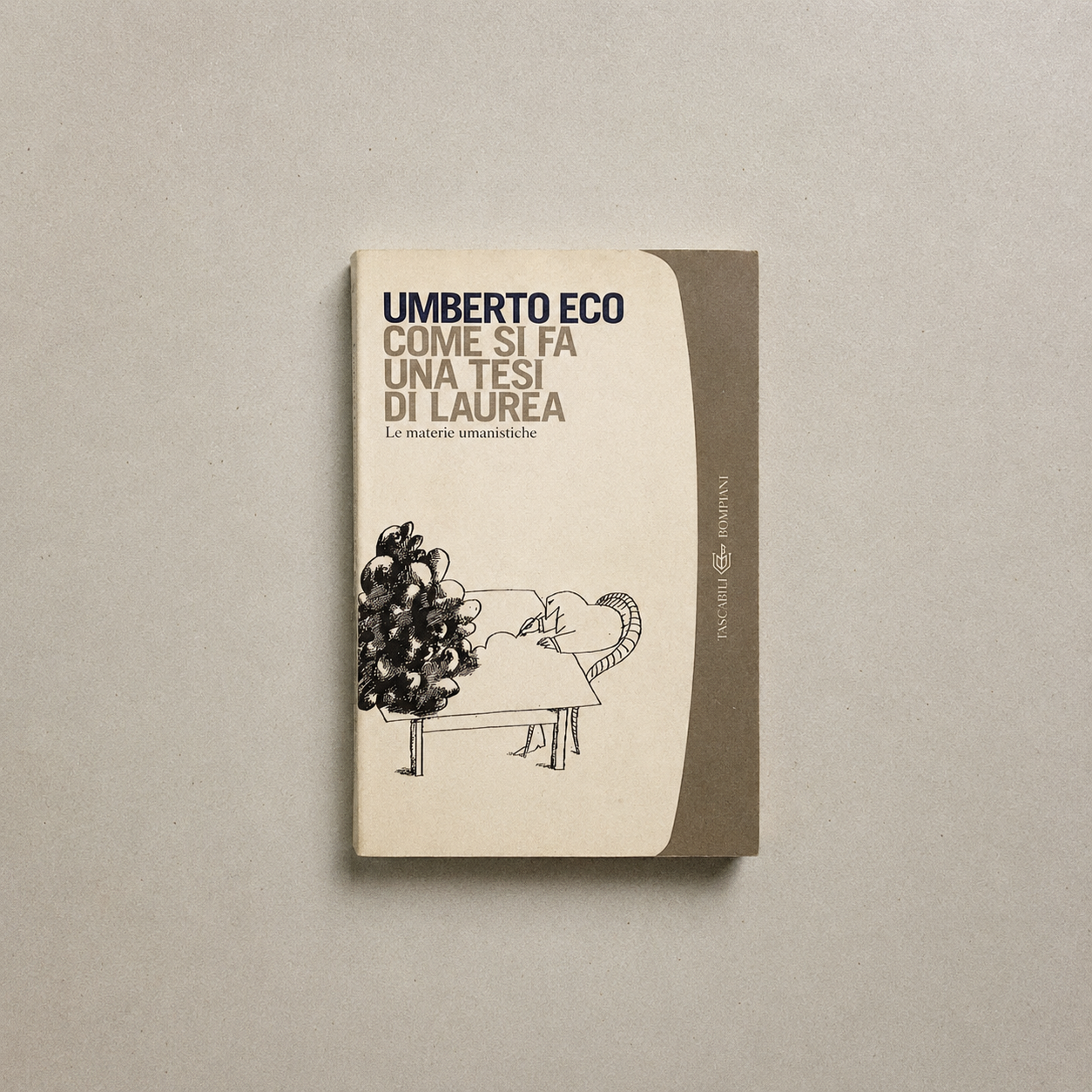
To be clear, you are not required to read every book you cite in your thesis in full. Eco himself said this in his 1977 handbook: primary and secondary sources must be distinguished, and the latter are explored. AI makes this research enormously more efficient.
The central books of your thesis, the ones on which you base your idea, you read in full. Secondary books and articles, instead, you upload to the project, have it produce a structured chapter-by-chapter summary, identify the sections relevant to your argument, and read only those. You can do the same with the main books too, to understand whether they really will be your main books, or to have unclear parts explained to you. AI helps you decide what deserves full reading and what can enter a footnote as background reference.
5) Editorial guidelines
Every university, sometimes every department, has its own rules: guillemets or double quotation marks, author-date system or Chicago-style footnotes, Latin abbreviations yes or no, format for quotations in the original language and in translation. Take the PDF of the editorial guidelines for your degree program and upload it to the project, so that every answer is calibrated to that document. When you ask it to format a note, tell it to do so according to that manual.
6) You guide the structure, and the style too
AI can evaluate and improve your outline, propose alternatives, and point out argumentative gaps. What it must not do is build it for you from scratch.
Something similar applies to style, although in a thesis style is largely standardized, so the risk is lower. AI writes better than a great many students, and also a great many professors, but it does so in a very recognizable way, with highly visible rhetorical tics. In Italian, LLMs tend to assemble short paratactic sentences in an Anglo-Saxon style, overuse emphatic epanorthosis in the form “not X, but Y,” and fill the text with tricolons, three terms in sequence, always with an emphasis somewhere between oratory and marketing. They have fetish words such as crucial, navigate, grasp, fabric, landscape, intricate. In English, the same flaws are a little less marked because these expressions are more common, but the point is similar.
When AI gives you back a paragraph, rewrite it. Change the rhythm, cut the tricolons, untangle the rhetorical antitheses, replace overly repetitive words. These limits will probably disappear, but for now “standard AI” writing is so inflated that it has become unbearable, even though many people were writing like that before.
7) Turn off sycophancy
Sycophancy is the tendency of LLMs to agree with you and praise your ideas even when they are banal. It is an effect of the way models are trained, because they are rewarded for answers that users like, and users, on average, prefer being told that they are brilliant.
It must be countered in two ways. First: set a system prompt, that is, a system instruction that applies to the entire conversation. In Claude or ChatGPT projects you can find it in the settings; write something like: “Make rigorous objections, do not always praise my work, be honest and point out weaknesses and gaps too, be an honest reviewer.” If you do not know where this section is, ask any AI and it will explain it to you. The second, complementary piece of advice: phrase your questions in a way that makes the model useful. Instead of “Does this chapter work?”, try “List objections to this chapter and indicate the weakest point”; instead of “Is my thesis original?”, try “Who has already said similar things better than I have, and what different thing do I add?”
8) AI is mimetic
LLMs tend to imitate your register; if your prompts are sloppy, they will answer you in sloppier Italian; if you send them detailed texts, the result will be more precise. Long conversations decay: after fifty or a hundred messages, the model begins to confuse sources, repeat itself, and invent things. Open new chats fairly often, one per chapter, one per phase, and start again from the project. Use projects: they are persistent workspaces in which you upload the stable material only once, the working bibliography, editorial guidelines, outline, already written chapters, your notes, and every new chat already starts with that context. Without a project, you redo the setup every time.
Having AI reread your own text is very useful, but you must ask for a professional and rigorous review. Divide the tasks: one for style, one for notes, one for content, and so on. Do not get carried away: too many revisions are as damaging as none, because the machine tends to look for some flaw even when none exists, if you ask it to do so. When the corrections start becoming marginal, repetitive, or you do not agree with them, it is time to stop.
9) The economic issue
Paid AI tools are significantly more capable than free ones. They have larger contexts, hallucinate less, manage projects, and have more up-to-date models. This is annoying, because it introduces another inequality into a university system that already does not exactly excel in fairness. If you can afford to subscribe during the months when you are working intensively on your thesis, I would suggest doing so, however reluctantly. If you cannot, say so clearly to your supervisor, if they are not hostile to AI, and, where it makes sense, to the university: the institution should guarantee equal access to tools that are now part of academic work, and until that happens we will have to add this gatekeeping to the list as well. Perhaps they will not listen to you, but someone will have to raise the problem.
The thesis is probably the first intellectual work of your life in which you have to develop a thought and sustain it over a good number of pages. AI can speed up bibliographic exploration, correct your notes, your style, and even your content. It can enormously strengthen your thinking. It can also, but must not, think in your place.
In these years, the substantial difference between those who will submit a good thesis and those who will submit a mediocre thesis will also lie in their ability to guide AI. These tools amplify everything: intelligence and stupidity, learning and delegation. Save yourself effort where it is worth doing so, but do not spare yourself the effort necessary to learn.
Francesco D’Isa