


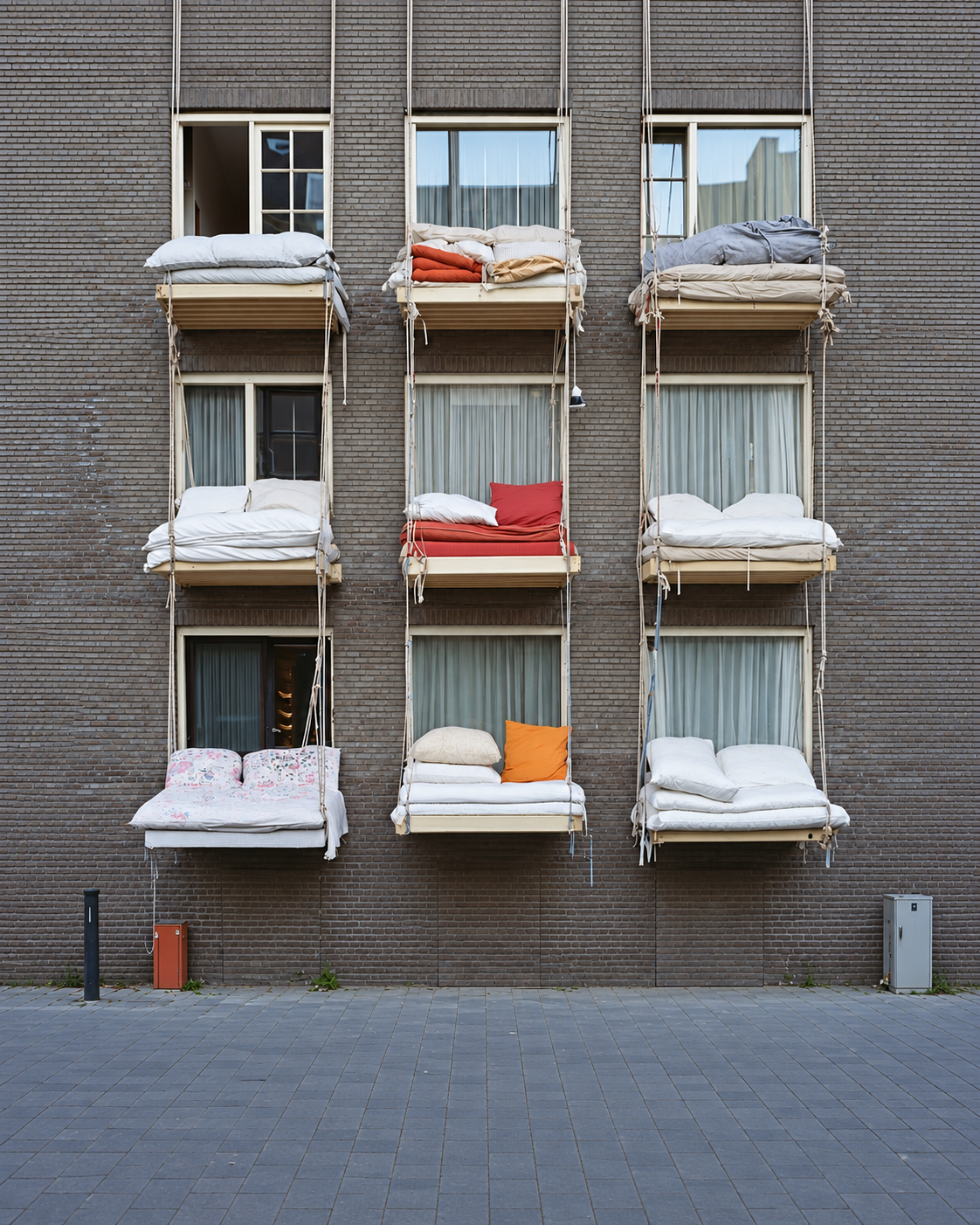
One of the most compelling qualities of images generated by artificial intelligence is also one of their most problematic: what they produce does not always make sense.
Generative systems possess no technical understanding of what they draw. They operate through statistical correlations, and the spatial inconsistencies that result would, by the standards of architectural representation, count as elementary design errors. The question is whether those standards are the only ones by which such images should be judged.
In conventional design, error is gradually eliminated. A drawing is corrected, measurements are checked, structures are made coherent, and the image is brought closer to what the designer intended to represent. The process follows a path that narrows toward precision and feasibility.
Generative imagery works in the opposite direction. Every prompt introduces a gap between the original intention and the resulting image, and that gap is not an accident along the way: it is the ordinary condition of the work. Not every generated image will directly inspire a project. But now and then, an unexpected detail emerges—something that, looked at carefully, deserves to be developed rather than discarded. At that point, the image becomes an opportunity to think differently and to explore new design possibilities.
The idea that failure can become a resource is, of course, much older than artificial intelligence.
In a recent article published by Artribune, titled The Poetics of Error Between Art and Architecture, Luigi Prestinenza Puglisi argues that a work can be great precisely because it is wrong. Architecture, he writes, is full of structural mistakes, and “error is not the accident. It is the method.”
Seen this way, error matters because of what it produces: it interrupts the familiar course of things and forces us, however briefly, to look elsewhere. Some errors bring a project to a halt. Others open it onto new visions. Embracing the latter does not mean granting value to whatever an algorithm happens to return.
Studies of serendipity have tried to bring some order to these phenomena. In 2018, Ohid Yaqub, in an article published in Research Policy, proposed a taxonomy of four mechanisms behind unexpected discovery: discoveries guided by theory, discoveries guided by the observer, discoveries emerging from networks of relationships between people, and discoveries born from error—the latter described as error-born serendipity.
Artificial intelligence makes this last mechanism unusually visible for a very practical reason: in a matter of minutes, it can produce a number of variations on a single intention that would take weeks to generate by hand. And with more variations come more opportunities for deviation.
So far, the assumption has been that errors simply happen. The truth is that they can also be actively pursued.
One of AI’s most interesting possibilities lies precisely in its ability to bring together elements that, according to the conventional logic of design, would have no reason to meet. Taken separately, these elements may appear unrelated. Put side by side, they produce a third image—one that no one could have anticipated before seeing it. Visual research thus becomes a form of design by association. The field of possible relationships expands, and so does the material available to work with.
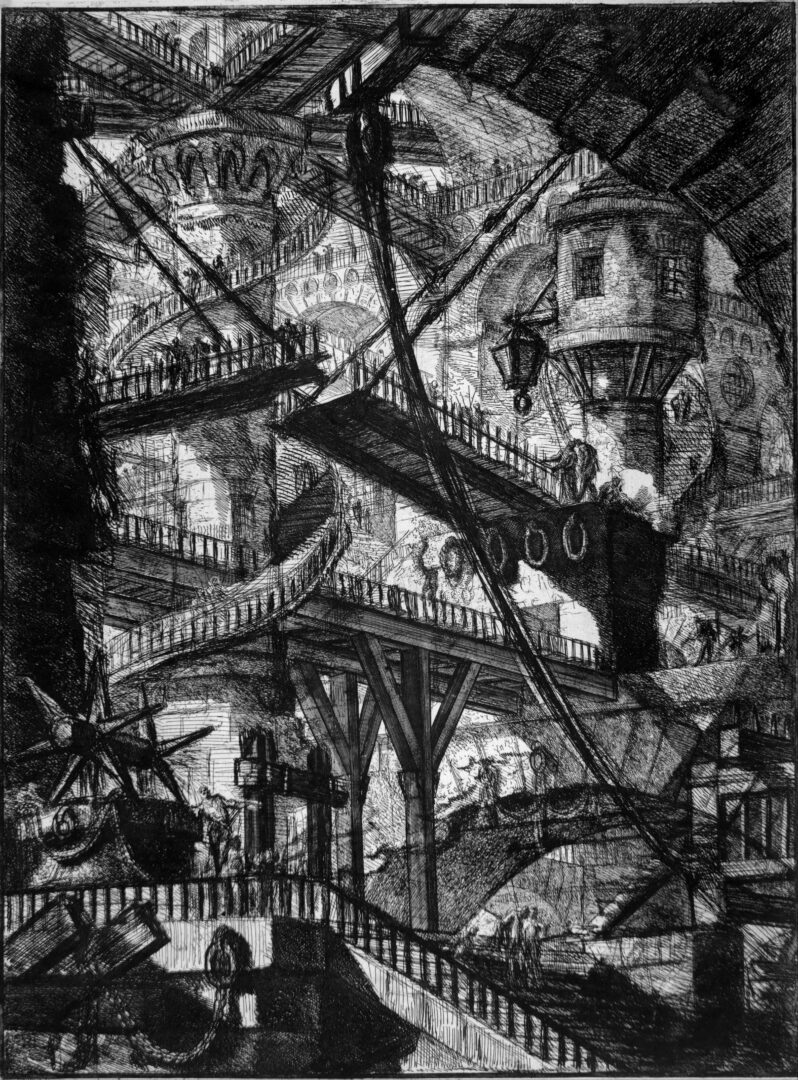
The idea that an impossible image can nourish a design did not begin with algorithms either. Piranesi’s Carceri d’invenzione, etched in the mid-eighteenth century, depict spaces no construction site could ever build, and yet they continued to speak to architects long after their own era. In Manfredo Tafuri’s essay The Sphere and the Labyrinth, Piranesi’s geometric and historical “errors” are treated not as oversights but as deliberate choices. Tafuri shows how the engraver intentionally distorts perspective and arbitrarily recombines ruins in order to invent a utopian past, dismantling the rules of classical space in the process.
An image does not need to stand up in the real world in order to be useful to thought. What has changed today is the sheer volume of such images, and the speed at which they can arrive.
This is where the glitch—the technical malfunction—enters the picture. In 2018, Santiago Pérez devoted a chapter titled Loss of Control, published in the volume Lineament, to the relationship between error, glitch, and imperfection. His argument is that within the hyperdetermined environment of digital fabrication and computational culture, losing control can offer a way back to intuition, serendipity, and discovery.
What matters, then, is not the flaw itself. What matters is that when a rule breaks, something the rule had kept outside the frame suddenly becomes visible.
Applied to visualization, the principle has very specific consequences. An AI-generated image may contain distortions, and those distortions may suggest a configuration no one had previously imagined. As a finished representation of a project, the image may be wrong. As a design question—as an underlying conceptual hypothesis—it may be worth considering.
On the architectural-research side, Aswin Indraprastha published a 2024 study in Jurnal Teknosains titled Make Discovery Through the Serendipity, examining a generative design platform. The study argues that exploration, speculation, and error can be recognized as credible foundations for innovation, and describes a bottom-up process driven by speculative trials. Its stated goal is to create environments in which solutions that were never planned in advance can emerge from within the design process—not replace it.
It is no coincidence that generative AI appears most useful in the earliest stages of a project.
A systematic review of 161 studies on the use of generative artificial intelligence in architectural design, published in 2025 in Automation in Construction and covering literature from 2014 to 2024, found that nearly 69 percent of applications were concentrated in the initial phase: ideation and visualization. Later stages were far less explored.
Today, one of the clearest functions of generative imagery is to expand the space of possibilities—not to replace the work of definition that follows.
The work of Francesco D’Isa offers another way into this question. In his artistic research, he uses generative systems to interrogate the production of images, the relationship between author and algorithm, and the degree of control that remains inside a probabilistic process. In a piece published by Artribune, he discusses the aesthetics of error and explains how this approach reached him through Eastern traditions such as Chán/Zen Buddhism and Taoism, along with a particular understanding of the gap between reality and our perception of it. His work belongs to art and image research, and the principle can be transferred to architecture only with different aims.
In architecture and design, the goal is not to produce an artistic image for its own sake. The image matters as a terrain for design exploration.
AI can generate thousands of combinations, but it remains the architect’s task to decide which ones are worth looking at, which should be discarded, and which deserve to be developed. The machine multiplies opportunities; design gives them meaning.
In this context, the way we treat error also changes. It is not always useful to correct it the moment it appears. Sometimes it is better to stop and look—to ask why a form that is clearly wrong nonetheless creates an intriguing impression. To see a project where there appears to be nothing yet is to recognize a possibility before a solution exists.
Artificial intelligence does not design in place of the architect. But it can introduce into the process what conventional design tends to eliminate: the unexpected.
And within the unexpected, a form, a relationship, a space, or a material may appear that we were never looking for. At that point, error ceases to be merely something to correct. It can become the moment when a project leaves the familiar road behind—and, precisely because it does, begins to see farther.
Alessandro Peritore