
Science fiction seeks alternative ways to make sense of the universe, as American writer Ted Chiangauthor of science fiction stories such as Story of Your Life (included in Arrival, Vintage Books, 2016), from which Denis Villeneuves Arrival (2016) was adaptedstated during a talk at the Trieste Science+Fiction Festival.
Since 2022, the Trieste Science+Fiction Festival has also hosted a special section dedicated to video gamesa sort of sub-festival called IVIPRO Days, organized in collaboration with the Italian Videogame Program Association (IVIPRO). IVIPRO was created with the goal of fostering connections between video game development studios and institutions, organizations, and public bodies that might wish to use video games to explore Italian cultures, histories, and territories. Over time, IVIPROs activities have expandedfor instance, with school projects (Play/Ground and Press Start to Learn), the creation of a video game archive (currently not accessible to the public), and game design courses focused on developing games related to cultural heritage and local identity. The IVIPRO Days, too, have evolvedfrom being a rather institutional event to becoming a broader discussion on the relationships between video games, media, and culture.
In the 2025 editionbeginning, as has become customary, online and continuing in person in TriesteIVIPRO Days also gained, for the first time, an entire day explicitly aimed at those working or wishing to work in the industry, dedicated mainly to meetings with representatives of foreign video game industries (in this case from Slovakia, Austria, Serbia, and Croatia). From the way Ive described them, IVIPRO Days might not seem like a science-fiction video game eventor even a science-fiction event in general. And yet they are, because video games are, in essence, entirely science-fictional.

Years ago, I defended this thesis in issue zero of the ill-fated Italian magazine Kuma, produced by Stay Nerd with the support of Lazio Innova. I claimed that every video game is science-fictional, explicitly referencingand expanding onthe proposal put forward by scholar of speculative narratives Pawe? Frelik to see the video game as a meta-medium of cyberpunk at large, in the chapter dedicated to video games in The Routledge Companion to Cyberpunk Culture (edited by Anna McFarlane, Lars Schmeink, Graham Murphy, Routledge, 2019).
For Frelik, video games can be viewed as a cyberpunk medium because they reflectsometimes explicitly, sometimes implicitlythe evolution of our cyborg relationship with technology, with virtual (reality) worlds, and with the industry that controls those worlds. Frelik was taking up an earlier idea by Brooks Landon (Diegetic or Digital? The Convergence of Science-Fiction Literature and Science-Fiction Film in Hypermedia, in Alien Zone II: The Spaces of Science Fiction Cinema, edited by Annette Kuhn, Verso, 1999), who argued that cinema as a whole is a science-fictional mediumespecially, though not only, in its early period (18941906)since it was born not as a narrative form but as a spectacle to elicit the same sense of wonder and discovery elicited by science-fiction writing.
A similar thing could be said of video games, starting again from their origins and their use as tools to test and demonstrate the potential of computer technology. Narratively speaking, if science fiction offers us something comparable to long and elaborate thought experiments (the alternative ways of making sense of the universe mentioned by Chiang), then video games allow us to actually play with those (science-)fictional experiments.
In video games, we often find ourselves in worlds that operate differently from the physical oneyet they remain internally coherent and at least seemingly predictable, worlds whose workings we discover through trial and error. That is, through experimentation.
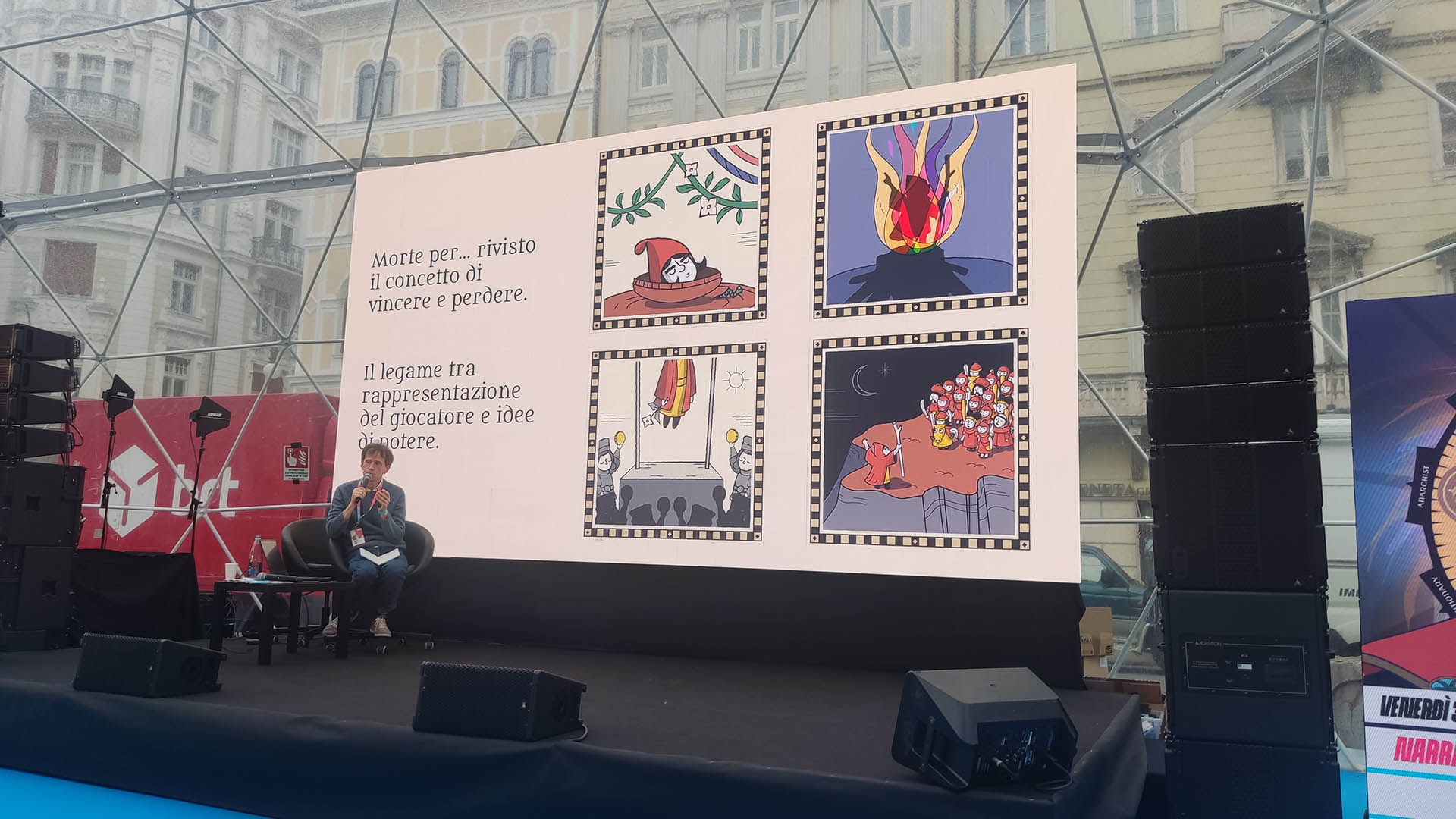
One of the games discussed during the 2025 IVIPRO Days, for instance, seems clearly to be a playable thought experiment: Becoming Saint (Open Lab Games, Firesquid, 2P Games, 2025). In the talk Incremental Narrative in Becoming Saint, Pietro Polsinelli of Open Lab Games described the genesis of this work, set in mid-14th-century Italy.
In Becoming Saint, we create and manage a Christian sect, gradually defining its rule and converting Italian cities in order to achieve, after our inevitable deathor even while still alivethe recognition of our sainthood. It is a tactical battle game, since the attempts at conversion (though not violent) are represented as small skirmishes between the followers weve gathered and the inhabitants of the urban centers we march upon during the various chapters/months into which the game is divided.
But, as Polsinelli explained, Becoming Saint is above all a game about our society and its evolution. It places us at the dawn of Italian and European capitalism, asks which path we would have wanted to take, and allows us to experiment with it within a possible synthesis of the physical world. Becoming Saint shows how video games (and all technologies) can make historythat is, how they construct an interpretation of history according to their own possibilities and limitations. It shows how technologies produce history even as they narrate it.
In this regard, there is a meaningful scene in Chris Markers Level Five (1997), which I have already discussed on The Bunker. At one point, the protagonist, Laura (Catherine Belkhodja), discusses a video related to the 1944 battle between the U.S. and Japanese armies for control of the Mariana Islands in the Pacific Ocean.
A Japanese woman is filmed by an American cameraman as she climbs to the top of a cliff on the island of Saipan. Japanese imperial propaganda had ordered both troops and civilians not to accept the shame of capture, but instead to demonstrate through death the steadfastness of their loyalty: the woman is going to commit suicide. At the last moment, she turns and sees the camera filming her. She jumps. Do we know she would have jumped if at the last minute she hadnt known she was watched? asks Laura. The woman in Saipan saw the lens and knew that foreign devils would show the world she hadnt had the guts to jump. So she jumps.
There it isthe representation of history that creates, that produces history itself: the map that produces the territory.
Among the film screenings of the 2025 Trieste Science+Fiction Festival was OBEX by Albert Birney (2025). In 1987, Conor lives almost confined to his home with his dog Sandy, makes computer portraits composed entirely of typographic characters on commission, watches and records films, and thinks that someday we’ll all be living in computers, even dogs. Thats exactly what happens when he orders by mail a new video game that traps Sandy and forces him to travel through its fantasy world to save her.
But Conor enters the video game by leaving his houseand leaves his house by entering the video game: the distinction between inside and outside, between the physical world and the simulation of an imaginary world, is blurred and uncertain.
Because we know, today, that we truly do live inside a computerthat our world is shaped by the computational systems through which we now conceive it. It is an awareness at once terrifying and necessary to explore: that our world is co-produced by our technologies. That science fiction, and the science-fictional medium of the video game, co-produce history.
Matteo Lupetti writes about art criticism, digital art and video games in publications such as Artribune and Il Manifesto and abroad. He has been on the editorial board of the radical magazine menelique and the artistic direction of the reality narrations festival Cretecon. His first book is UDO. Guida ai videogiochi nellAntropocene (Nuove Sido, Genoa, 2023), a reinterpretation of the video game medium in the age of climate change and within the new multidisciplinary paths that foreground the non-human and its agency.