


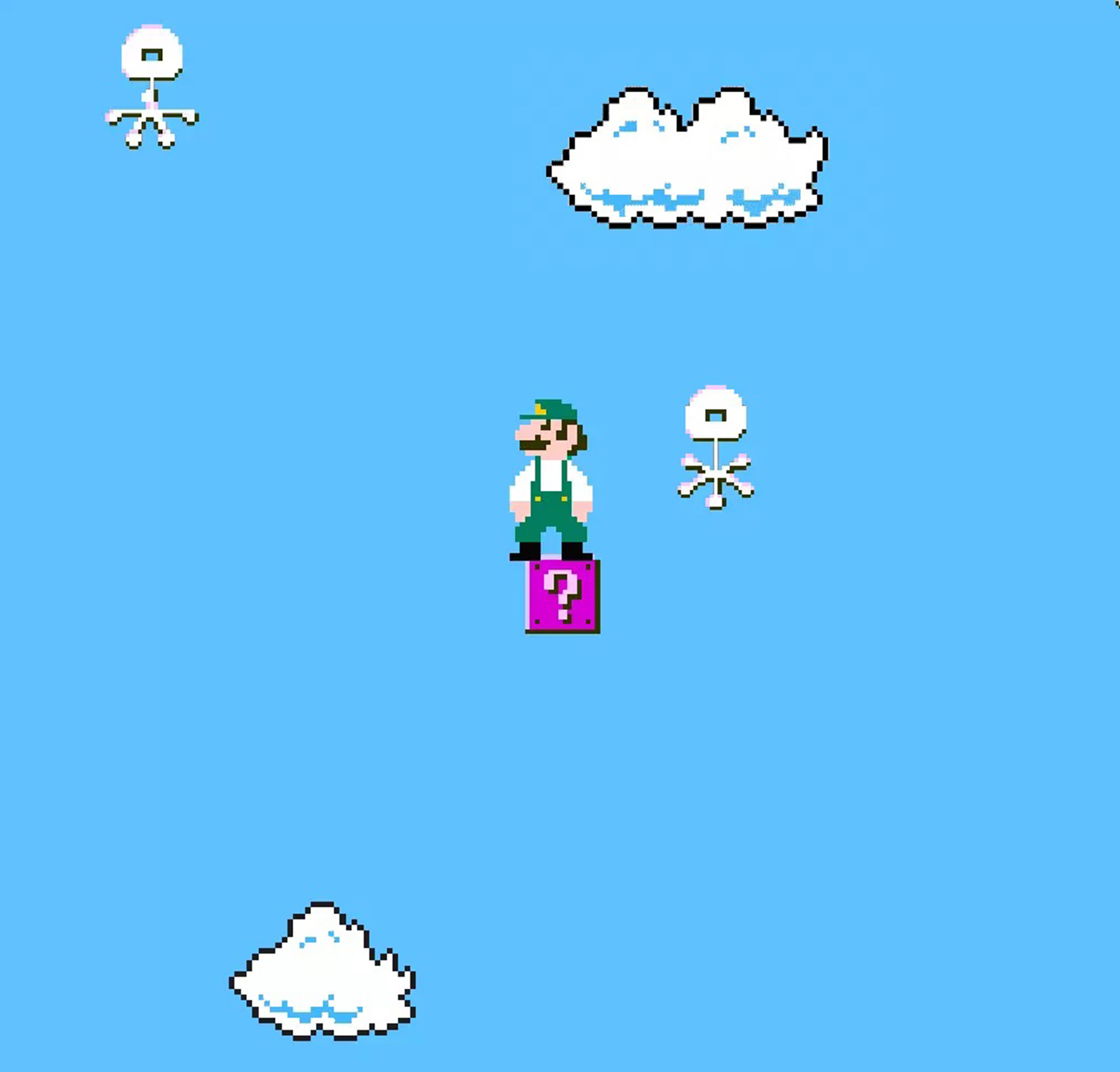
Mario, the famous protagonist of Nintendos video games, is a working-class man: a carpenter in Donkey Kong (1981) and then, above all, a plumber starting from Mario Bros. (1983). In Rab Sitting (2024), by the Italian artist Manuel Ghidini, he is suspended in mid-air, standing on one of his characteristic question-mark blocks. The situation recalls Totally Fucked (Cory Arcangel, 2003), created by modifying Super Mario Bros. (1985), though here Ghidini reuses only visual and sound elements, adding office chairs that dance and fly across the sky.
The chair is the coveted workplace: its comfortable but has wheels, and therefore demands a certain dynamism, the artist tells us. The start screen of Rab Sitting encourages us to reach these chairs, and to do so we can move Mario using three buttons and the slot-machine-style lever of the custom-built arcade cabinet that Ghidini assembled for the game. We try to figure out how it works, attempt after attempt, but whatever we do Mario seems destined to fall and die.
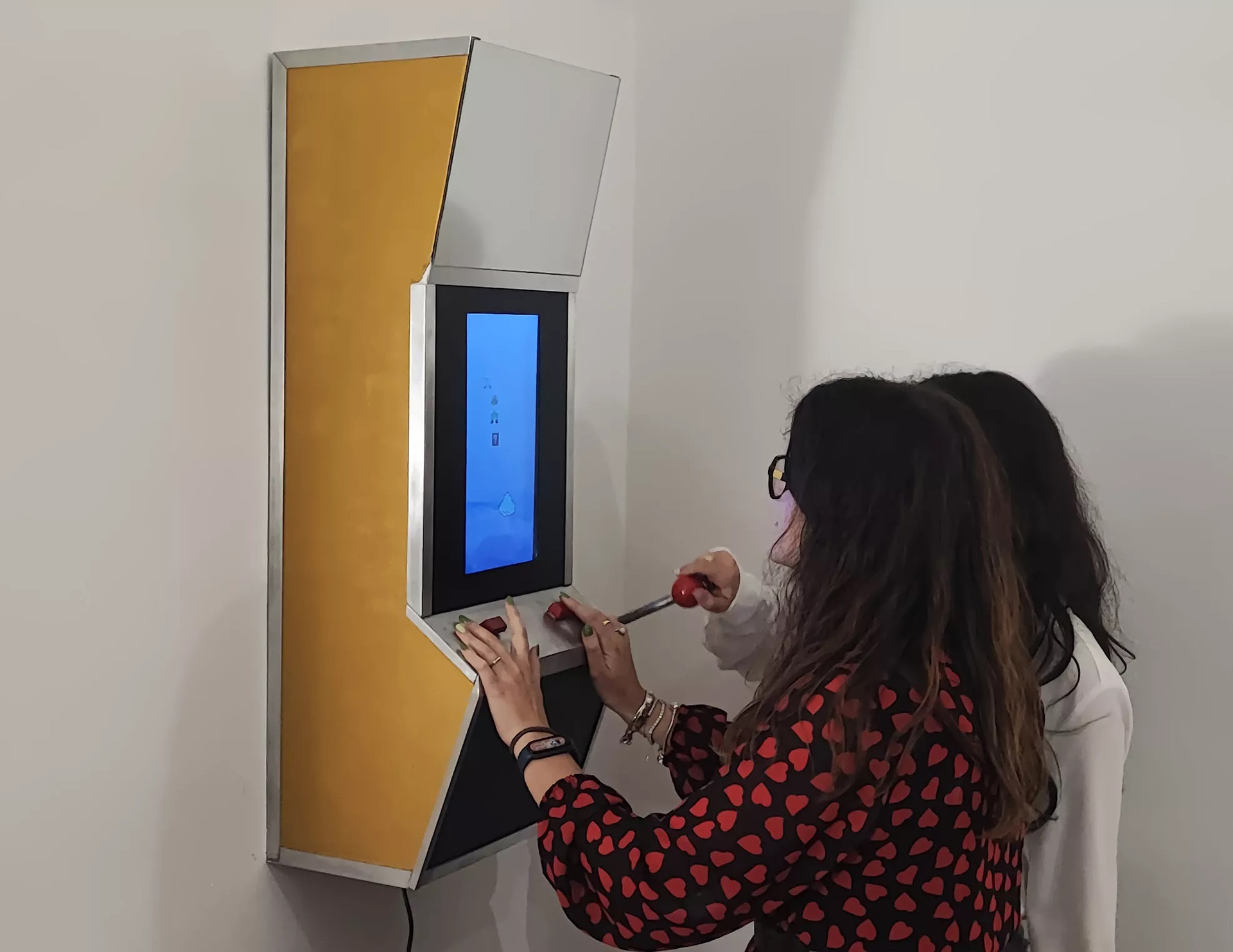
He falls if we move or jump too much. He falls if we pull the lever. He even falls if we do nothing: sometimes a Bullet Bill, the enemy projectile from Super Mario Bros., arrives and destroys the block were standing on. When we die, it can even happen that instead of losing lives we gain them, for no apparent reason.
Rab Sitting originates from an animation Ghidini created for RAB EXPRESS, a dance performance by the collective Cantiere Idina Who, of which he was a member. Rab/rob in Slavic languages refers to the enslaved person, and is the root of rabota/robota (corvée or simply work) and of robot. In the performance, rab indicated the exploited worker in a digitalized context, Ghidini explains. Rab Sitting calls into question the meritocratic ideology of both video games and work, which both present themselves as environments where effort is clearly rewarded with a linear progressiona career.
Matteo Lupetti writes about art criticism, digital art and video games in publications such as Artribune and Il Manifesto and abroad. He has been on the editorial board of the radical magazine menelique and the artistic direction of the reality narrations festival Cretecon. His first book is UDO. Guida ai videogiochi nellAntropocene (Nuove Sido, Genoa, 2023), a reinterpretation of the video game medium in the age of climate change and within the new multidisciplinary paths that foreground the non-human and its agency.