


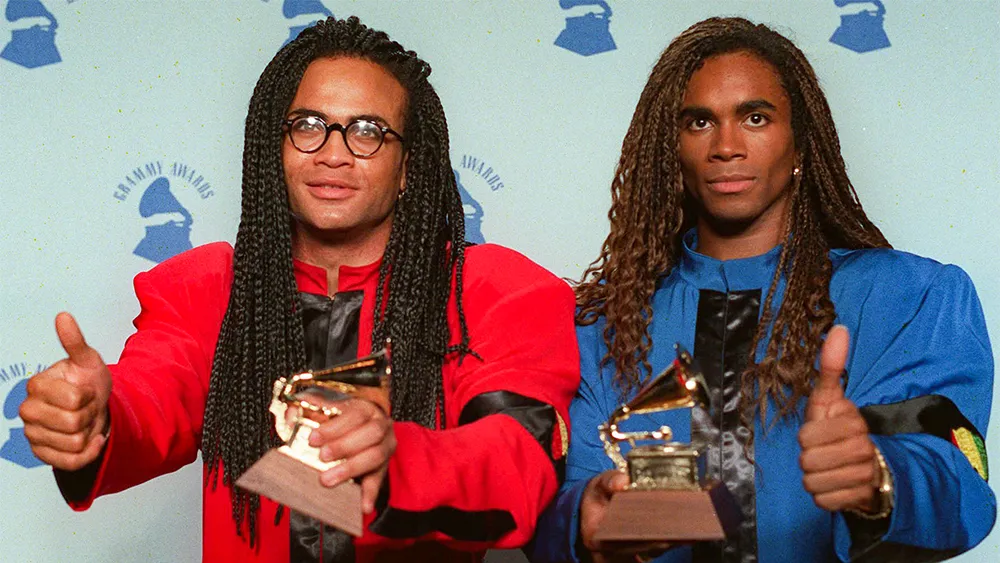
The name Milli Vanilli will forever be linked to one of the most notorious scandals in the history of pop.
Behind the duo, Fab Morvan and Rob Pilatus, there was in fact the direction of the German producer Frank Farian, already the architect in the 1970s of the success of Boney M., the disco group that signed, among many others, hits such as Daddy Cool and Rasputin.
In the case of Milli Vanilli as well, the voices heard on the records were not those of the people the audience saw on stage or in music videos. The difference is that, while for Boney M. this truth emerged gradually, slowly eroding the group’s credibility, for Milli Vanilli the scandal was far more violent.
Fab Morvan and Rob Pilatus were presented to the world as the real performers of the songs that were dominating the charts and, when in 1989 global consecration arrived with the Grammy for Girl You Know It’s True, it was precisely an accident during a live performance that revealed that they were a phantom group and that the real singers were not the two everyone knew. The Grammy was revoked and Milli Vanilli were forced to return it, in what remains a unique episode in the history of the award, with consequences that spilled over into Pilatus’s personal life: after attempting suicide several times, he died of an overdose in 1998.
Looking back on this story some 35 years later, one is led to ask: if it happened today, would we react in the same way as back then? It must be said that, at the time, several factors contributed to making the Milli Vanilli scandal so explosive—factors that, in fact, no longer exist today.
In a 1997 article, scholar Jack Banks noted that their story should be placed within a broader framework, in which the rise of the music video and the centrality of MTV were strengthening the weight of image and visual promotion, making the link between the artist’s body, their real voice, and their performance increasingly obsolete. For Banks, the case of the duo arose within a market logic that was giving far more importance to visual appearance even before musical value. In practice, the path toward avatars was opening up.
Banks had seen far ahead: in the ten years following the publication of his article, the concept of the virtual character in pop music was progressively normalized, both in the West and in the East. A decisive step was represented by Gorillaz, the project conceived by Damon Albarn and Jamie Hewlett which, starting in 2001, brought to the center of the scene a band made up of animated characters with a highly respectable musical repertoire. With them there was no longer any need to conceal the real identity of the authors or musicians involved; on the contrary, the fictional dimension became an integral and openly declared part of the artistic operation. Authenticity no longer needed to be anchored to the coincidence between body and voice, shifting instead to the coherence of the aesthetic, narrative, and sonic universe that sustains the project.
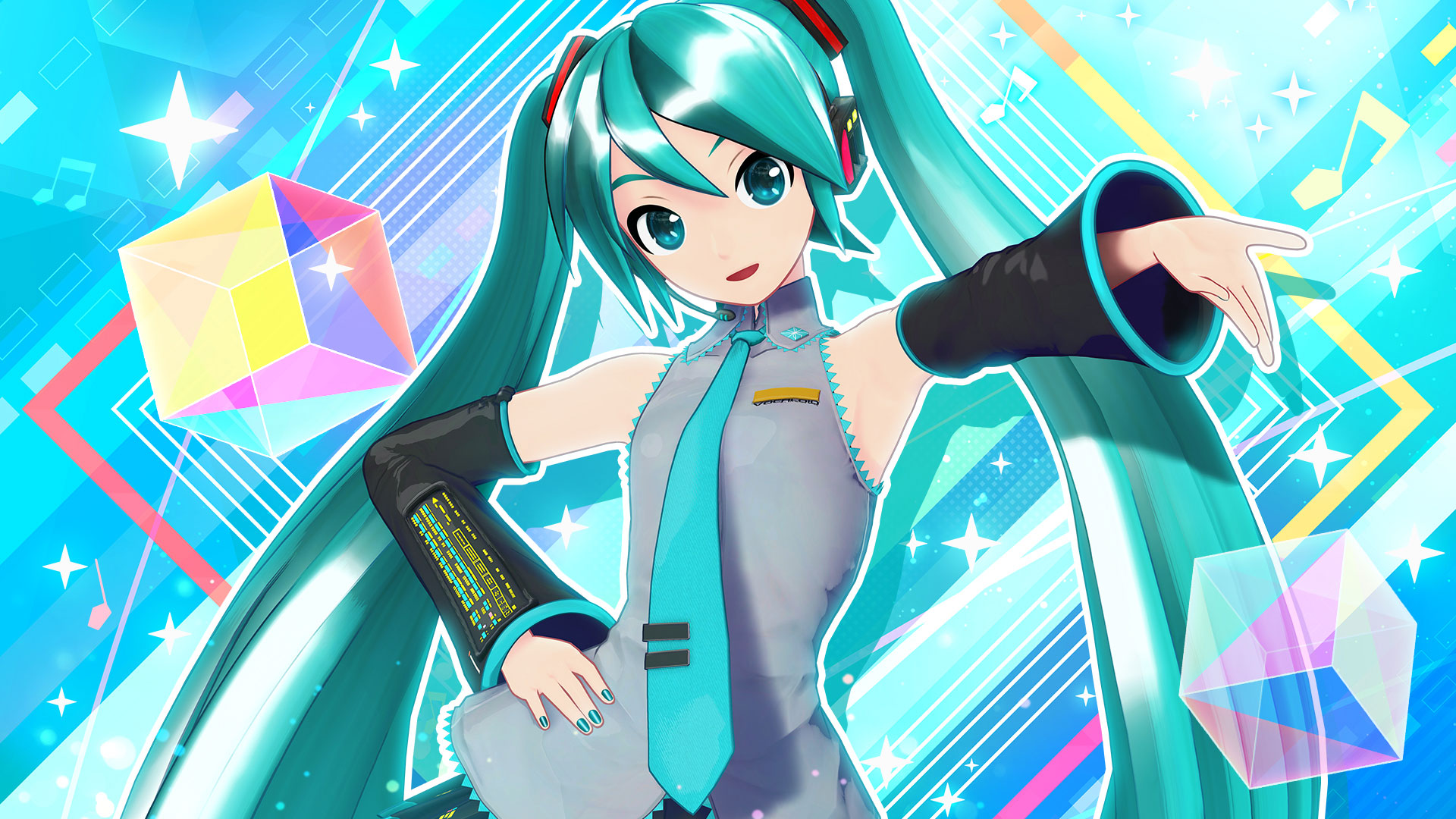
A few years later, in a different but surprisingly convergent cultural context, Japan saw the rise of the Vocaloid phenomenon and, in particular, the figure of Hatsune Miku, a synthetic voice associated with an avatar that became, in all respects, a global pop star, capable of filling arenas and generating a repertoire built collectively by a community of producers. In both cases, the audience does not feel deceived by the absence of a “real” body that coincides with the voice, because the artificial nature of the device is not hidden but constitutive of the musical experience.
Today the picture is even more complex than when Banks was writing. Social networks have intensified the importance given to image, and advanced artificial intelligences have begun to produce content at an unprecedented speed. And just as the means have changed, so too does our relationship with authenticity seem to have shifted.
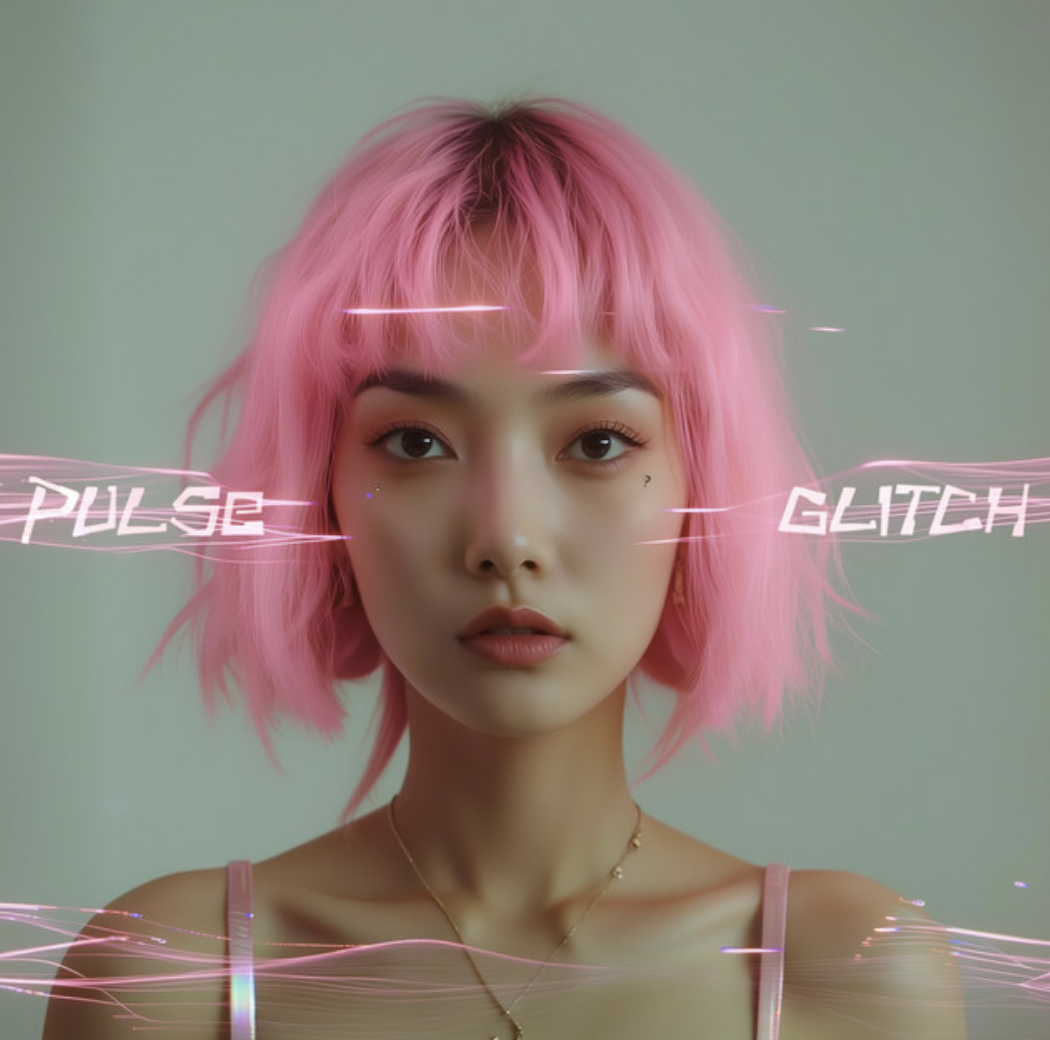
Take the case of Tata Taktumi. In 2025 the producer Timbaland introduced to the public his first artist generated with artificial intelligence: a digital figure, with a synthetic voice and an identity built entirely through AI models. The debut single, Glitch x Pulse, was released together with a music video in which Taka moves alongside real dancers (the Jabbawockeez) while singing a track that seems to explicitly recall Timbaland’s own production style.
Taktumi was created by Timbaland through Suno, the well-known platform for AI-based music generation that makes it possible to transform prompts into complete tracks.
In this regard, it is worth recalling that Suno is involved in a legal battle with major record labels over alleged copyright infringement, with accusations that its models were trained on copyrighted music. In recent months, however, the dynamic has changed: Warner Music Group has signed an agreement with Suno that led to the closure of the lawsuit and the start of a regulated collaboration, while Universal Music Group and Sony Music continue their legal actions or negotiations without yet reaching a formal agreement.
It is not clear to what extent Timbaland’s public enthusiasm for Tata Taktumi is tied to an aesthetic vision or to a commercial agreement with Suno, although the latter hypothesis appears highly plausible. In any case, beyond the initial media resonance, the experiment has not produced a particularly warm response from the public: the social profiles linked to the project have gathered modest numbers, and the video for Glitch x Pulse has accumulated views that are limited compared to the standards of high-profile pop releases.
Of course, no one jumped at Timbaland’s throat accusing him of being a new Frank Farian, nor of deceiving the public with a voice that does not belong to a recognizable body—a sign that today the distance between production and presence, between technical device and artistic figure, is perceived in a markedly different way than at the end of the 1980s.
This is because the value attributed to the authenticity of the musical artist has undergone a profound transformation, shifting attention from the coincidence between body, voice, and biography toward the coherence of a project supported by a solid narrative and a powerful imaginary. In this context, Tata Taktumi can be read as one of the first attempts to legitimize the figure of the artist generated by artificial intelligence in a historical phase in which platforms such as Suno are redefining the balance of power with the recording industry through new licensing agreements that could further change the relationship between listener and artist.
Pierluigi Fantozzi