


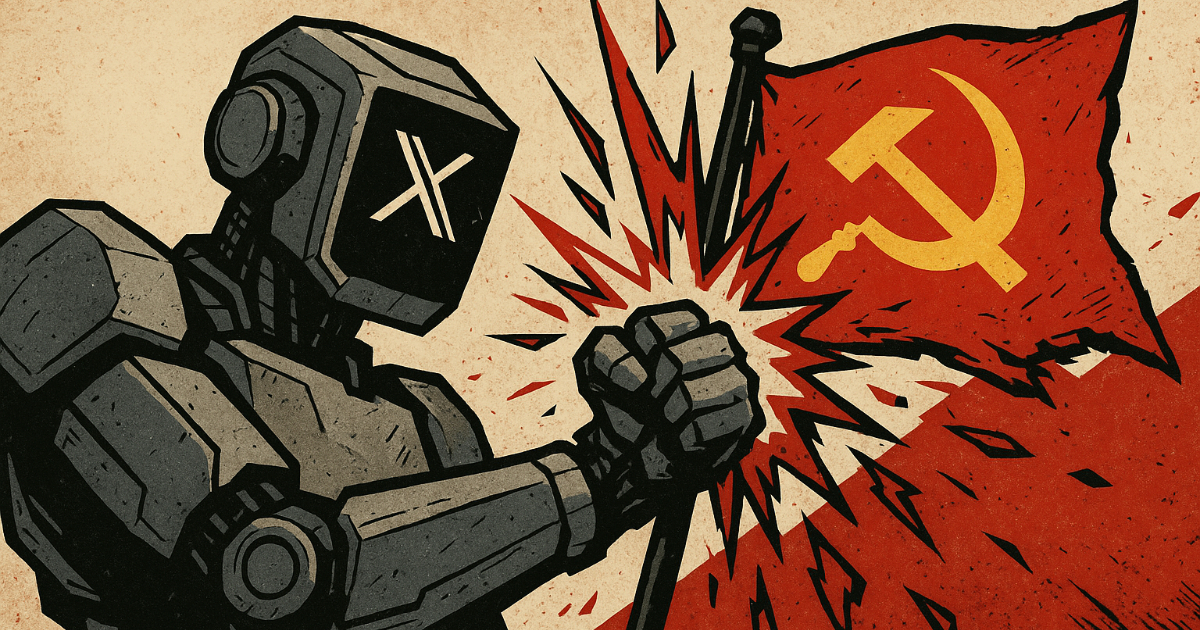
On 17 July, Xi Jinping opened the World AI Conference in Shanghai with a speech that struck me as far more focused than those delivered by Western leaders, much as had already happened with the Pope’s encyclical. It was the first time he had attended the event in person. The previous day, twenty-nine countries had signed the agreement establishing the World Artificial Intelligence Cooperation Organisation, an intergovernmental body based in Shanghai whose members include Russia, Brazil, Indonesia and several countries from the Global South.
Around the same time, Dean Ball, OpenAI’s head of long-term strategy, was commenting on X about the release of Kimi K3, Moonshot’s open-weight model, whose 2.8 trillion parameters allow it to compete with the best proprietary systems. He concluded that a world dominated by similar models would most likely lead to “full AI communism”, a scenario that, in his eyes, resembles a dystopian hell.
Reading the thread, I experienced that peculiar sense of estrangement that arises when someone describes as horrifying something that you find desirable. The hell depicted by Ball looks remarkably similar to what I consider the best available outcome. It is, after all, typical of the privileged to regard whatever preserves their privileges as universally just.
Let us return to Xi’s speech. Four points stand out. The first calls for open source and sharing to be encouraged as engines of innovation. The second emphasises safety and human oversight, while also urging countries to oppose the misuse of the concept of national security, a clear swipe at US export controls. The third argues that the development of AI should not erode the diversity and uniqueness of different cultures. The fourth proposes a multilateral system of governance centred on the United Nations, warning that unequal access to technology could generate new forms of injustice.
These principles are followed by concrete commitments, ranging from training opportunities for developing countries and cooperation centres with regional organisations in the Global South to the expansion of MAZU, an AI-based weather-warning system, to thirty countries. Xi concludes by saying that the development of artificial intelligence should become a “symphony of international cooperation” rather than the solo performance of a single country.
I am well aware that a state address is a political act whose ultimate purpose is to optimise power relations in its own favour, and I have no intention of naively portraying Xi as a benefactor. Beijing’s embrace of openness is also born of necessity, since sanctions have deprived it of a technological advantage. Ball himself suggests as much when he observes that China’s open strategy is partly an unintended consequence of American controls.
The new Shanghai organisation is therefore as much an instrument of hegemony as its Atlantic counterpart. Even so, the Chinese approach remains far preferable. An ecosystem in which model weights circulate freely does not guarantee the absence of censorship, because the base model still carries its own alignments. It does, however, guarantee that anyone can remove or alter them through fine-tuning. This makes such an ecosystem better regardless of the good or bad intentions of those sustaining it.
Ball’s thread also deserves attention because it contains a curious slip. Open-weight models, he writes, are inherently decelerationist. They discourage investment because, when anyone can download a model close to the state of the art, the rents used to justify data centres costing hundreds of billions evaporate. Another curious feature is his description of the end of a speculative boom with an enormous environmental impact as bad news.
The public scandal, as always, concerns safety. The real scandal is economic. What makes “AI communism” truly hellish in the eyes of an OpenAI strategist is the idea that artificial intelligence might become a public good, an infrastructure rather than a paid product.
His proposal displays the same unsettling candour as the rest of the thread. Banning open source seems foolish to him. A better strategy would be to generate enough regulatory uncertainty and institutional obstruction to make its adoption risky. He imagines, for instance, the Federal Reserve warning about possible backdoors in Chinese models. Fear instead of prohibition. Faced with such direct statements, I always wonder whether there is an exceedingly clever plan behind them that I am unable to see, or merely the brazen arrogance of power.
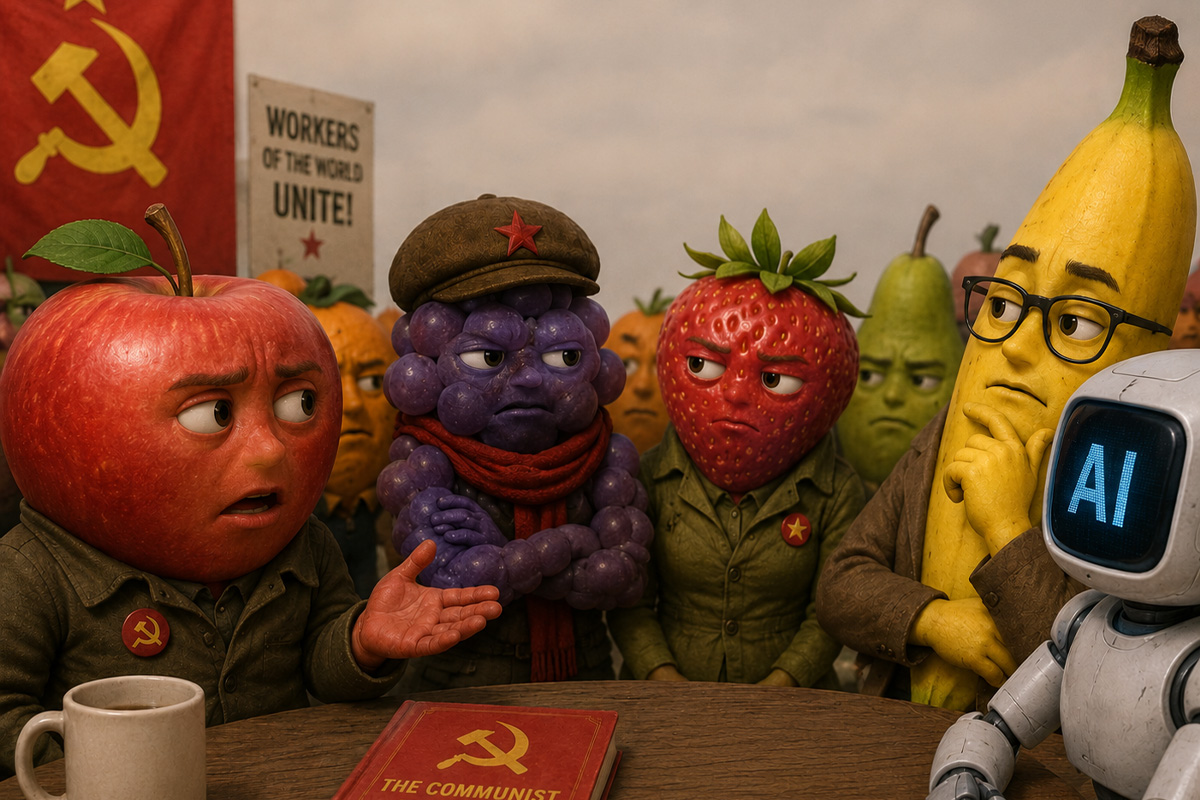
The most disturbing aspect is the use of “public good” as an insult. Nobody describes an aqueduct as “water communism”, or a municipal library as “reading communism”. When an infrastructure is essential, the idea that it should be accessible to everyone seems self-evident, even to people such as many Americans who still regard the word “communism” as both an insult and a bogeyman.
When the same logic applied to a cognitive tool is perceived as dystopian, it is because that tool has already been defined as a commodity. A commodity belonging to a very small number of actors, since frontier models can be counted on the fingers of one hand and are owned by a handful of companies based almost entirely in a single country.
The frequently invoked safety risk is real, but control, whatever form it takes, is always exercised by someone. There is always a hand deciding what is permitted and what is not. If that hand belongs to the same entity that owns the models and profits from them, or to a government pursuing selfish and deeply questionable strategies, I have no reason to trust it, just as I distrust any institution that appoints itself as guardian.
Between a world in which a few actors control the tool and monitor everyone else, and a world in which the tool belongs to everyone and people can at least meet on equal terms, I have no hesitation in choosing the latter.
Danger, after all, is the price of all knowledge. It is precisely because knowledge is both dangerous and empowering that we should examine what happened with some of the great technologies of the past, such as writing. Its spread certainly did not give knowledge to everyone, but it lowered the threshold of access and allowed those who mastered it to perform tasks that had previously been reserved for a handful of castes.
Artificial intelligence operates on a different level but produces a similar effect. It teaches or accelerates certain cognitive operations, including research, translation, analysis and programming, and makes them available to anyone capable of accessing the models.
It is fairly obvious that companies have every interest in preserving their dominance. It is nevertheless worth remembering that the culture of openness is not a recent utopia, but the historical foundation of modern knowledge. Movable-type printing broke the clergy’s monopoly over texts and placed vernacular scriptures in the hands of anyone who could read, causing a degree of scandal that is easy to imagine. Nineteenth-century public libraries arose amid suspicions identical to those expressed today, because giving books to workers and women was said to corrupt both groups.
In 1942, when sociologist Robert Merton listed the norms underpinning the ethos of science, he called the first of them “communism”: discoveries belong to the community; those responsible for them receive recognition but cannot claim ownership; secrecy is the very negation of research. The word now brandished as an anathema by an OpenAI strategist was once the term used in sociology for one of the main conditions that make science possible.
In 1993, CERN released the World Wide Web into the public domain. Free software, which Microsoft executives once described as a cancer and, predictably enough, as communism, now supports the infrastructure on which their own profits depend.
Artificial intelligence itself is the product of this culture. The transformer architecture originated in a paper freely published by Google researchers in 2017. The frameworks used to train models are open source. Shared datasets and preprints have played an enormously important role. Closure arrived later, when there was a stream of rent to protect, in what legal scholar James Boyle has called the second enclosure of the commons, by analogy with the enclosures that privatised England’s common lands. This time, it is not a field being fenced off, but knowledge itself, through the continual expansion of copyright and patents. The fact that the company symbolising this shift is called OpenAI has become an almost proverbial irony.
And what about intellectuals? Why do they not unite against the monopolistic model? Perhaps they too have something to lose, and it is not so much money as their position as mediators of knowledge: the authority enjoyed by those who can read what others cannot, a positional advantage that a tool capable of summarising, translating and reasoning erodes at its foundations.
Recent events offer an exemplary illustration of what it means to guarantee, or deny, access to AI. Fable, the public version of Anthropic’s Mythos models, currently the most powerful system available to an ordinary user, has had an intermittent existence. Suspended by the US government after three days and reclassified under export controls, it became available again in July through limited time windows, subject to usage restrictions and pay-as-you-go pricing that makes it effectively unaffordable outside industry.
Federico Nejrotti wrote an article on the subject that I recommend. He describes the sense of scarcity and disorientation this produces and asks what worthwhile tasks can be entrusted to a near-superintelligence when the time available to use it is limited. His melancholy conclusion is that his own intelligence may not be sufficient to make proper use of it.
I agree with his premises far more than with his conclusions. I have a very long list of worthwhile tasks, and I suspect that anyone who works with these tools has one as well. The question that troubles me is who will be able to afford them.
If effective use depends on access to the most powerful models, and that access is rationed through time windows, consumption-based pricing and economic status, then the tool that might have redistributed cognitive capabilities becomes the means through which those capabilities are concentrated once again.
The proprietary model of AI proposed by the Americans rests on an individualist culture that sits uneasily with this technology. Individualism assumes that value is produced by exceptional individuals and that hierarchies merely recognise it. Every language model is a practical refutation of this idea, because it is made from everyone’s data.
The texts on which it is trained are the sediment of centuries of collective writing, conversations, shared code and encyclopaedias compiled more or less without compensation. The machine’s supposed genius is a distillation of the contributions of billions of people, almost all of them anonymous and unpaid.
Individualism tells us that we must be special, but we are not. We are unique, each of us unrepeatable. For that very reason, nobody is special, because uniqueness is a condition distributed equally among everyone.
If the most important contributions come from the collective, as has ultimately always been the case with every intellectual enterprise, then a system that privatises the result and charges for access those who helped produce it is not merely unjust. It is incoherent.
The answer to Ball’s question about who would pay for the models if they became public is that the public would pay for them, just as it paid for basic research, electricity networks and the Internet itself. This is precisely what Ball, with a certain degree of historical and political short-sightedness, calls “communism”, the West’s great taboo word.
Within this framework, Europe plays the worst role of all. In June, after months of internal negotiations, the European Union signed the Pax Silica declaration as a bloc. Pax Silica is the initiative through which Washington organises its trusted partners around the American technology stack, including export controls on frontier models. At the same time, Brussels continues to speak of strategic autonomy, digital sovereignty and openness. Its words point in one direction, while its signatures point in another.
A continent that built its rhetoric around the AI Act and European values has accepted the role of a captive customer, receiving American models according to schedules and conditions determined elsewhere. When an open alternative arrives, it comes from Beijing.
With our universities and public funding, Europe could have been the actor proposing artificial intelligence as a common good. Perhaps there is still time to do so, provided that our vassalage does not prevent it.
An apology for China would be misplaced. I have no expertise that would allow me to analyse its political strategy seriously. What I defend is openness.
If the actor offering artificial intelligence as a common good for humanity is Beijing, while those who invented it lock it away and turn it into a commercial weapon, then the latter deserve the blame.
Between a world in which the tool through which we think belongs to three companies and one in which it functions as public infrastructure, however imperfect and contested, like all infrastructure, I know which side I am on. Long live AI communism.
Francesco D’Isa