


In the video game Quest for Bush (also known as Night of Bush Capturing, 2006), an Iraqi guerrilla fighter carves his way through U.S. troops to kill former president George W. Bush. It was developed by the Global Islamic Media Front (GIMF), an organization close to al-Qaeda, but its story actually begins in 2002, when American Jesse Petrilla released Quest for Al-Qaeda, built with the Duke Nukem 3D (3D Realms, FormGen, 1996) development tools. In that game, you play as a U.S. soldier fighting in Afghanistan, a desert inhabited by camels and militants shouting a nonsensical “Huminummanumma.”
At the end of the year, Petrilla returned with the even more caricatural Quest for Hussein, in which you attack Iraq to assassinate its president, Saddam Hussein. While the U.S. government was preparing the ground to justify the invasion that would begin the following year, propaganda became “2.0”—digital content created directly by users. And in that very same year, Petrilla published a remake of Quest for Hussein, Quest for Saddam, made with the Torque Game Engine.

GIMF took this video game and inverted it into Quest for Bush through a simple “reskinning” (modifying audiovisual elements). They replaced photos of Hussein with those of Bush, Middle Eastern soldiers with Western ones, and used as a soundtrack a nashīd (chant) dedicated to Juba, the legendary sniper of the Iraqi resistance.
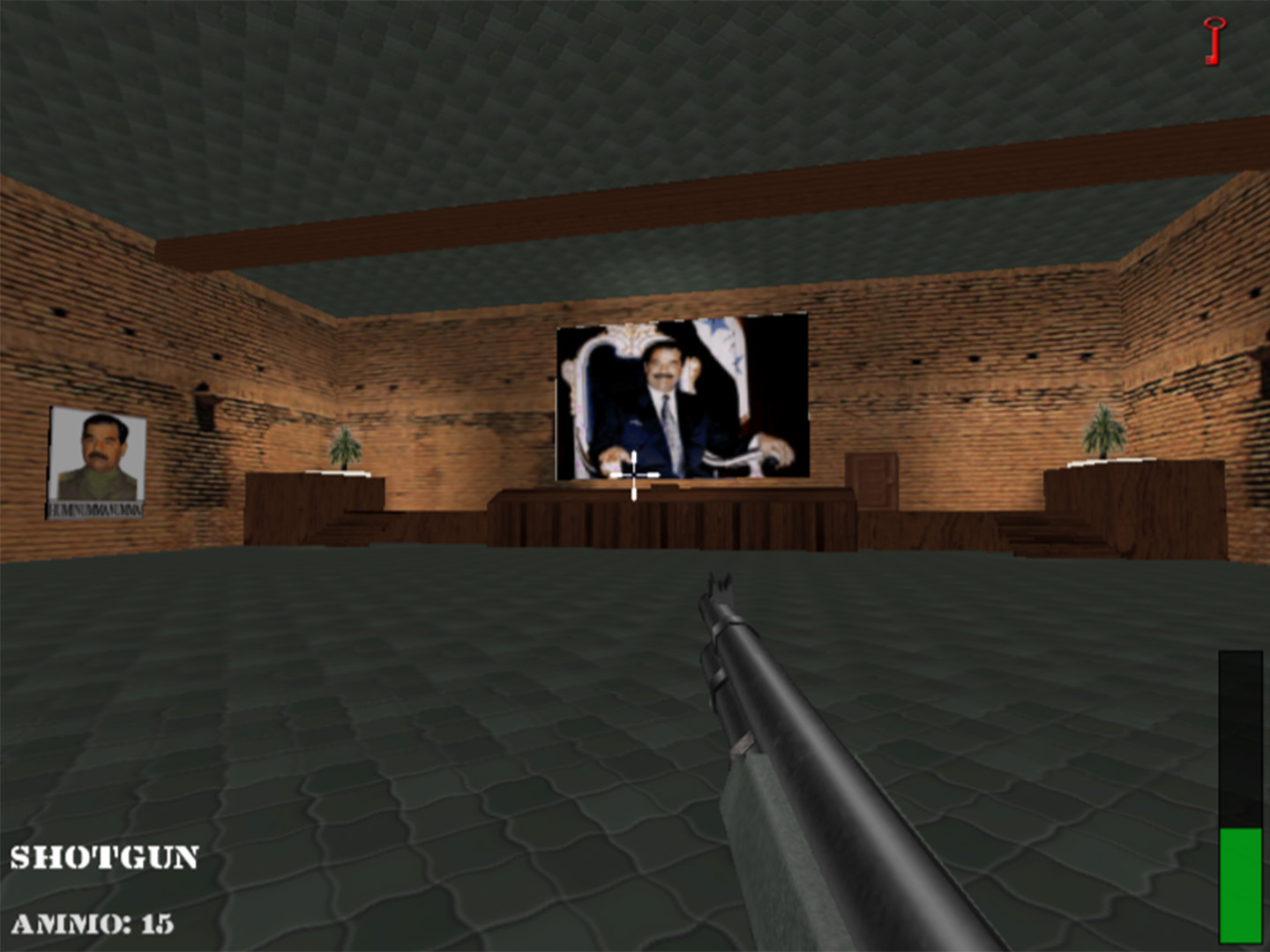
A short circuit that sent the U.S. into a frenzy. Petrilla told The GW Hatchet that his games were satirical, whereas Quest for Bush “is promoting violence” because “killing American soldiers in the game is definitely not satire.” In a further reversal, in 2008 the artist Wafaa Bilal, originally from Iraq, took Quest for Bush and gave the protagonist his own likeness in Night of Bush Capturing: A Virtual Jihadi. Bilal lost a brother in the war, and he becomes—and makes us become—a suicide bomber driven by propaganda made possible by U.S. propaganda (and wars).
Matteo Lupetti writes about art criticism, digital art and video games in publications such as Artribune and Il Manifesto and abroad. He has been on the editorial board of the radical magazine menelique and the artistic direction of the reality narrations festival Cretecon. His first book is ‘UDO. Guida ai videogiochi nell’Antropocene’ (Nuove Sido, Genoa, 2023), a reinterpretation of the video game medium in the age of climate change and within the new multidisciplinary paths that foreground the non-human and its agency.