



What we today associate with technology (data, networks, the cloud), which accompanies nearly every aspect of our lives, appears immaterial, yet it is in fact supported by physical, political, and epistemic infrastructures deeply rooted in the real world. This awareness compels us to question one of the most persistent narratives of technological modernity: the idea that the digital coincides with an ethereal, dematerialized dimension, autonomous from the material conditions of its existence.
In reality, as highlighted by Kate Crawford in Atlas of AI, digital systems—as well as artificial intelligence—are neither immaterial nor autonomous, but emerge from a complex network of relationships involving natural resources, human labor, energy and logistical infrastructures, as well as cultural and political apparatuses. The so-called “cloud,” often evoked as a metaphor of lightness and ubiquity, is in fact a constellation of energy-intensive data centers, submarine cables, servers, and rare mineral mines. The network itself is a stratified territory that spans the planet, from the Earth’s crust to satellite orbits.
The materiality of the digital manifests first and foremost at the geological level. The devices we use daily (smartphones, computers, sensors) are the result of extractive processes that transform elements formed over millions of years into rapidly consumable objects. Crawford emphasizes how this temporal compression—between the “deep time” of mineral formation and the accelerated time of technological obsolescence—represents one of the fundamental contradictions of the contemporary digital ecosystem. In this sense, every digital interaction implies a chain of material transformations that remain invisible to the user.
The material dimension is, in fact, also political. Digital infrastructures are designed, owned, and managed by specific actors (large technology corporations and state institutions) that determine their operational logics. The apparent neutrality of technologies conceals a series of normative and value-based choices: what is made visible, what is classified, which data are collected, and how they are used. As Crawford observes, artificial intelligence is also a “form of exercising power,” a system that incorporates and reproduces existing asymmetries.
Finally, there is an epistemic dimension. Digital technologies actively contribute to constructing the world and the fabric of reality. Through processes of classification, modeling, and prediction, they produce categories of knowledge that influence how we understand what surrounds us. In this sense, digital infrastructure is also a cognitive infrastructure: a set of devices that define what is knowable, measurable, and meaningful.
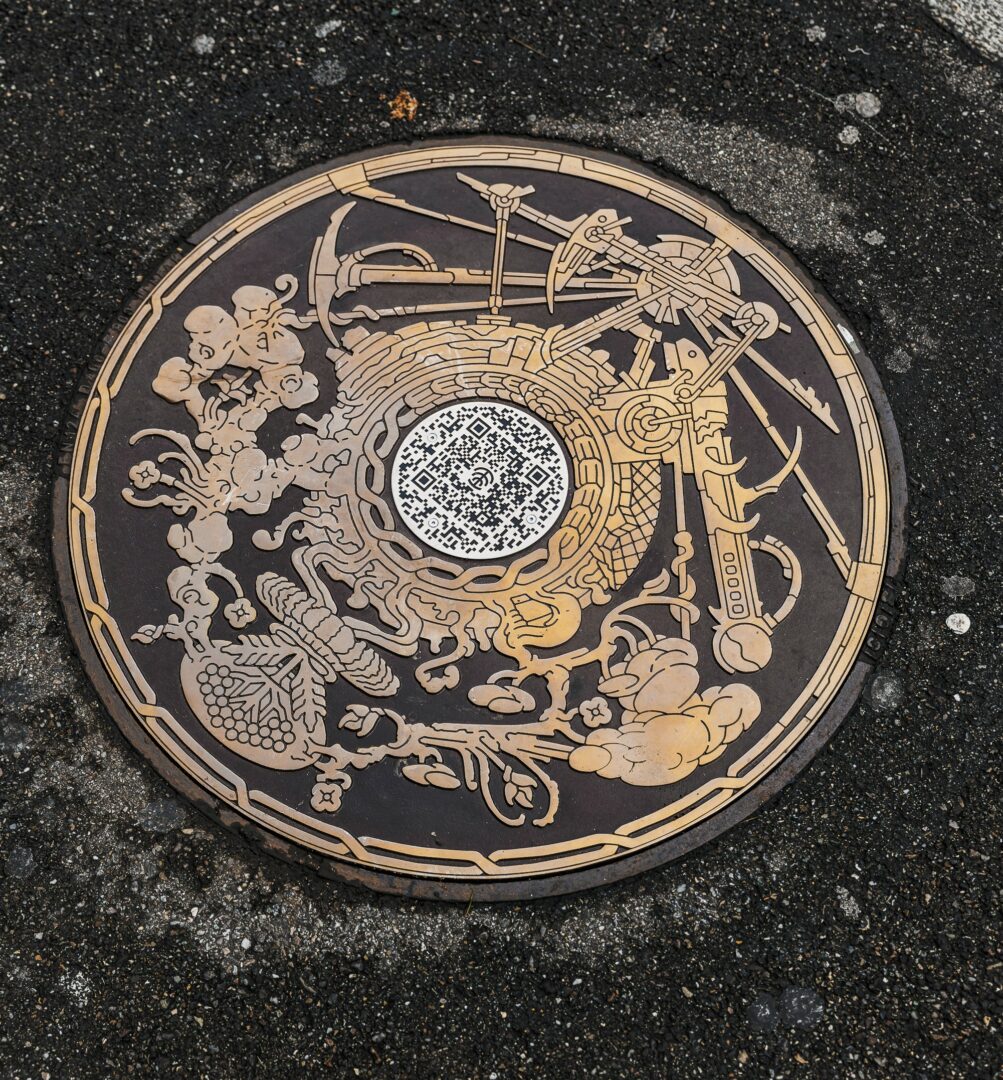
This triple dimension—material, political, and epistemic—allows us to understand how the digital is anything but immaterial. On the contrary, it takes shape as a system deeply rooted in the world, whose implications extend across the environment, society, and the processes of knowledge production. It is precisely from this awareness that artistic projects such as (W)HOLE by Clusterduck gain particular relevance. Commissioned by KiöR Zürich and developed in the urban space, the work situates itself within a line of research that investigates the hidden materiality of digital technologies, translating complex concepts into an aesthetic and participatory experience.
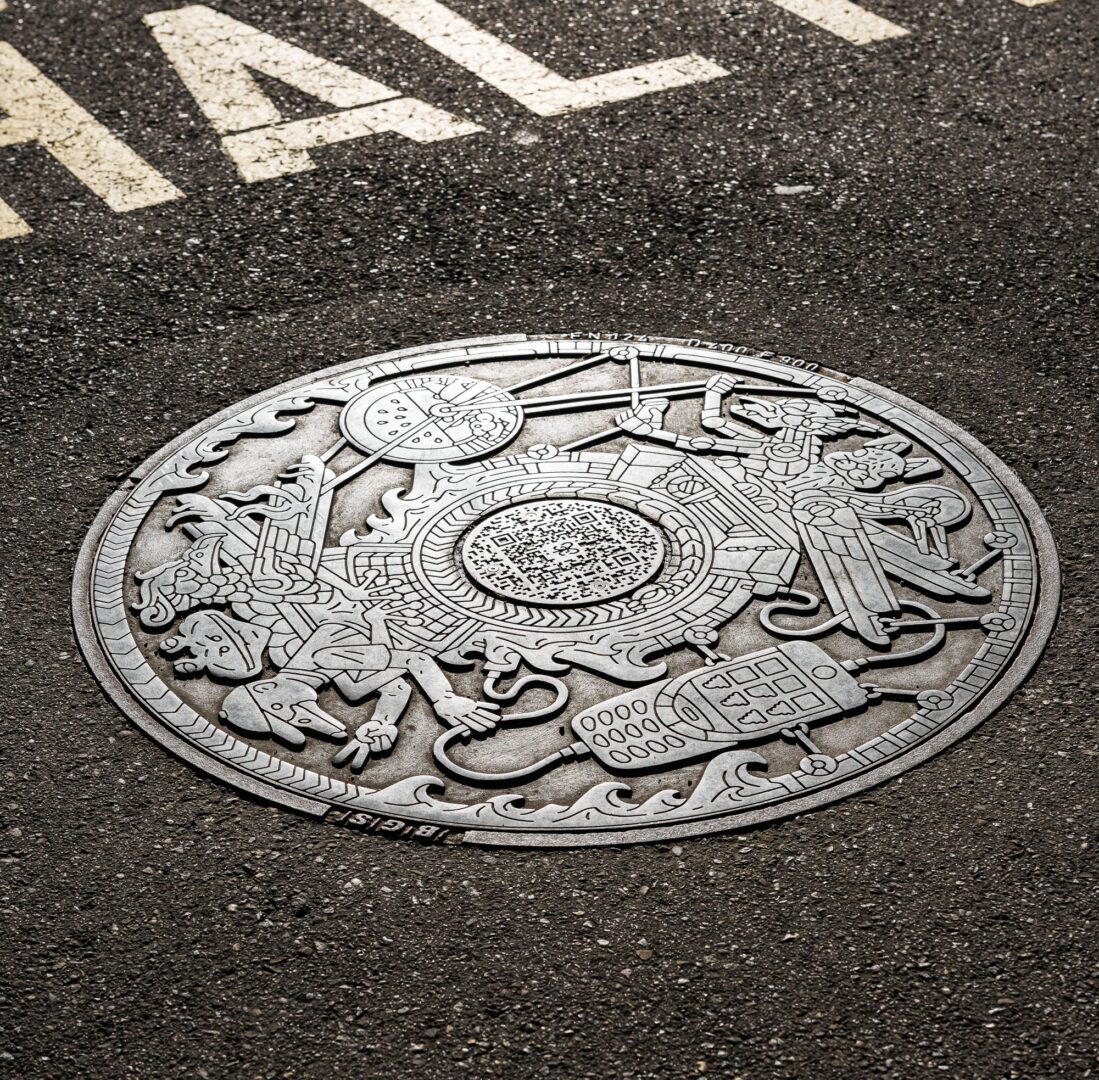
The conceptual device around which (W)HOLE is structured is the manhole cover—an apparently banal urban element, yet rich in symbolic potential. Clusterduck adopts it as a metaphor and a threshold: a point of access to what normally remains invisible. Manhole covers become “portals” to an underground dimension made of cables, sensors, protocols, and data management systems. In this way, almost literally, the project inscribes itself within the tradition of media archaeology, which seeks to bring to light the material and historical layers of contemporary technologies, opposing the dominant narrative of digital dematerialization.
The artistic operation unfolds through a combination of immersive technologies—augmented reality, 3D modeling, photogrammetry, and sound design—that transform the city into a stratified narrative environment. The proposed experience is modular, participatory, and constructed as a path of active exploration. The six “realms”—Earth, Cloud, City, Address, Interface, and User—reflect the structure of the so-called “stack,” that is, the set of layers composing the global architecture of the digital. This articulation directly recalls the thought of Benjamin Bratton, who theorized the stack as a new form of planetary sovereignty.
(W)HOLE does not merely offer a “didactic” visualization of this model; on the contrary, it problematizes it, positioning itself within the critical debate that has questioned the centrality of large platforms and their capacity to define the conditions of contemporary experience. The reflections of Geert Lovink on “stacktivism” and of Tiziana Terranova on the “Red Stack” are evoked as possible alternatives: models of infrastructure based on cooperation, shared access, and collective autonomy.
In this context, the reference to Ludwig Wittgenstein introduces an additional dimension. The idea of “language games” suggests that meaning is not given once and for all, but emerges from shared practices. Applied to the technological domain, this perspective implies that digital infrastructures too are not neutral or inevitable entities, but social constructions that can be rethought and redefined. (W)HOLE thus presents itself as a space of symbolic negotiation, in which citizens are invited to participate in the construction of new meanings and new forms of understanding the digital.
From an aesthetic point of view, the project is situated in a hybrid zone between public art, immersive installation, and educational platform. The allegorical objects (the sculpted and engraved manhole covers) function as physical anchors for the experience, while the augmented layer opens up a speculative, almost dreamlike dimension. This duality reflects a typical tension of new media art: on the one hand, the desire to make the invisible visible; on the other, the awareness that every visualization is inevitably partial and mediated.
Clusterduck’s project also has a participatory component. The “activatable repository” provides the observer with an archive of resources, articles, and tools aimed at promoting a democratization of technological systems, in an attempt to translate critical reflection into action.
Moreover, the urban setting plays a fundamental role. By placing the work in public space, Clusterduck breaks the separation between art and everyday life, inviting passersby to engage with the infrastructures they traverse and use every day. The city thus becomes a palimpsest, a place where the stratifications of the real and the digital overlap and become visible. This approach recalls the practices of locative media art, in which the geographical and social context is an integral part of the work.
In an era marked by what is often defined as a “polycrisis”—a convergence of ecological, economic, and political crises—(W)HOLE takes on a profoundly political dimension. The questions it raises concern not only technology, but the way we construct shared reality. Who controls the infrastructures? Who decides how they are designed and used? Which interests shape access to information? And, above all, is it possible to imagine alternative forms of technological organization based on principles of cooperation rather than extraction?
Laura Cocciolillo