


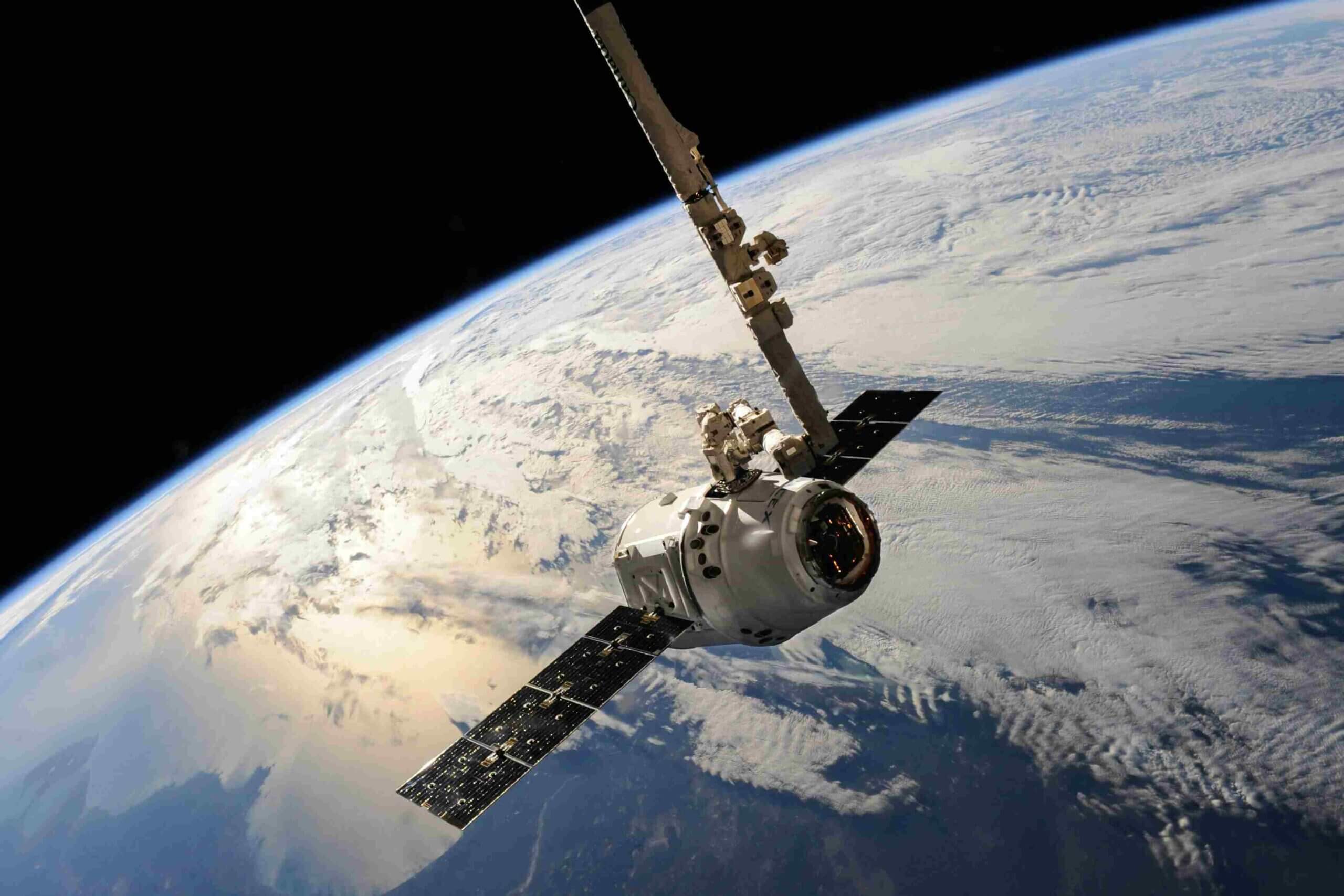
You lie down on a field, in the darkness of the night, in search of that ancient kind of enchantment that comes from admiring the wonder of the starry sky, as humanity has done since the dawn of time. You have found the right little corner of the world to immerse yourself in the dark — a privilege reserved for a few in the age of light pollution. But there is something disturbing. As you strain your eyes, one after another, moving points of light appear. It happens continuously, constantly, at every moment of the night. Sometimes they move slowly and are barely perceptible out of the corner of your eye; other times they are bright and fast, or even arranged in a spectacular train of lights that disappears from view after a few seconds. You sense that they are satellites, but you did not expect there to be so many.
Space is not only the place where things will happen in the future, but is already today a fundamental component of the economy. They call it the Space Economy, and it includes that entire ecosystem of infrastructures, technologies, companies, and services related to space, the portion of the Universe located beyond the Kármán line — that is, from 100 kilometers of altitude upward. It is still a niche market sector compared with others, but it is in constant and rapid growth, and is often interconnected with other leading sectors such as tech or the military sector.
ESA reports that in 2024, the space economy was worth a total of 596 billion dollars globally, with public investments (especially in the military sphere) of 122 billion and private investments of 7 billion. The previous year, on a global scale, the value of the space economy stood at just over 520 billion dollars. But one can also look at the number of space launches. In the Apollo era there were around a hundred space launches a year, largely connected precisely to the competition of the space race. Then they declined until reaching a historic low of 50 launches in the early 2000s, before beginning to surge again from 2005 onward. In 2023 there were 221, in 2024 there were 259, and in 2025 there were as many as 330.In total, the number of satellites currently around the Earth is over 18,000, and every year thousands more are launched, some to replace previous ones that have reached the end of their life, others for new projects or to bolster constellations already in orbit.
In 2025 the absolute record was reached, with 4,491 new satellites registered by UNOOSA, the UN body that deals with outer space. Some satellites have scientific purposes, for example Earth observation (such as ESA’s Sentinels), meteorological, or astronomical ones. Most are for telecommunications, or have strategic, military purposes. But it is striking to note that in recent years, about one space launch out of three has been carried out for the benefit of a single private actor, namely for the Starlink satellites of the American company SpaceX alone.

Starlink’s megaconstellation today counts around 10,000 satellites in orbit and just as many planned, with possible extensions up to 34,400 in total. There are other megaconstellations, active or in development, and many public and private actors intend to build something similar in the future, but as of today around 65% of all satellites in orbit are Starlink. “High-speed internet from space,” reads Starlink’s homepage, to provide “fast connectivity wherever and whenever you need it.” Elon Musk has always, at the level of marketing, presented his company in a philanthropic light, as a way to bring internet to the whole planet, even to the most isolated areas. It makes it possible to help developing countries, for medical, agricultural, and humanitarian purposes. But beyond the corporate façade, it is hard not to read in it the exploitation of a common resource — space — for the benefit of a private interest.
Space seems large and empty, ultimately belonging to no one, but in reality it is a heritage of humanity. UNESCO too, through the 2007 Declaration in Defence of the Night Sky and the Right to Starlight, recognizes access to the night sky as an inalienable right for humanity. And this is true both for cultural and ecosystemic reasons, as well as for scientific reasons. Ever since megaconstellations began to be discussed, the main scientific and astronomical institutions have shown themselves concerned. The International Astronomical Union has released official statements speaking of interference at visible frequencies and radio ones, forcing astronomers to schedule observations according to satellite orbits or to remove their traces through sophisticated algorithms. The issue has been considered so relevant that it led the IAU to found the IAU Centre for the Protection of the Dark and Quiet Sky. Starlink has committed to reducing and mitigating the effects of its satellites, but this is only a partial solution, even more so given the number of satellites planned for the future.
If Starlink was initially operating at a loss, today, with 10 million subscribers reached in February 2026, today — the company says — it is in the black and growing more every year. But beyond the economic interest, it is important to underline its political weight as well. Starlink was used extensively during the Russian invasion of Ukraine, to the benefit of the Ukrainian population, but it was not provided in support of the Palestinian population during the Israeli invasion. Musk then offered Starlink to the Iranian population when the government blocked access to the internet. In some cases, during the period in which Musk stood alongside Trump in his policies, Starlink was also used as a diplomatic lever. Whatever one thinks of these conflicts, it is evident that a private company like Starlink — or its military version, Starshield — can have a weight, even a decisive one, that plays into the hands of one side or the other depending on the direction chosen by the company and by the megacapitalist of the moment.
The question arises spontaneously: are we okay with this process of privatization of space and its terrestrial repercussions, or should we oppose it in some way?
Luca Nardi