


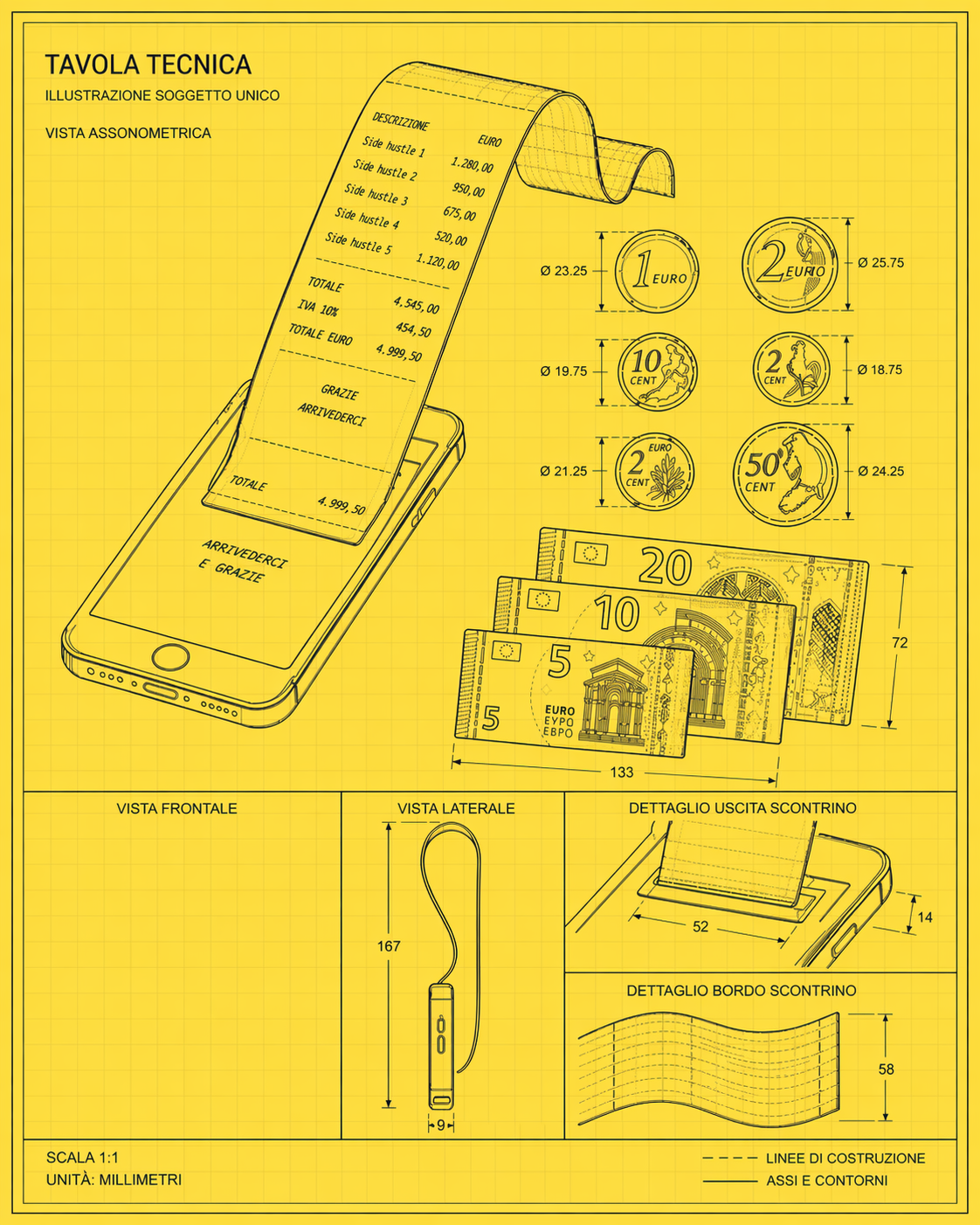
For years, online content promising to teach people how to get rich in their spare time has been a genre of its own. Almost always, videos about “passive income” are set in bright, slightly sterile-looking rooms. At the center of the frame are young people—often men—who are attractive, or at least well-groomed. Speaking with the confidence of someone who knows exactly what they’re talking about, they explain how to make hundreds of euros—or rather, dollars—a day while doing almost nothing, through AI-generated e-books sold on Amazon, courses on how to sell courses, apps that pay you to watch videos or like influencers’ posts. The pitch is always the same: no skills required, just a few minutes a day, and money will start falling like snow in Canada in January. They have discovered the secret, and now you know it too.
These activities are almost always presented as “side hustles.” Behind the term, however, lies a wide range of jobs, some more legitimate than others: teaching yoga on weekends is a side hustle, reselling vintage clothes on Vinted is a side hustle, making ceramic objects and selling them is a side hustle. These are jobs that, with enough effort, could become full-time occupations, and they require time and skills. Then there are the side hustles that are explicitly sold as shortcuts: seemingly automatic methods for generating free money with minimal effort.
Distinguishing between these two very different categories of side hustle is Ryan’s main pastime. Ryan is a creator who has gained hundreds of thousands of followers on Instagram and TikTok through his profile, @sidehustlereview. His format is simple: he takes the easy money-making methods circulating online, tests them himself, and documents how much time he actually spent and how much money he really made. In most cases, the results are disappointing and frustrating.
Ryan says he got started almost by accident. “My house had suffered major damage because of a storm, and I needed extra money to fix it,” he says. “So I started looking for side hustles online and tried a few. I realized very quickly that most of the ones I came across were being described so superficially that they seemed suspicious.”
Ryan works in marketing, which gives him an advantage because he understands how the business models he is analyzing actually work. Otherwise, his method is relatively standardized: he devotes about two hours a day to each side hustle, for two weeks. “The goal is simple: to see whether it allows me to make money within that window,” he explains. Then he analyzes how much effort it really took to make that money. At first, he mostly reviewed methods he came across on his own, but now he says he hardly needs to anymore. “At this point, I mainly find them through user tags,” he says. “I feel like I’ve seen almost everything by now, but every once in a while something new or unusual still comes up. If people are curious, I’m happy to test it.”
What he has discovered is that many of these videos hide an almost pyramid-like structure. The creator promoting an easy money-making method often does not earn money directly from using that method, but from selling courses that teach other people how to do it. Those who buy the course receive, among other things, a ready-made script for producing videos identical to the one that convinced them to buy it. At that point, the cycle starts again: the new video attracts new buyers, who purchase the same course, and receive the same script. “The real goal is to bring new paying users to the courses,” Ryan explains. When you see big income claims with no explanation of where the customers come from, he adds, it is because the customers are the viewers themselves.
In many cases, Ryan has paid out of pocket to access these courses and premium materials. In them he found “a lot of recycled stuff, AI-generated material, books with resale rights that you can find anywhere. But every once in a while there is something solid. The difference is whether they are actually teaching you how to do something, or just selling you the idea that you could do it.”
Another widespread mechanism is affiliate marketing. It works like this: a company selling a product or service—an app, a platform, a course—offers a commission to anyone who brings in new users. In itself, there is nothing illegal about it: it is the same principle behind influencers’ personalized discount codes, for example. The problem is that the commission is paid on sign-ups, not on results. That means the person promoting the product has every incentive to exaggerate its potential, even if they know perfectly well that it does not work.
“I’ve been contacted by groups offering commissions for all kinds of sites,” Ryan says. “Platforms for selling pictures of feet, tools for creating coloring books with AI. They want you to promote how easy it is to make money, when they know there is no real demand or that the product cannot compete in the market.” The creator still makes money, and the company pockets the sign-up fees: the only one who loses out is the user who believed it.
This kind of scam finds especially fertile ground among Generation Z—those born between 1997 and 2012—a generation that has been familiar with side hustles for years. According to a recent survey, 57 percent of Gen Z respondents in the United States have a side hustle. Another report, published in February 2023, interviewed ten thousand people across ten different countries: the United States, Brazil, the United Kingdom, Germany, France, Spain, South Africa, China, India, and Singapore. It found that 40 percent of Gen Z respondents said they held at least two different jobs, compared with 36 percent of millennials and 21 percent of baby boomers.
For some, these side jobs are mainly a response to a need for personal fulfillment. As journalist Olivia Goldhill wrote in Quartz, in many cases side hustles offer “something worth much more than money: protection against the feeling of being stuck, bored, screwed over by life.” If your main job neither defines nor satisfies you, the side hustle can become the place where you express who you really are.
Very often, however, people do them for purely economic reasons—to add a little extra to stagnant wages at a time when the cost of living keeps rising and the labor market is becoming increasingly unstable. “Today you have a job, tomorrow you could be laid off. Side hustles are about security and control in such an unpredictable economy,” Aashna Doshi, a software engineer at Google who creates social media content in her spare time, told The Guardian. In this context, many side hustles seem to have an extremely low barrier to entry: all you need is a phone and an internet connection. And for a generation raised watching influencers on social media, the idea of making money online is anything but alien.
Ryan receives all kinds of messages: some people thank him for helping them avoid being scammed, some ask him to test something they saw online, and some tell him they found something that actually works. Occasionally, he is also contacted by the creators he has exposed. “Some have sent me legal threats. Others have tried to explain why they were not scamming anyone, but without letting me into their courses to verify whether they were right. And some, to be fair, turned out to be honest and open to discussion.”
For Ryan, the point is not that everything is a scam; it is that almost nothing works the way it is advertised. Making money online with a YouTube channel or a blog is absolutely possible. What is rarely emphasized enough, however, is that it requires a very intense kind of investment, especially in terms of time and energy.
Asked whether side hustles can be something positive, Ryan answers with a little story: “There’s one about three men laying stones. One says he’s just putting one brick on top of another. Another says he’s making money. The third says he’s building a cathedral.” The moral, for him, is that it all depends on your approach: “If you treat your side hustle as a long-term project, and not as a hunt for easy money, then it can be worth it.” Otherwise, you are just another person laying bricks for someone else
Viola Stefanello