


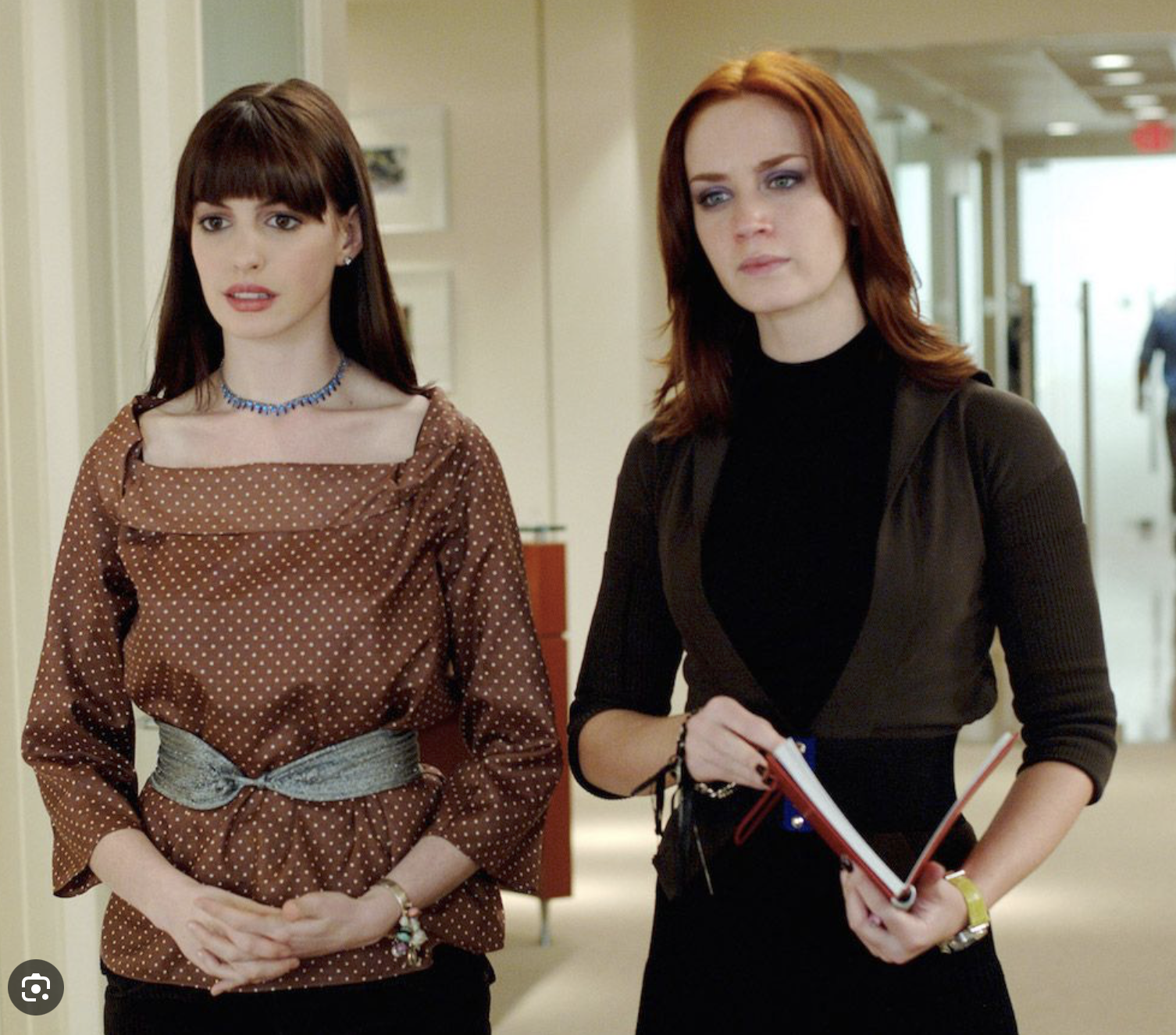
When the first Devil Wears Prada came out I was 12, listening to Californication by the Red Hot Chili Peppers on loop, that solo at three minutes and 17 seconds was undoubtedly my pre-ante-litteram orgasm, I had braces and was wondering what I would do when I grew up while knowing absolutely nothing about the world or about life.
I went to see the film with my friends, in a small village cinema, and I was so fascinated, thrilled, struck, enlightened by it, choose whichever synonym you prefer, that the next day I asked my mother to book me an appointment at the hairdresser’s: I wanted Andy Sachs’s bangs too, that thing that had transformed her from awkward into a self-confident woman, ideally in less than an hour. I remember that after seeing Stanley-Tucci-Nigel-forever pull a poncho out of the wardrobe of wonders and offer it to her as though it were the Holy Grail, I rushed to the bottom of my closet to fish out the one my aunt had given me the year before, and that I would never, ever have worn outside the house because it was fuchsia, and decided to wear it proudly on the first day of my new haircut. It also so happened that I owned a strange white wool hat, which looked a lot like the tweed gavroche, terms acquired with age, that Anne Hathaway wears in one of the many sequences where we see her crossing the street to go to the office, after the restyling complete with Chanel boots, yes, those ones. Now, I cannot tell you what the others thought of me that morning in the little garden outside the middle-school gates, but I know that when I got out of my father’s car and walked those 20 meters of path alone to reach them, wearing that fuchsia poncho, the white hat and my brand-new bangs, I felt invincible. Probably, if I asked one of my old classmates to tell me how I looked from the outside, and I will not, not only out of love for my dignity but because no one would remember anything, the situation would turn out to have been much more grotesque. If I had a photo of the outfit to attach to this article I swear I would feed it to you, but thank God life back then was still free of mobile phones.
Despite the fact that our lives have been incredibly different and that we have become incredibly different women, the planets aligned and made it so that I went to see the film’s sequel with those same friends, twenty years later. I would call it evocative, realizing that half the theater had not even been born when the first one came out, and that the very young girls sitting next to us would occasionally unlock their phones to have a little scroll through Instagram, which in 2006 had not even been invented. And I assure you it was much more than a simple damn girls, we’re old. It was almost a mystical realization about time passing. And how much of it.
But let us get to it. The Devil Wears Prada 2 is kind of ugly, like the vast majority of sequels to films that, whether you like it or not, made a bit of history. Did I expect better? Honestly no, I expected a kind of ugly film and I saw a kind of ugly film. A thousand references to the first chapter, starting literally from the first frame, where Anne Hathaway’s hand wipes the bathroom mirror while she brushes her teeth. But you immediately realize that the flavor of what you are about to see will be very different from what you saw twenty years ago: the protagonist is holding a black electric toothbrush which in Italian supermarkets is usually the Oral B Vitality Pro, the color grading chosen in post-production for this scene is in icy tones, and there is no fucking Suddenly I See, the KT Tunstall soundtrack, framing her face.
The subliminal message, for those able to catch it, that hits you like a club right away? Life sucks, and now Andy Sachs knows it too.
Not by chance, about four minutes into the film, she is fired on the spot along with her entire team because the newspaper she works for has run out of funds, and the news is delivered to her by a phone notification, after all, Il Post wrote that “sources at Condé Nast Italia, who asked to remain anonymous, said the company informed the editorial staff of Wired Italia of the closure ten minutes before publishing the statement online,” so, well, nothing outside ordinary administration. Spoilers aside, to hook the nostalgia of those like us who were already in the theater the first time, there are plenty of references to the first film: from the cerulean belts that are indeed identical, to the corn chowder that apparently still makes you fat, from the Chanel boots that have now gone down in history, to the advice whatever happens, don’t go upstairs, which Andy dispenses, with great tenderness toward herself, to the new intern who has to deliver the Book to Miranda’s house. Despite these clumsy attempts, the film itself cannot even tie the shoes of the original, not that anyone ever thought it would, but it does do something. Namely, it unexpectedly makes you reflect on a whole series of issues. If the first chapter presented you with a world that was certainly exhausting and at times insane but objectively enviable, or at least enviable to my twelve-year-old self, so much so that Meryl Streep, slyly, toward the end declared Everyone wants to be us, after seeing the sequel one is left wondering: but who exactly wants to be you?Because that us, which now includes me too, yes, in fact, a dream come true, is unquestionably in deep shit. Someone said that The Devil Wears Prada 2 is a love letter to journalism, in parentheses, the director is the son of the historic editor of The New York Times, and someone else said the film is actually about the crisis of publishing. I think it tells us much more than that, except it unfortunately skims superficially over the important things.
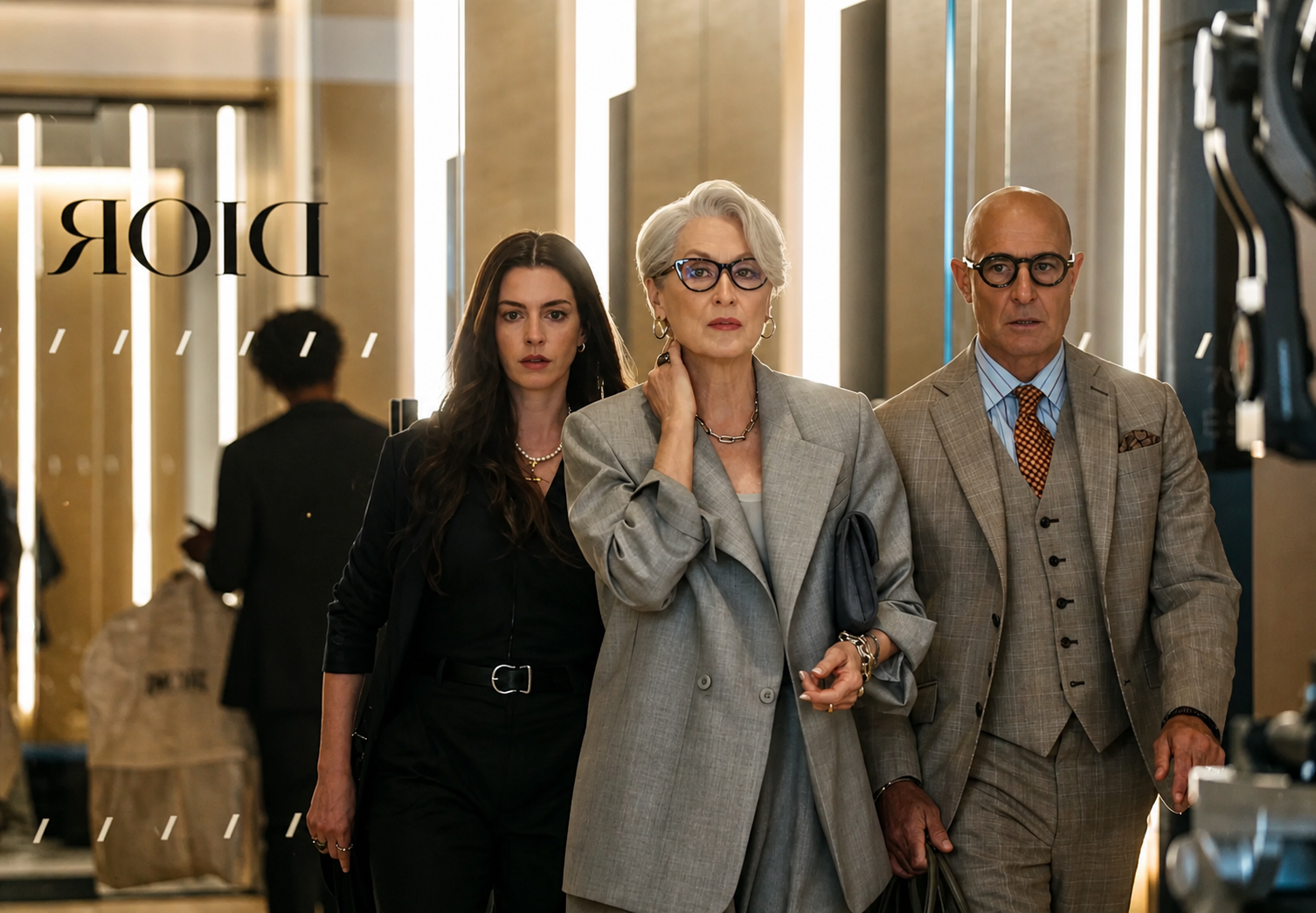
The film certainly tells of an identity crisis, embodied by Meryl Streep’s character, who across these two films goes from being The Iron Lady to a little old lady with the onset of Alzheimer’s who sells herself short so as not to have too many hassles to manage. Absolutely nothing remains of the Miranda Priestly of 2006 except the coats, which, in any case, she now hangs up herself. Or the crisis is embodied by Emily, Emily Blunt we love you, who goes from being the one who downs a cube of cheese when she feels she is about to faint because she is permanently on a diet, who goes from being the one who would have killed to do that job, to any old harpy sitting on the upper floors of a major brand and who, if she wants, has the power to leave the publishing world she once loved in its underwear. Because, as she herself is keen to throw in the face of her former boss Miranda Priestly, you exist only if we allow you to. A chilling concept, but shamelessly true for anyone who works in this sector. And you do not need to be on the editorial staff of Vogue to know it, any publishing outlet today survives exclusively if it is allowed to.
Sitting next to the identity crisis is the generational crisis. And of two different generations.
Halfway through the film Anne Hathaway, still beautiful but objectively a bit Botoxed, finds herself face to face with her nemesis Emily Blunt for an interview, and in a moment of sisterly sincerity in which the two tell each other in three words what they have done over the past twenty years, the former says to the latter something like I also have two daughters, and right now they are in and she mentions some New York place I have no idea about; at which point Emily Blunt’s character looks at her strangely and the other is then forced to specify that the daughters are in fact two frozen eggs, but that she likes to think of them as two little girls. Too bad the scene lasts less than a minute, because the layering of discussions to be had here would be quite complex. But perhaps this is not the place.
The other generation is the one even younger than Andy, so, to be clear, that of the kids who in the second film occupy the role she had in the first: the twenty-something interns. These almost invisible beings, used to having the same social relevance as a bidet: ignored until they are needed. The only substantial difference between those in the film and the ones we were or deal with in the office is the elite they come from. In the film, no less than Yale, Cornell and Harvard, the crème de la crème of the American Ivy League, are named as the universities of origin of the editorial team’s last wheels on the wagon, and here too there would be so many things to say. But despite their golden opportunities, these kids are there, ready to be squeezed like oranges outside the Acropolis of Athens in August, one of the best fresh orange juices I have ever drunk. Here, this is a splendidly anachronistic detail of the film. Because today’s twenty-year-olds will absolutely not let themselves be exploited like that, and they would not even dream by mistake of staying in the office until 10 p.m. Can I say it? Wonderful. This social construct that tore us apart and perhaps continues to do so is over, and the film, unfortunately, does not say this.
And now we come to the much-invoked crisis of publishing, periodical, not book publishing. While Meryl Streep passively listens to consultants telling her that soon everything will be done with artificial intelligence, the biggest problem Andy Sachs has to deal with is that her pieces, compelling and wonderfully written, do not make her boss happy because no one clicks on them. People do not read, they scroll. And while they scroll, evidently they do not find that little rectangle “catchy” enough to interrupt the flow by clicking on it. And so Andy is in crisis because she does not understand what to give readers. The point, as she herself grasps, is that readers as she understands them no longer exist, there are digital users. And digital users do not have the time or the desire to leave the scroll and take ten minutes to read what Andy writes, nor do they even try to find it. This is the great theme. Once you remove the print editions bought only by those who are truly attached to that particular magazine, the rest is on screen.
And as Nigel says, an older-looking Stanley Tucci but still in great shape, everything comes down to producing content that people can click on while they are peeing. More or less, that is what we all do. This very article, if it is lucky, will be read by few people compared with the number who will come across its Instagram post. And so one will have to think about how to turn it into an appetizing carousel. The concept of the carousel, not by chance, is highlighted more than once in the film as a fairly significant problem. Do you remember the old saying that you should not judge a book by its cover? Well, an Instagram post is effectively the cover of an article, and yes, people absolutely do judge by that and that alone. Because however good a piece may be, if its social cover does not pull enough, it will sink into oblivion along with all the rest of the rot. This is the real crisis of publishing. And we deal with it every day.
To be clear, the friends who were in the theater with me, both times, and who do something completely different in life, were not remotely touched by all these points for reflection and did not really pick up on them either, because probably either you work in the field or they slip away, like the problems of any sector. So the reading of all this is certainly very personal and tied to the work I do. But certainly, if twelve-year-old me was somehow inspired by The Devil Wears Prada, thirty-two-year-old me gives a nod of assent to the sequel because yes, it is all sadly true.
Beatrice Galluzzo