


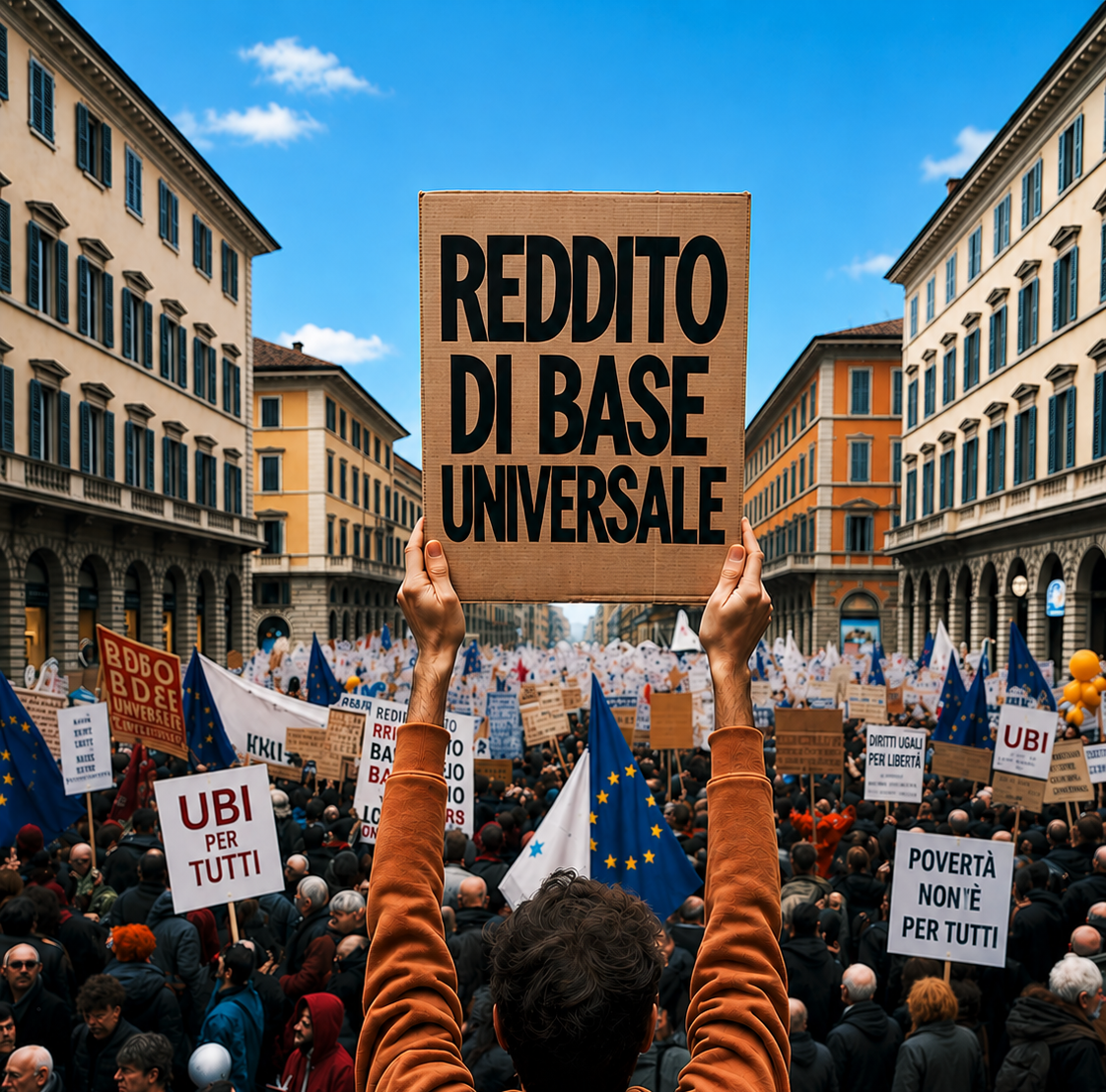
Ten years ago, when large language models were still laboratory experiments, an entrepreneur named Sam Altman announced the launch of a long-term study on universal basic income, often abbreviated as UBI. At the time, Altman, whom we now all know as the co-founder of OpenAI, was the president of Y Combinator, Silicon Valley’s most famous startup accelerator. In launching the study, Altman believed that we would soon find ourselves in “a world where technology replaces existing jobs, and basic income therefore becomes necessary.”
That same year, Elon Musk, who at the time still had an excellent reputation, said that UBI seemed inevitable to him, given the automation that was coming. Four years later, another tech entrepreneur, Andrew Yang, would build an entire presidential campaign around this idea. But the ground was already extremely fertile: universal basic income, usually defined as a universal monthly payment made by the state to all citizens without further conditions, seemed like the only policy capable of bringing together right-wing libertarians, progressives, billionaires with philanthropic aspirations, and shitposters dreaming of full automation while sharing Mark Fisher memes in niche Facebook groups. It seemed only a matter of time. Then something strange happened.
Over the past four years, since the public launch of the first version of ChatGPT in September 2022, plenty of people have in fact started losing their jobs. Klarna CEO Sebastian Siemiatkowski has said that AI helped him reduce staff by 40 percent. Marc Benioff attributed the cutting of 4,000 roles at Salesforce to AI agents. Accenture eliminated 11,000 positions, explicitly citing AI as the reason.
The sectors affected or under pressure now cut across the economy, and go far beyond manufacturing, which had been the imagined target in the debates of the 2010s. The most visible cuts are in tech, but the contraction is also affecting finance, customer service, logistics, law, accounting and, increasingly, so-called “basic” journalism: local reporting, sports summaries, financial reports, newswire dispatches. A Harvard Business School working paper updated in August 2025, based on an analysis of almost all US job postings between 2019 and 2025, found that the sharpest reductions in open positions were concentrated precisely in finance and technology, the very sectors that until a few years ago had seemed most protected from automation.
In short, the situation is exactly the one that, in 2016, had convinced Altman and Musk that basic income was inevitable. Yet the discussion around it seems to have vanished entirely from the political agenda.
To be precise, the idea of guaranteeing every citizen a basic income predates the 2010s by a long way. As early as 1797, the British revolutionary Thomas Paine proposed in a famous pamphlet that the state should compensate all citizens with a direct payment for the privatization of land, which had historically prevented people from securing food for themselves. The American sociologist G.D.H. Cole coined the term “basic income” in 1935, but it would take until 1971 for the proposal to reach the US House of Representatives for the first time. The proposal was supported by intellectually distant figures such as the Keynesian James Tobin and the libertarian Milton Friedman, and the following year both Richard Nixon and the Democratic candidate McGovern advanced similar proposals during the election campaign.
For a moment, basic income had seemed inevitable, but the proposal lacked a strong base of popular support outside the welfare rights movement, which in the United States at the time was fairly niche, and politicians gradually dropped it. Soon after, Reagan and Thatcher would be elected, and the rhetoric that welfare measures encourage idleness and dependence on the state would spread. For thirty years, until the 2010s, the idea would be kept alive mainly by academics and researchers meeting at poorly attended conferences.
The issue then came back into fashion in Silicon Valley, apparently starting precisely from the concerns expressed in 2016 by Altman and Musk: the fear that automation would eliminate jobs in a very short period of time and on a gigantic scale. Chris Hughes, co-founder of Facebook, began funding research and activism on the subject. Götz Werner, founder of the German drugstore chain DM, publicly supported it for years.
Here and there, the first pilot programmes began to spread: in Finland, in Kenya with the NGO GiveDirectly, in Ontario, in Stockton, California, in the Netherlands, and in Germany. In 2020, during the pandemic, several governments distributed direct aid to citizens that closely resembled, at least in form, a temporary emergency UBI.
That was the moment of maximum visibility for the idea, including in Italy, where even before the pandemic the first Conte government had introduced the so-called “citizenship income.” The measure had ambitions that were still decidedly limited compared with a true universal basic income, since it was conditional on active job-seeking, income and asset thresholds, and a series of obligations for beneficiaries. But in public debate it was often presented by its supporters as a step in the right direction: when it was introduced, Deputy Prime Minister Luigi Di Maio called it “the abolition of poverty.” It never really worked as promised, and in 2023 it was abolished by the Meloni government, which replaced it with more fragmented and conditional practices.
Today in Europe, the concern is not so much how to redistribute the wealth produced by AI, but how to make sure Europe obtains a sufficient share of those revenues, given that at the moment most economic returns are American or Chinese. For a country like Italy, with one of the highest public debts in Europe and an underground economy that makes even quantifying the tax base difficult, the prospect is even more complicated. UBI as a political proposal is practically absent from public debate, and despite widespread fears about the impact of AI on the world of work and white-collar employment, the minimum wage remains essentially blocked.
In Silicon Valley, where enthusiasm had been palpable until just a few years ago, something began to change when the data from pilot projects started revealing uncomfortable things.
The very OpenResearch pilot that had increased participants’ autonomy and financial stability also produced a result that was harder for its funders to stomach: beneficiaries worked on average one week less per year than those who received nothing. For Silicon Valley investors and managers, this was proof that basic income makes people lazy, because they are less motivated to work. There is, of course, a completely different way of reading the same data: that people were not demotivated, but simply less willing to accept any working conditions just to survive. To convince them to work that extra week, in other words, it would have been necessary to offer more money, or at least benefits.
No one had ever said it explicitly, but the subtext of California’s enthusiasm for UBI was that the measure would be necessary as a buffer to stabilize a permanent underclass of people rendered unemployable by technology, not as a tool to strengthen workers’ bargaining power. The fact that UBI was not just a consolation prize for those left without work, but also a potential negotiating lever for those already working, was not promising from their point of view.
For the people who had taken part in the pilot projects, however, it was. Regardless of the country, the data consistently show that receiving a basic income reduces anxiety, improves mental health, increases trust in institutions, and leaves more time and space to invest further in one’s education. The experiment conducted in Finland between 2017 and 2018, for example, is often cited as proof of failure because the centre-right government did not renew its funding when it expired, but in reality it produced encouraging results: there were no significant effects on employment, but participants reported clear improvements in perceived well-being and mental health. The German pilot analysed by DIW Berlin in 2025, in which 122 people received 1,200 euros a month for three years, found no withdrawal from the labour market and no statistically significant reduction in working hours, while recording the same improvements in mental health, as well as a slight increase in participation in training activities. The OpenResearch pilot increased participants’ autonomy and financial stability.
Despite this evidence, UBI is rarely discussed today, and almost never using the precise term: the proposals currently circulating all take an indirect form. In April, OpenAI published an industrial policy document imagining a state fund financed by AI profits and distributed to citizens. A Democratic candidate in New York, Alex Bores, proposed an “AI dividend” that would be triggered only once the replacement of human labour became documentable. And Andrew Yang has started touring conferences again to explain that some form of universal income will be necessary, though without committing too much to concrete proposals.
Perhaps the most paradoxical case is that of Dario Amodei, CEO of Anthropic, who last year said he supported the introduction of a “token tax”: a percentage, he suggested 3 percent, applied to every revenue stream generated by the commercial use of AI models, with the resulting tax income redistributed by the state. “Obviously, it’s not in my economic interest,” he said. “But I think it would be a reasonable solution to the problem.”
His proposal and the others may seem close enough to universal basic income, but in reality they share one characteristic: they are designed as top-down redistribution mechanisms. A basic income that allows someone to refuse a poorly paid job, or to strike without falling into poverty, is a tool of power for workers. A percentage of AI revenues ending up in a state fund is instead a tool for managing consent. And it is no coincidence that, by now, only one of the two is really being discussed.
Viola Stefanello