


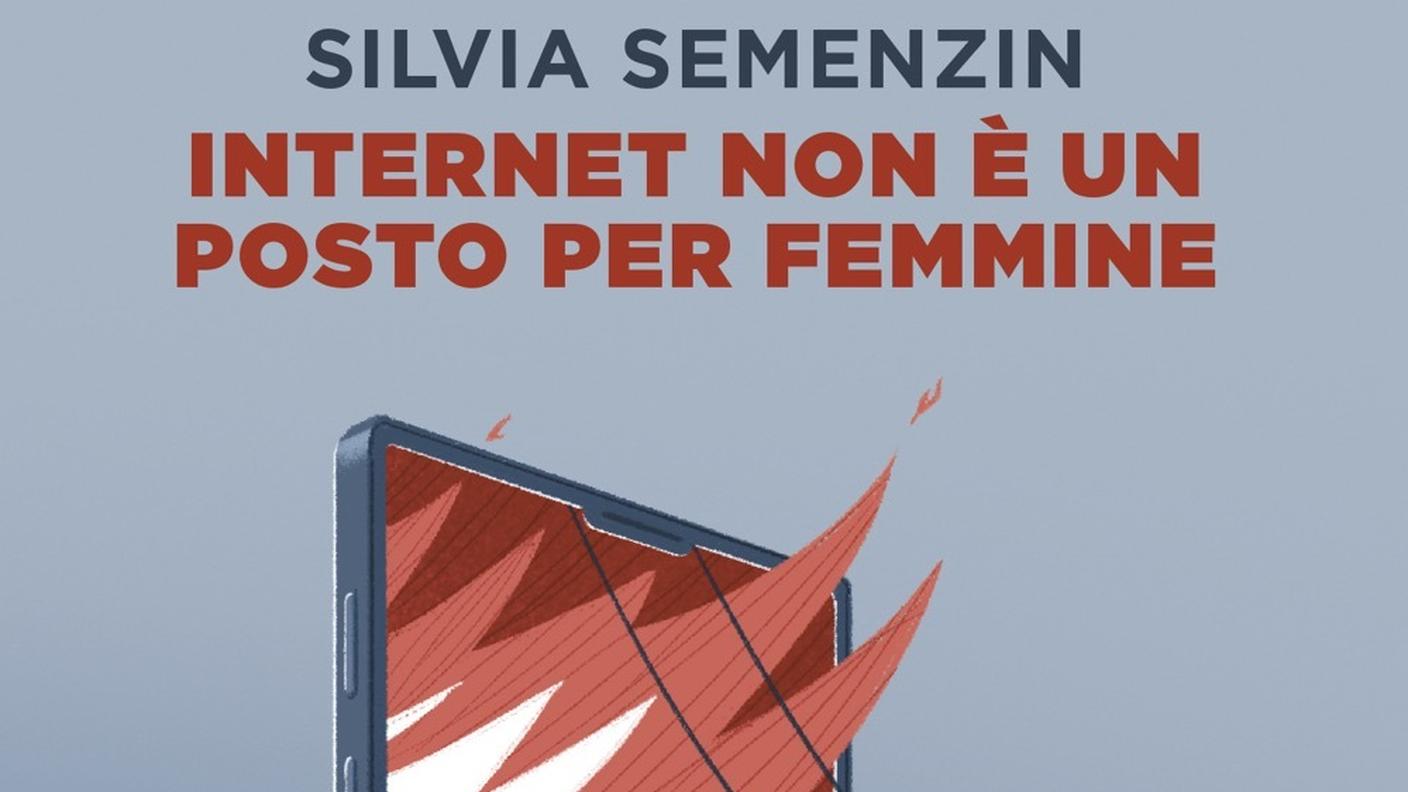
In her latest essay, Internet Is No Place for Girls, published by Einaudi, Silvia Semenzin shares a number of episodes that led her to become who she is today. She tells us that during her doctoral years in Milan, while studying the sociotechnical imaginaries of blockchain, she frequented certain Italian hacktivist circles, where people talked about surveillance, privacy, anonymity and freedom online: “about ten of us would meet in a bare little room filled with smoke at Macao (a well-known Milanese social center, Ed.).” Things changed when Semenzin began focusing more closely on online gender-based violence and platform regulation: “Someone started spreading the rumor that I was actually ‘an enemy of the internet’ and that my fight against the non-consensual sharing of intimate material threatened internet freedom and anonymity.”
“The last evening I showed up to the meetings, after I made some comments about the paradox of talking about freedom of expression online, considering that for many women it meant exposing themselves to daily harassment and threats, a guy suddenly stood up and stared at me, purple in the face: ‘Code is neutral! Learn to use it to protect yourselves!’ For me, it was a revelation. In that instant, I understood that everything presented as ‘neutral’ was nothing more than the clean face of a systematic process of erasing the non-male.”
The essay is built around this idea: the internet is not, and never has been, a neutral space. It is an environment shaped by power relations, economic interests, gender hierarchies and business models that often place profit above the safety of those who inhabit it. Today, this opacity is increasingly evident, including in lawsuits and hearings involving the heads of major platforms. But for many women, queer people and exposed subjectivities, the non-neutrality of the internet has long been a lived reality.
A digital sociologist, researcher and feminist activist, Semenzin has worked for years on online gender-based violence, digital misogyny and platform accountability. In 2018, she was among the promoters of #IntimitàViolata, the campaign that contributed to the introduction in Italy of the crime of non-consensual dissemination of intimate images, after having experienced that abuse firsthand herself. Fortunately, she did not let herself be stopped by those who had once been her hacktivist companions.
Internet Is No Place for Girls, however, is not only about violence. It is also an attempt to reclaim the political possibilities of the web: cyberfeminism, digital communities, online sex education, the spaces where the internet has been, and can still be, a place of freedom, connection, organization and love. A few months after the book’s release, we spoke with her about it.
The book shows that the history of the internet is tied to the subordination and sexualization of women: from the lack of recognition for their work in programming, to pornographic platforms, which served as an early laboratory for monetization, distribution and marketing, leading to the corporate internet we know today. In this history, there are also moments when the internet, I’m thinking of cyberfeminism, was imagined as a fluid space where a better society, freer from hierarchies and constraints of gender and identity, could be created. Today, a freer internet guided by love is your battle. In your own online experience, what have been the “spaces” where you felt free to express yourself? Where do you find or see that freedom today?
The internet is not only a space of oppression and power, but also one of experimentation and counterpower, all elements that together have helped shape modern digital spaces. In my experience, therefore, there have also been many positive experiences online, such as early forums and early social media, which allowed me to explore my interests and meet people outside my own circle, all the way to the way I use platforms today, which still continues to allow me to connect with new and like-minded people, as well as, despite censorship and shadowbanning, to make my work known beyond my immediate environment. Among the happiest experiences, I certainly remember the Virgin & Martyr project, which I carried forward for five years together with extraordinary colleagues. Through it, we brought sexual, socio-emotional and digital education to Instagram and into Italian schools. The project later stopped because of a lack of funding and because of the hostility our country continues to show toward this kind of initiative, but it was nevertheless a game changer, because it allowed me to get to know myself more deeply and to weave my studies on violence together with sex-positive, intersectional and inclusive perspectives.
In the essay, you report some rather disturbing data on algorithmic recommendation systems, which contribute daily to strengthening the “manosphere.” I’m thinking, for example, of the 2024 study conducted by researchers at the University of Dublin on the TikTok and YouTube algorithms, which found that accounts belonging to teenage boys are exposed to misogynistic content within the first 23 minutes of browsing. You also talk about similar mechanisms for women, the “femosphere.”
I have focused on observing how recommendation algorithms today privilege expressions of masculinity and femininity that reinforce gender stereotypes and contribute to shaping our digital expression. Examples of this dynamic can be found both in the more extreme forms of the manosphere and femosphere, such as incels, alpha males or tradwives, and in softer, more imperceptible forms, embodied by creators who narrate their everyday lives through aesthetics and stories hostile to feminism and gender equality, or who reaffirm the importance of conforming to gender stereotypes and toxic visions of romantic relationships. Digital trends such as, for example, “il malessere” on TikTok, which sociologist Roberto Graziano has studied, show very clearly how young people continue to romanticize patriarchal gender roles and an idea of love based on possession. For me, it is important to learn to recognize these nuances, so that we do not allow algorithms to educate us about gender relations and sexuality.
About six months after the book’s release, how has it been received? Have you received feedback you didn’t expect? What kind of reception has it had among male readers?
I’m happy with the reception. I have received a great deal of unexpected warmth, especially from people I did not know or from whom I did not expect an interest in the book. I’m thinking, for example, of women in their fifties or sixties who had never read a feminist text or a book about technology, and who found this reading useful in helping them orient themselves in the current context or approach feminism. From men, especially when the book was announced and had not yet come out, unfortunately I continue to encounter a certain hostility: some of them, having read only the title, felt personally called out and attacked me. Those who attended my presentations, however, were always very respectful and open to dialogue. I have also received feedback from readers who completed the entire book and felt more like allies in the fight for the liberation of the internet. This is important to me, because feminism is an issue that concerns everyone, not only women.
In the book, you talk about different forms of online gender-based violence, including starting from your own experience. When someone is subjected to this kind of treatment on the internet in Italy, what are the first steps to take and whom can they turn to?
In Italy, unfortunately, we are still behind when it comes to legal protections for those who experience digital violence. We have specific laws only for the non-consensual dissemination of intimate images and for deepfakes, although these are still largely built around the idea of “revenge porn.” Soon, however, we will have to implement the European Directive on violence against women, which will require Member States to define four forms of digital violence as criminal offenses: online incitement to hatred, cyberharassment, cyberstalking and the non-consensual dissemination of intimate material, including deepfakes. In any case, while we wait for these legal updates, my advice is always to turn to anti-violence centers, which in Italy still represent the main guarantee of competent, non-judgmental legal and psychological support that is attentive to gender issues. Looking ahead, it will also be important to support these centers in acquiring the technical skills and tools needed to remove online content, as already happens in other countries.
Speaking of laws, what do you think of proposals to ban minors from social networks?
I am against censorial laws that try to implement techno-solutions to address problems that are, first and foremost, social. Banning minors from accessing social networks is a patch on a much broader problem that remains unresolved, namely a digital economy based on models that are often unethical and, in some cases, deliberately toxic and violent. Moreover, anyone who wants to access the internet will always find a way to do so, and this is especially true of minors, who are often much more skilled than adults at finding alternative solutions. This is shown, for example, by the case of young people who bypassed age-verification systems in the United Kingdom in order to access pornographic websites by using fake mustaches. I therefore believe that the point is not to prevent access to technology, but to build a safer, more transparent digital ecosystem that respects the rights of the people who inhabit it.
What are you working on right now?
I continue to work on this issue from both an academic and a political point of view. I am writing several scientific articles, while together with feminist and digital rights networks we are working to ensure that the problem is regulated and taken more seriously by institutions. This means, for example, calling for the regulation of spaces that are not yet adequately scrutinized, such as Telegram, which remains a privileged place for the spread of online violence against women. It also means organizing so that, in Italy too, prevention can be carried out through sex education or through the creation of support and protection platforms for victims. I have many other research interests on the table, but this remains the one that makes me get up in the morning: the day I stop dealing with it will be the day we have solved the problem, and I hope that day comes soon.
Viola Giacalone