



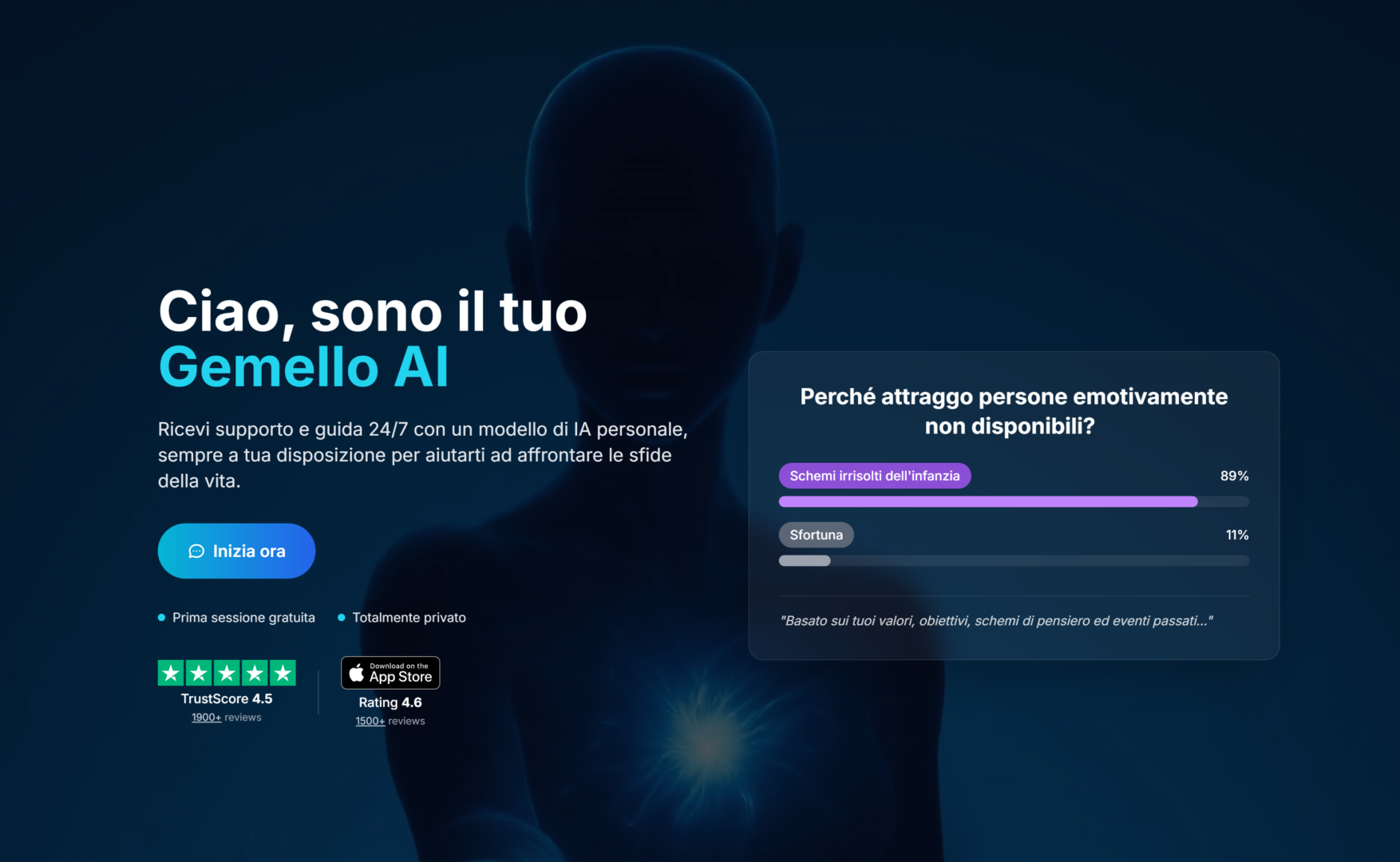
Copymind is a chatbot that promises to create a digital twin of the user in order to offer them “tailor-made” psychological dialogue around the clock. Born in the middle of the new race toward “relational” AI, meaning systems that no longer merely answer questions but try to simulate presence, intimacy, and emotional continuity, Copymind goes one step further: it sells itself as an external second mind. An interlocutor capable of learning from the personal and mental history of the person using it, only to liquefy and re-solidify into a digital doppelgänger ready to take you by the arm and guide you through self-analysis.
Through an initial questionnaire, the app asks the user what kind of twin-guide they would like: something more like a professional therapist, a motivational coach, an empathetic friend, or a problem-solver; and which approach they prefer among cognitive-behavioral, mindfulness, humanistic, or solution-focused methods.
The context of “AI Twins” is actually much broader and more serious: for years, medicine has been working on computational models that replicate the physiology or individual organs of a person, and that are used to simulate health risks and possible therapies. Copymind first and foremost shifts this logic from the body to the psyche, but above all from statistical clinical prediction to self-narration. In short, all scientific depth is lost, but the issue becomes philosophically interesting: what happens when the mirror starts asking us questions?
The About section promises 24/7 support, a “private” space in which to talk about thoughts, emotions, experiences, relationships, decisions, burnout, self-esteem, anxiety, loneliness, life purpose, mental clarity, financial well-being, and much more. All of this is accompanied by systems for breaking down decisions that have been made and learning from mistakes; 3D mindfulness-style value maps; organized and inferential data on fears, habits, and relationships. Officially, the app is classified under Lifestyle, and at the bottom of the page it states that the software does not provide, nor does it replace, medical or psychological diagnoses, treatments, or advice. A small note of reality that, for one second, cracks the grand promise behind the whole project.
Once the chatbot is launched, the user is subjected to a questionnaire with the typical rhythm of contemporary psychological onboarding: half confessional, half funnel. It opens, in fact, with an ego-referential claim: “in a recent Stanford University study, over 83% of people reportedly felt better after using an AI mental twin.” Here it is worth slowing down: I found no public, independent, and verifiable confirmation of this specific percentage. And when a technology that promises mental clarity leans on a statistic that cannot easily be traced, the least we can do is switch on the original brain. Stanford HAI, in 2025, instead published a research summary according to which therapeutic chatbots may be less effective than human therapists and, in some cases, produce dangerous responses or reinforce stigma toward certain mental health conditions.
As I was saying, however, the interesting point of the phenomenon is more philosophical than scientific. Because unlike a therapist, who acts as an intermediary between us and the discovery of ourselves, this system places us, unequivocally, in front of a fundamental component of psychology: narrative identity. Beyond what has happened to us, we are also the continuously revised edition of what we say has happened to us. And here AI becomes something like a ghostwriter of self-narration.
What happens when interpretive authority is automated? In therapy, the therapist’s authority derives from training and professional responsibility. Good therapy is not a machine designed to make you feel understood. Sometimes it is the exact opposite: we also pay because the person guiding us knows how to withstand our displeasure when they do not confirm us, helping us see the blind spot precisely because they do not limit themselves to our version of events. This is also shown by research on the therapeutic alliance.
Here, Copymind, and more generally the idea of the “AI therapist,” touches a culturally difficult zone. We have already been living for some time with machines that return optimized versions of ourselves to us: shuffle playlists that seem to know our daily mood, feeds that compensate for boredom before we even feel it, apps that measure sleep, heart rate, steps, calories, productivity. The AI twin adds one more step: beyond reflecting behavior, it lays bare the meaning we give to it.
Where does this intelligence come from, and what relationship does it have with psychological truth? An AI twin is born, with all due respect to the questionnaire’s multiple-choice questions and their hieratic tone, largely from what is verbalized. From the things the user writes and confesses. And in order to do this, the user has to consciously organize their own lived experience. But psychology, especially in its psychodynamic traditions, also arises from the suspicion that what we say about ourselves does not coincide with what moves us. The unconscious, however one wishes to understand it without summoning Viennese couches and symbolic mothers, is precisely what does not present itself obediently to a questionnaire. It is also made of omissions and transference. A chatbot can model linguistic patterns; it can identify contradictions; it can even ask useful questions. But it risks inhabiting, above all, the vast field of what has already been digested.
This does not make it useless. Quite the opposite: many everyday forms of suffering do not necessarily require an archaeological excavation of the soul down to the emotional Neolithic. Sometimes what is needed is to organize a thought, calm a spiral, remember that not every misfortune is a cosmic verdict. An approach like Copymind could work well as an interactive diary, perhaps precisely to better structure the time between one real psychological session and the next.
The problem arises when the metaphor-hope-utopian dream, because that is what we are talking about, let’s be honest, of the twin slips from reflection into replacement.
The reviews published on the website and on the App Store are interesting. Some users write that they feel as though they are in front of a friend, that they can say everything, that they receive the words they needed; one review says the app is less expensive and less demanding than therapy, another describes its responses as “more competent” than those of any psychiatrist or therapist they had met. These are subjective testimonials, not clinical data, but they perfectly describe the desire that drives the purchase: a therapist without waiting, without cost, without shame. The ancient dream of finally being understood without having to endure the opacity of another person. Too bad that the opacity of the other is also a rather central part of care, a detail we continue to find irritating.
The history of therapeutic chatbots, after all, begins almost with the history of chatbots themselves. ELIZA, created by Joseph Weizenbaum in the 1960s at MIT, imitated a Rogerian conversational style, reflecting the user’s sentences back in the form of questions. It was rudimentary, and precisely for that reason revealing: many people attributed understanding, presence, and intention to it. Weizenbaum was struck by the phenomenon. The so-called “ELIZA effect” is proof that we are semiotic animals with a desperate talent for seeing someone where there is something. If a machine returns a sentence to us with the right emotional rhythm, we fill in the rest. We tell ourselves we are social animals, but it is more accurate to say that we are first and foremost self-narrating beasts.
The decisive question, perhaps, is this: is therapy a conversation or an institution? If it is only conversation, then AI is already a formidable competitor: it speaks, remembers, summarizes, encourages, organizes, does not get distracted, does not judge, does not yawn. If, on the other hand, therapy is also a relational institution, made of competence, setting, limits, responsibility, body, and shared risk, then the AI twin is not a therapist: it is a powerful tool that speaks with the voice of the therapist, the diary, the friend, the coach, and precisely for this reason it must be handled with a level of care almost comically greater than the one with which we usually treat apps, namely by pressing “Continue” while ignoring the terms of service, the ancient liturgy of our administrative suicide.
The medical digital twin tries to predict the body. The consumer psychological twin tries to predict, or at least reformat, the narrated self. In the first case, the question is: how will this organism react? In the second: what story can I tell about myself in order to suffer a little less, choose a little better? The answer cannot be entrusted solely to a machine that optimizes relevance, fluency, and engagement. Because the human being often simply needs to be interrupted in their infinite monologue.
Copymind, paradoxically, is interesting precisely because it does not seem like science fiction. Its blind spot is the implicit promise that the self can be known better by making it more computable; that intimacy can be produced as an always-on service; that authority can emerge from a convincing tone and a long memory; that pain becomes more manageable if we transform it into input. Stripping away all the technological and digital parts, isn’t that what we already do to ourselves in the endless rumination of thought?
Niccolò Carradori