


Humanity has always explored new territories. It seeks resources, places to settle, lands to conquer. Sometimes planting a flag has been enough to claim ownership of a place; other times conflicts, wars, and territorial claims have begun and remained unresolved for decades or centuries. But how does it work in space? Or, to put it another way, who does space belong to?
Let’s take a step back in time, to 1967. We are in the middle of the Cold War, and the space race is more heated than ever. The Soviet bloc and the U.S. bloc had already begun filling the sky with artificial satellites, and two years later NASA would plant the first flag on the Moon, with the legendary Apollo 11 mission. It was precisely in this context of rivalry that the major powers of the time gathered around the table to draft the Outer Space Treaty, an international treaty regulating the activities of nations in outer space. Today there are 138 signatories in total, including all the major space powers. But what does the treaty provide for?
First of all, that activities in space must be carried out in the interest of all humanity, and not of a single nation: “outer space shall be the province of all mankind,” and astronauts are its ambassadors. No nation can proclaim sovereignty over any celestial body, meaning that no one can appropriate space. No one can place nuclear weapons or other weapons of mass destruction in orbit or on other celestial bodies: the Moon and other celestial bodies must be used only for peaceful purposes. Finally, nations must avoid contaminating other celestial bodies and are responsible for damage caused by their objects in space.
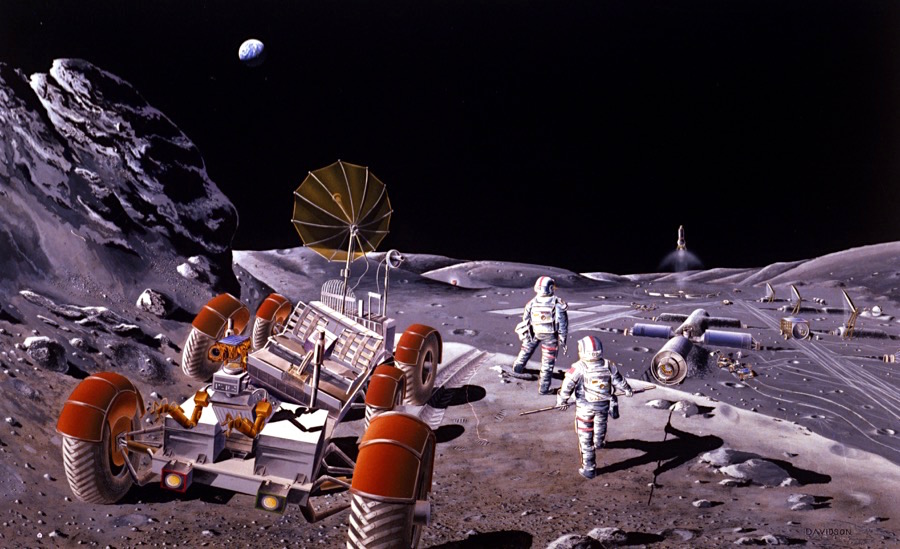
The fact that no one can appropriate a celestial body, however, does not imply that it cannot be used. For this reason, the principle does not conflict with the construction of bases on the Moon, such as those planned under the Artemis program. It does, however, risk coming into conflict with possible future asteroid mining operations. For some time, people have been considering the possibility of extracting precious resources from asteroids, such as rare earth elements and precious metals, and then bringing them back to Earth: would that not perhaps be “appropriating a celestial body”?
It must be said that the Outer Space Treaty is a treaty of great value and one that should be protected. But as we well know, in political practice international treaties are often violated even on Earth. Obviously, there are problems: although weapons of mass destruction and nuclear weapons are prohibited, the treaty does not rule out the possibility of placing conventional weapons, for example, on the lunar surface. Is it really so unlikely to imagine a science-fiction future in which we will have exported war into space as well? It is undeniable that even today many conflicts are supported by the space economy, such as geolocation carried out through satellites for military drone targets.
Furthermore, although the major space powers have ratified the treaty, not all the actors involved have done so. Some nations are missing from the list, and thinking in the long term, it is possible that other actors will enter the scene and decide not to view space in those peaceful terms, which could create tensions. Then there are private actors. Private companies such as SpaceX are not signatories to the treaty: it is the nations they belong to that must answer for their activities, but this supervision is often vague and difficult to enforce.
Truth be told, even space achievements themselves are generally seen for propaganda purposes and exploited politically to glorify national pride: this goes against the principle of space and astronauts as envoys of all humanity. Armstrong’s first step on the Moon was “one small step for man, one giant leap for mankind,” but beyond the rhetoric based on the same principles as the Outer Space Treaty, that step was American because it led the U.S. bloc to win the space race.
The Outer Space Treaty is therefore not an endpoint, but a starting point. Other treaties and space laws must be based on it, ones that can truly serve as administrators of peace for the future of humanity in space.
Luca Nardi