


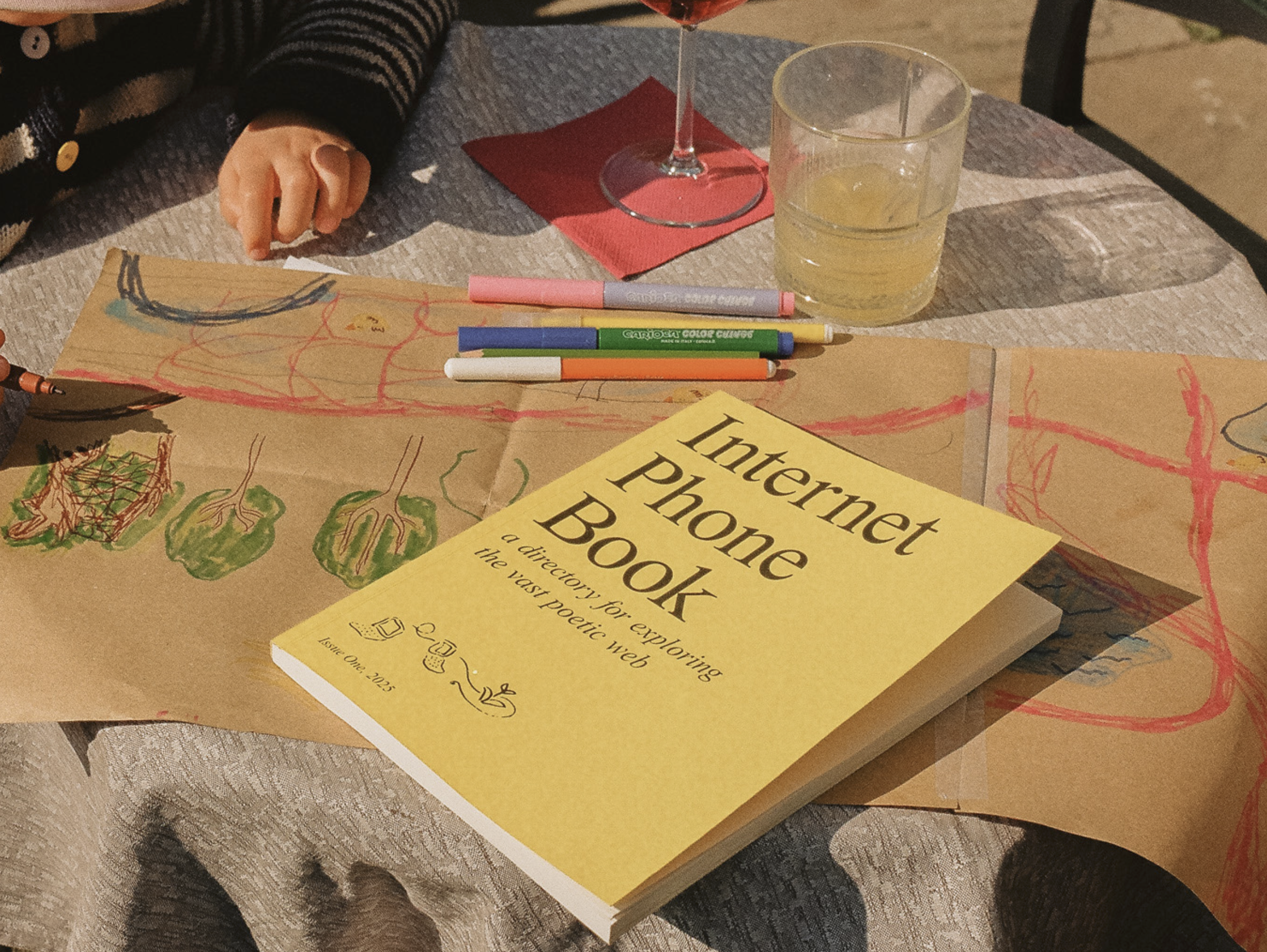
About a year ago, a yellow phone book began appearing in the Instagram stories of a number of designers, academics, and intellectuals I have followed for years. On the cover it said Internet Phone Book, and it could be bought online and in independent bookstores in various European capitals, while supplies lasted. Inside, as one would expect, there was a list of numbers. Calling them from a mobile phone, however, would be pointless: next to each one there is no person to call, but a personal website to visit.
To get there, you type the number into the website internetphonebook.net/dial: from there, you are redirected to another web page, without having to copy out its full address. Each entry is accompanied by the time zone of the person who runs the site and the “weight” of the page in kilobytes; every now and then, a little flower marks the ones the curators found especially beautiful. It was created by Kristoffer Tjalve and Elliott Cost, who for years have been frequenting the less-traveled corners of the web.
The Internet Phone Book is a convenient gateway to a phenomenon that, for several years now, has been experiencing a small revival, and that goes by different names depending on who is talking about it: indie web, small web, handmade internet, poetic web. The programmer Kevin Boone, who has written about it on his own website, gathers them all under the label retro-web. Whatever one wants to call it, it refers to a constellation of personal websites built more or less from scratch by their owners, devoted to a niche topic or simply to the passions of the person who created them, designed to be explored by jumping from one link to another rather than by scrolling through a feed decided by an algorithm.
“We always think of the history of the internet as a progression: first there was a web made up of independent sites, then came web 2.0, then we moved from desktop browsing to mobile browsing,” Tjalve, one of the curators of the Internet Phone Book, told me over the phone. In reality, however, the web of small, eccentric, highly personal sites “never disappeared: it simply moved away from the collective consciousness for a while.”
If it had not disappeared, then why does it feel as though we have not seen it for ages? This mainly has to do with the fact that, with the commercialization of the web and the rise of social networks, an enormous number of people came online who had never opened a personal website or blog, and who only ever experienced a noisy internet built around commercial mechanisms of attention and far removed from the idea of a space where one might stop and create something of one’s own. Meanwhile, platforms increasingly discouraged links to external sites, because every link leading away from the feed is time stolen from scrolling; and as links between one site and another grew scarcer, the web made of pages referring to one another became harder even to see.
According to Tjalve, if many people today, including some who had never experienced the web before social networks, are once again curious about the idea of exploring small and strange websites, it is largely because of a mixture of fatigue and desire. “I think people are pretty tired of social media in all its forms,” says Tjalve. “Bored by content generated by artificial intelligence, and looking for anything that feels a little more human.” In recent months, for example, the site Your AI Slop Bores Me has attracted a lot of attention. It was created in March by Mihir Maroju, a seventeen-year-old student from Puducherry, India. The site works exactly like ChatGPT, but instead of a language model, a real person replies, chosen at random among the other users connected at that moment. To ask a question, you first have to earn credits by answering other people’s questions while pretending to be an AI, with sixty seconds to do so. The site reached twenty-five million unique visitors in just a few weeks.
Almost always, however, the little sites of the indie web are not born with an explicitly critical intent toward social networks or artificial intelligence: they simply offer an alternative, and above all entertain the people who create them. Some connect their site to the physical world: feral.earth, by Austin Wade Smith, runs on a small solar-powered server connected to a weather station, and it is the real environmental conditions around that server, the wind, the tides, the phases of the moon, the sun hitting or not hitting the panel, that determine which pages can be opened and which remain inaccessible for the time being; visiting the entire site takes about four months.
Some have tried to make the web into a shared real-time space: One Million Checkboxes, by Nolen Royalty, was simply a page with a million boxes to tick, except that each box ticked changed at the same instant for every other visitor too, turning it into a kind of collective game among strangers. It remained online for only two weeks, in 2024, before its creator shut it down.
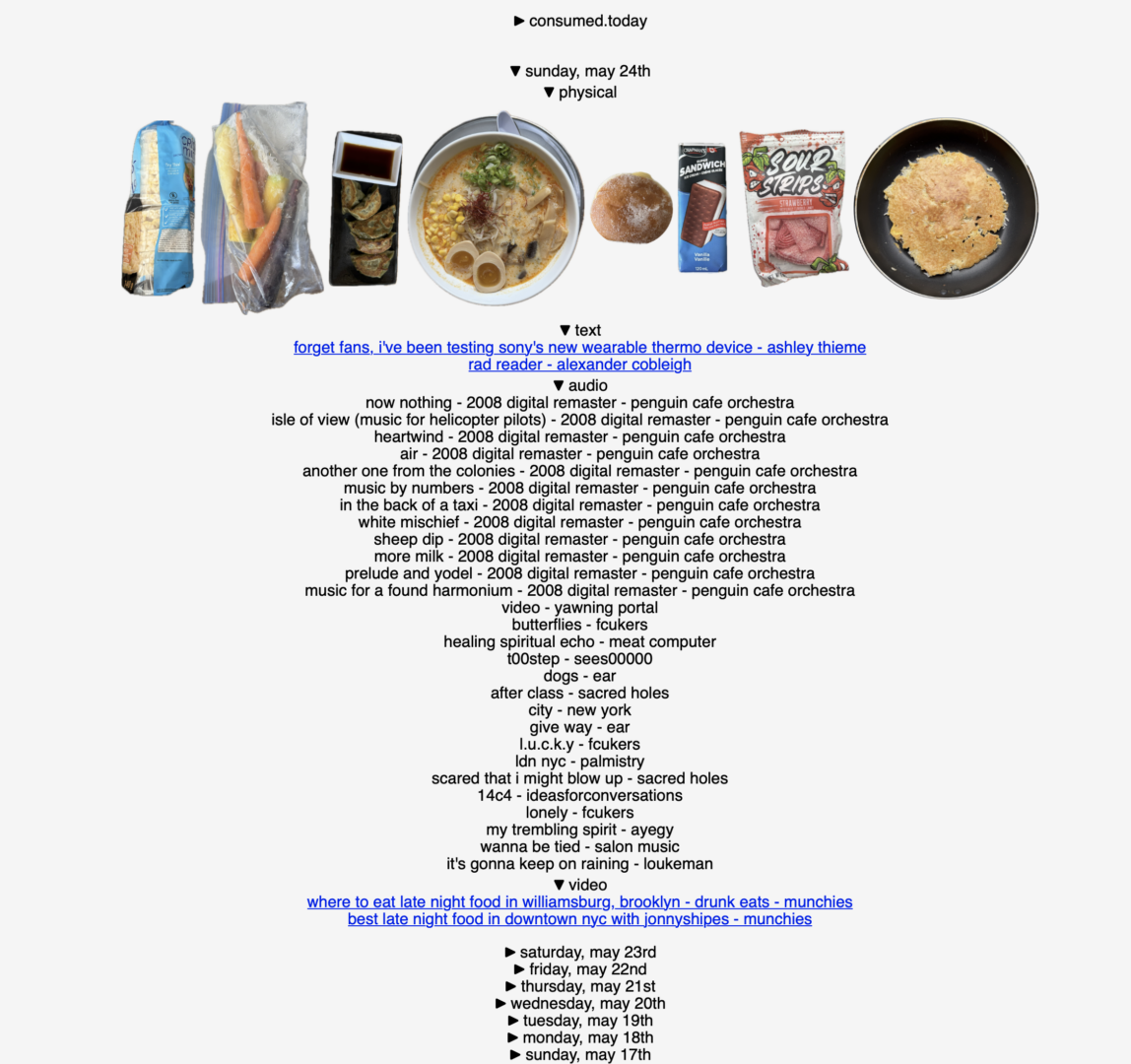
Then there are those who use their site as a meticulous diary: on Consumed Today, the author who goes by the nickname Shen records everything he “consumes” each day, not only meals, photographed one by one, but also what he reads, watches, and listens to, building an intimate archive that satisfies the slightly voyeuristic curiosity of whoever happens upon it. And there are those who try to replace one experience with another: One Minute Park, by Elliott Cost, collects one-minute videos shot in parks around the world, and shows a different one for every minute of the day, as though offering a breath of fresh air to those who, at that moment, cannot go to a park.
Underneath all this lies a precise idea of what the internet should be: not a television channel to be passively consumed, but what Tjalve calls a “relational technology,” the place where friends and loves are met and where one comes to understand something about oneself. But where does one begin, both to discover it and to help keep it alive?
A first problem, naturally, is that finding these sites is not immediate if you do not know where to look. “You certainly don’t stumble upon them while scrolling through social media, but often they don’t even appear if you search on Google,” says Tjalve. The solution, he says, involves recovering tools that seemed obsolete. First, there are printed directories such as the Internet Phone Book, in which every site appears because its author submitted it. “We are not the ones indexing the internet: it is the internet saying it wants to be part of this thing,” Tjalve explains. Then there are various search engines designed specifically for personal websites, such as Marginalia, which favors textual and non-commercial pages, or Wiby, which draws from old-style pages, bare and somewhat rudimentary, like those of twenty years ago.
To these are added platforms such as Neocities and Nekoweb, services that allow anyone to publish their own website for free without knowing how to build one from scratch, and that also showcase those of other users, so that from one you end up poking around in another. And there is Are.na, a kind of online filing cabinet where everyone archives the things they find in thematic folders and can rummage through those of others, which Tjalve identifies as the tool that has helped more than any other in finding one’s bearings.
But what holds everything together above all is the link, the oldest tool of the web. Many personal sites host a blogroll, that is, a list of other sites their author appreciates and recommends to visitors, so that from a page one likes, one arrives at those of its “neighbors,” and then at the neighbors of the neighbors. Others belong to a “web ring,” a group of sites devoted to the same theme and connected in a circle, each with a link to the previous and the next, so that they can be browsed one after another without going through a search engine. And to follow updates from the sites one has discovered, without relying on notifications or algorithms, there is RSS, a technology from 1999 that gathers in one place the new content published by the pages to which one has subscribed.
Tjalve emphasizes that this is not mainly an English-speaking phenomenon: in Europe, for example, communities have existed for decades that gather primarily outside social networks, meet, publish books, and run their own servers, such as servus.at in Austria, Varia in Rotterdam, and Aksioma in Ljubljana. Similar scenes are emerging in Korea, the Philippines, and Vietnam.
The main obstacle, especially for those who did not hang around the web before social networks, is how to actually build the website of one’s dreams. Tjalve, however, says that all it takes is scaling down one’s expectations and focusing on fun: “I barely know how to code myself,” he admits. His first site that got a bit of attention was basically a Google spreadsheet embedded in a page, because at the time he did not know how to do anything else; there are others made of a single text file. “A website can be anything,” he says.
From a practical point of view, in any case, one can begin with one of the many website builders, or upload one’s pages for free to GitHub Pages. And once inside, the beauty of it is precisely the freedom to take whatever form one wants, far from preset templates that force people into boxes. “You build your own space and you build your own neighbors, and you take care of it yourself,” says Tjalve. His advice for beginners is as simple as possible: start small and figure things out along the way.
Tjalve does not seem interested in making this internet reach an enormous number of people. He himself, he says, is “a small-town type,” the kind of person who goes down into the street and knows the baker by name, and says he only hopes that people know this internet exists and understand its value, leaving each person to choose how they want to spend their time online.
Viola Stefanello