



In February 2025, Donald Trump posted on his Truth Social profile the infamous AI-generated video depicting a post-genocide Gaza complete with gleaming skyscrapers, Elon Musk gorging himself on hummus, golden statues of the US president, and bearded women dancing on the beach.
It was one of the first viral examples of “slopaganda,” a neologism combining slop, meaning mass-produced artificial junk, with political propaganda. The content was bizarre and absurd, to say the least, and, given the severity of the situation in the Gaza Strip, it understandably sparked outrage around the world.
Another circumstance made the whole affair even more grotesque: Trump had amplified a piece of content originally conceived as political satire directed against him.
The clip had in fact been created by Israeli-American filmmaker Solo Avital, who intended it as a criticism of Trump’s megalomaniacal plan to turn Gaza into the “Riviera of the Middle East.” The US president had not only reversed the meaning of the video, but had also exploited it to give the plan visibility and embed it in the global imagination.
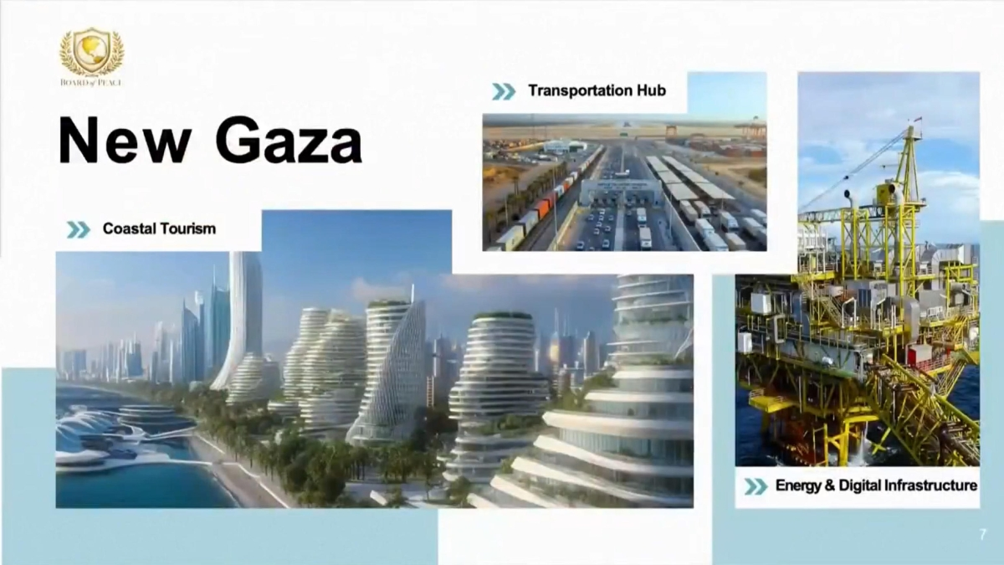
The futuristic buildings, luxury resorts, lush greenery, and lavish Miami-style waterfront later reappeared in a series of slides presented by Jared Kushner at the World Economic Forum in Davos as part of the launch of the Board of Peace, Trump’s parallel version of the United Nations.
In January 2026, the son-in-law of the 47th US president unveiled the “New Gaza” project before the audience. Flicking through maps and renderings that looked as though they had been lifted from the brochures of a fourth-rate real estate agency, Kushner promised that the reconstruction of the Strip would generate spectacular business opportunities and “opportunities for everyone,” except, obviously, for the Palestinian population, who were neither mentioned nor involved.
According to an article in the Financial Times, Kushner and the Board of Peace’s plan also included the creation of a dedicated stablecoin, a cryptocurrency pegged to the US dollar, to boost the economy of the “New Gaza.”
In essence, the Strip imagined by Trump and his son-in-law was a kind of crypto tax haven for the world’s ultra-rich. Or worse still, to borrow journalist Gil Duran’s caustic description, it was “a techno-fascist casino built on the ruins of genocide and ethnic cleansing.”
In the end, however, Kushner himself shelved the plan. In July 2026, he acknowledged that neither the funding, the conditions, nor the political will existed to transform Gaza into an ultramodern city-state. “Change is like heaven,” he said. “Everyone wants to go there, but nobody wants to die.”
Although the “New Gaza” project has failed, the idea of creating extraterritorial, hyper-technological enclaves remains rather fashionable among certain sections of the US ruling class and the techno-oligarchs of Silicon Valley.
Indeed, quite a few of them subscribe to an ideological project known as the “Network State.”
The concept was devised by Balaji Srinivasan, an entrepreneur who founded several startups and served as chief technology officer at the cryptocurrency exchange Coinbase.
In 2022, Srinivasan published The Network State: How to Start a New Country, in which he advocates the creation of a series of privatized, automated “startup states” governed by algorithms, shielded from the laws and tax systems of sovereign states, and exempt from compliance with international treaties. It is both a secession of the ultra-rich from liberal democracies, regarded as excessively stifling and oppressive, and a form of techno-libertarian neocolonialism.
On closer inspection, however, the entrepreneur did not invent anything new. He simply took similar ideas previously formulated by various thinkers and repackaged them in the techno-enthusiastic language typical of startup founders.
One of Srinivasan’s main influences is the anti-communist philosopher Ayn Rand, the founder of Objectivism and widely regarded as one of the intellectual mothers of American libertarianism.
In her 1957 novel Atlas Shrugged, Rand describes a utopian community known as “Galt’s Gulch,” where entrepreneurs, inventors, and scientists take refuge after abandoning a society that overtaxes them and plunders their talent in the name of collectivism. Galt’s Gulch embodies Rand’s ideal of a world in which private property is sacred and untouchable, and individuals pursue their own self-interest without concern for society as a whole.
A similar vision also appears in The Sovereign Individual, the ultra-libertarian manifesto written in 1997 by James Dale Davidson and William Rees-Mogg. The authors argued that the digital revolution and cryptography would erode the power of nation-states, encouraging the emergence of a constellation of city-states and enclaves for the ultra-rich, whom they compared, without irony, to deities.
Davidson and Rees-Mogg’s book was one of the major intellectual influences on Peter Thiel, Silicon Valley’s most reactionary magnate. It also inspired Patri Friedman, grandson of the free-market economist and Nobel laureate Milton Friedman, to establish the Seasteading Institute in 2008, an organization dedicated to creating floating city-states and funded by Thiel himself.
Another key source for Srinivasan also dates back to 2008: Patchwork: A Political System for the 21st Century, a pamphlet by neoreactionary blogger Curtis Yarvin. Much like Davidson and Rees-Mogg before him, Yarvin imagines a future in which nation-states are replaced by thousands of microstates run like joint-stock companies.
The political legitimacy of these micronations would not derive from democratic consent, which Yarvin despises, as his later writings would make even clearer, but solely from their ability to retain capital and residents. The latter would be free to “exit” one micronation and move to another in search of better conditions.
Balaji Srinivasan’s “Network State,” then, is essentially a compendium of these ideas adapted to the Trump era.
The entrepreneur outlines two paths for establishing a Network State: using money and political influence to buy governments, or purchasing land and building a new state from scratch, in what Srinivasan calls an operation of “techno-Zionism.”
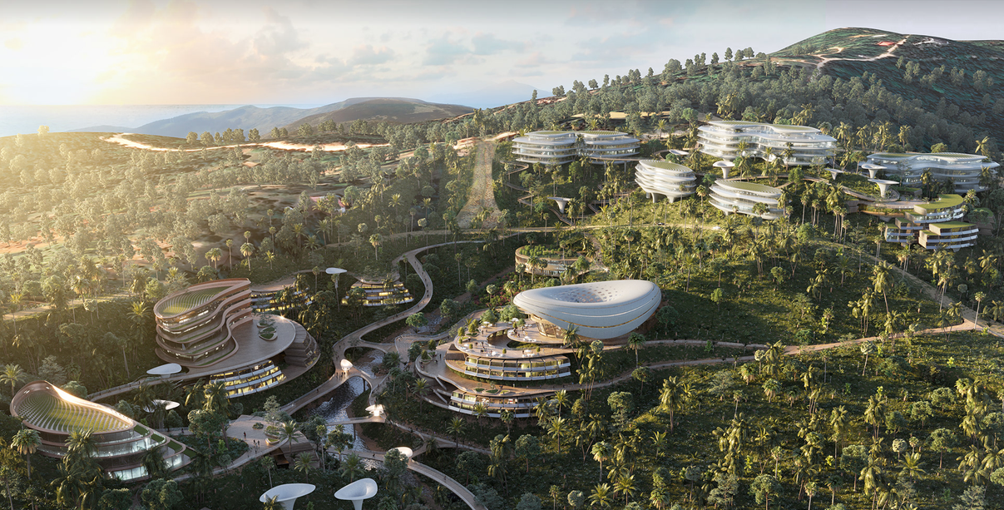
This second option has already been pursued by several projects. One of the best known is Próspera, a special-regime city built from 2017 onwards on the island of Roatán, Honduras. The “startup state,” as the press has dubbed it, is located in one of the four “Zones for Employment and Economic Development” (ZEDEs) created in 2013 by then-president Porfirio Lobo to attract private investment, particularly from abroad.
The investors behind the company that owns Próspera include investment funds linked to Peter Thiel, Netscape founder Marc Andreessen, OpenAI’s Sam Altman, the aforementioned Patri Friedman, and other techno-oligarchs. In 2024, Bryan Johnson, the billionaire biohacker obsessed with longevity, flew to the island to undergo an experimental treatment developed by the startup Minicircle.
Unsurprisingly, Próspera is fiercely opposed by the local population, which in recent years has repeatedly protested against land expropriations and the plundering of natural resources, including fresh water.
In response to public criticism, the Honduran government then led by Xiomara Castro repealed the law authorizing the ZEDEs in 2022. Próspera immediately filed an international lawsuit seeking eleven billion dollars, claiming that the state had violated its contractual obligations. Were the city-state’s claim to succeed, Honduras would face bankruptcy: the amount demanded by Próspera is equivalent to one-third of the country’s GDP.
The case is still ongoing, but attitudes towards Próspera in the country have shifted following the highly contested election of the new right-wing president, Nasry Asfura. According to an article in The New York Times, Trump openly backed Asfura’s election campaign, despite his ties to the MS-13 criminal organization, precisely in order to save Próspera and the concept behind it. As journalist Jean Guerrero wrote, the logic behind Trump’s interference in Honduras is to “expand the territorial power of a transnational elite that sees itself as above the law.”
Trump himself, after all, had promised during the election campaign to build at least ten “Freedom Cities” in the United States, which would not be subject to federal regulations.
As Wired reported, the extralegal status of the Freedom Cities would make it possible to create areas where “experimentation with anti-aging technologies, the development of nuclear reactors, and the construction of buildings could proceed without prior approval from government agencies.”
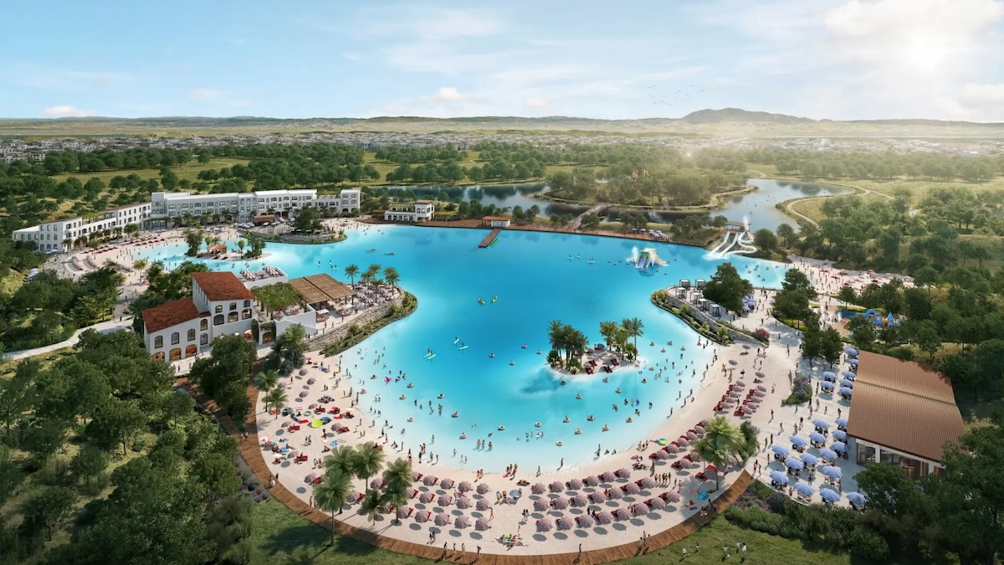
One of these cities could arise in California. Starting in 2017, the company Flannery Associates purchased as much as 22,000 hectares of land to build a city-state project called “California Forever,” financed by Silicon Valley heavyweights such as Reid Hoffman, the co-founder of LinkedIn, and Marc Andreessen.
Another “freedom city” could be established at the Guantánamo Bay military base in Cuba. Or at least, that is what Palmer Luckey, the founder of the military-tech company Anduril, hopes for. “The United States should immediately expand its naval base at Guantánamo by turning it into Liberty City, a kind of American Singapore in the Caribbean,” he wrote on X. In Luckey’s view, this city-state should attract Cubans and deprive the Communist Party of “workers in crucial sectors,” thereby accelerating “the fall of the regime.”
Another project that combines Srinivasan’s Network State ideology with the expansionist ambitions of the Trump administration is Praxis. The startup was created by former surfer Dryden Brown and has received millions of dollars from the usual figures: Thiel, Altman, the Winklevoss twins, and other techno-oligarchs.
In Brown’s vision, Praxis will be “a tax-free enclave” ruled by “a monarch-CEO at the head of shareholder-citizens.” Like Yarvin and Srinivasan, Brown is no great admirer of democracy. On the contrary: according to Mother Jones, he is rather fixated on scientific racism and fascist intellectuals, from Julius Evola to Alexander Dugin.
Brown is obsessed with Greenland, which is where he wants to build Praxis. Two years ago, he personally went to the capital, Nuuk, to “try to buy it,” while more recently he supported Trump’s menacing attempts to annex the semi-autonomous island.
Finally, Balaji Srinivasan himself has also tried to put his theory into practice. In 2024, he announced the creation of the Network School, a kind of academy aimed at entrepreneurs eager to create their own “Network State.”
As its physical location, Srinivasan chose the ghost city of Forest City on the island of Johor, in Malaysia. From the outset, the local authorities did not look kindly on the American entrepreneur’s project. Then, when rumors spread that Srinivasan planned to bring Israeli passport holders to Johor, despite their formal ban on entering the country, the reaction was extremely harsh.
Although the rumor later proved to be false, the controversy surrounding Srinivasan’s academy did not die down. What came under scrutiny was the Network State project itself, which public opinion viewed as an unacceptable attempt to undermine the country’s independence.
Srinivasan demanded a meeting with Malaysian Prime Minister Anwar Ibrahim, threatening to withdraw investments. The attempted blackmail failed. On July 21, Onn Hafiz Ghazi, the Chief Minister of the state of Johor, announced that he had revoked the Network School’s license because “no entrepreneur, company, or organization is above the law of a sovereign country.”
In short, the Malaysian authorities recognized the danger inherent in the concept of the Network State. And they acted accordingly, reaffirming that there is no room for a movement that, to quote journalist Gil Duran, seeks to replace democracy with “a new form of extremism that is networked, funded by cryptocurrency, and cloaked in the language of freedom.”
But the city-states imagined by Srinivasan have, in fact, nothing to do with freedom: they are authoritarian, neocolonial dystopias for the ultra-rich, embodying in every respect the essence of twenty-first-century techno-fascism.
Leonardo Bianchi