



The British Film Institute has long served as one of the world’s foremost custodians of moving images. Its vast archive stretches from public information films shown on the BBC after World War II to early newsreels, silent films, home movies shot by ordinary Britons and landmarks of British cinema such as Lawrence of Arabia and the films of Alfred Hitchcock. The institution’s mission is deliberately expansive: to preserve every form that moving images have taken over the past century, documenting how people in Britain have lived, informed themselves and entertained one another.
That ambition now extends to a medium few would instinctively associate with a national archive. Over the past several months, the BFI has assembled a team devoted to identifying and preserving the internet’s earliest memes, GIFs and viral videos.
Few national institutions have taken on the challenge, and those that have adopted markedly different approaches. There is no established blueprint for deciding which fragments of online culture deserve preservation—or how they should be archived.
The Internet Archive, for example, attempts to capture the web itself, page by page, but it is a nonprofit organization rather than a national institution with a clearly defined collecting mandate. In the Netherlands, the Netherlands Institute for Sound and Vision has spent years working directly with creators and influencers, regularly acquiring original video files while also preserving the web pages where those videos first appeared. London’s Victoria and Albert Museum has taken a different route altogether, acquiring Me at the Zoo—the first video ever uploaded to YouTube—and recreating YouTube’s 2006 interface so visitors can experience what that page looked like nearly two decades ago.
The BFI has chosen a more archival approach. Every selected video is accompanied by detailed cataloguing information, including its creator, publication date and technical metadata. Rather than downloading publicly available copies, curators ask creators to provide the highest-quality original file still in their possession. Whenever possible, those files are also accompanied by an essay explaining why a particular work was considered worthy of preservation.
So far, roughly 430 videos have entered the collection. Around 60 are already available through Replay, the BFI’s digital archive, which can only be accessed from public libraries across the United Kingdom.
Browsing the collection feels less like scrolling through the internet than walking through an archaeological record of its earliest years. There is the webcam installed at the University of Cambridge in 1991 to monitor whether the office coffee pot was empty—a feed widely regarded as the world’s first livestream. There are Flash cartoons that circulated by email long before social media existed, interactive web dramas such as Online Caroline, some of the earliest video blogs and countless instructional videos explaining how to accomplish everyday tasks.
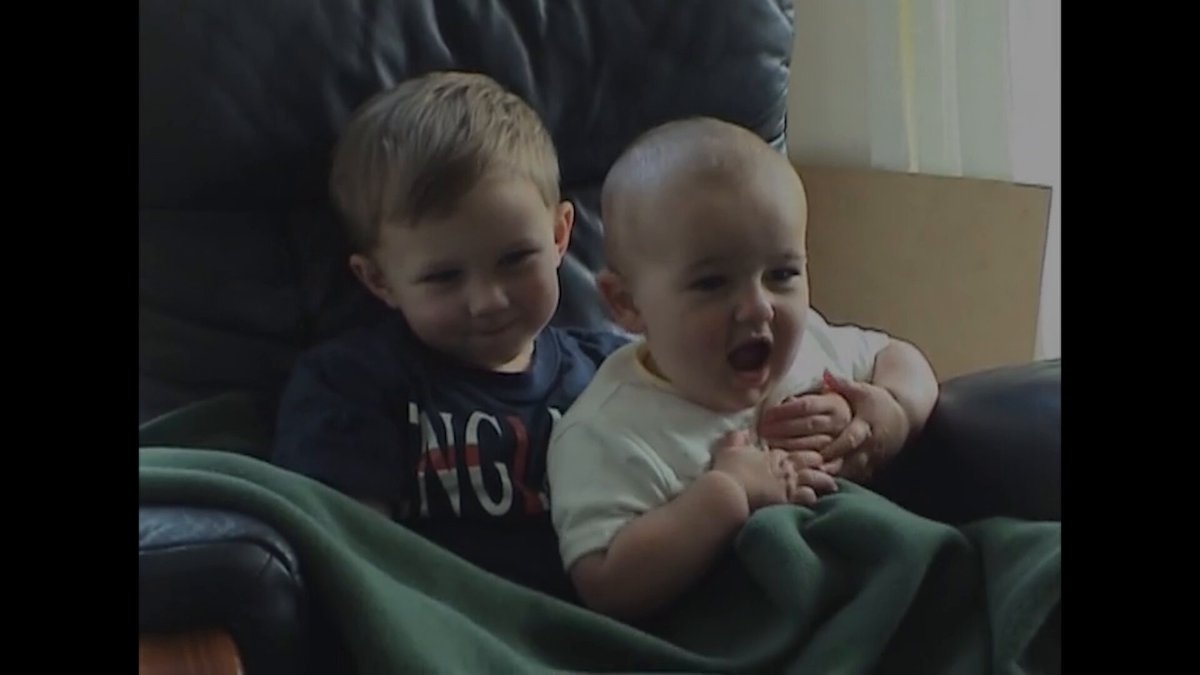
The archive also preserves internet folklore that transcended national boundaries: Mr. Weebl’s endlessly looping animated badgers; Charlie Bit My Finger, the home video that became one of YouTube’s defining early viral hits; the endlessly reused GIF of Robert Redford nodding in approval; a man providing sports-style commentary while his Labradors eat from their bowls; and The Daily Star‘s 2022 livestream comparing the lifespan of an iceberg lettuce with that of Prime Minister Liz Truss’s government.
“For archivists, the value of these videos is fairly self-evident,” says Will Swinburne, one of the project’s curators.
His reasoning is shaped by the history of early cinema. Many of the first motion pictures were treated as disposable entertainment and discarded once they had served their immediate purpose. Historians now regard those losses as irreparable. Preserving online video, Swinburne argues, is an opportunity not to repeat the same mistake.
Unlike film, however, the internet cannot be collected exhaustively.
The BFI receives every film released theatrically in Britain and records the nation’s television output. The web offers no such possibility. Selection is unavoidable.
Popularity alone is not the deciding factor.
“We weren’t interested simply in how many views something had,” Swinburne says. “We were interested in the kinds of video cultures that only exist online—or exist because of the internet.”
His own favorites are often videos that hardly anyone watched.
“They may have only a handful of views,” he says, “but they represent an entire style of online filmmaking.”
He points to an ordinary tutorial explaining how to install a blackout blind. Viewed in isolation, it appears insignificant. Seen historically, it represents a vast corner of internet culture built around strangers teaching one another practical skills.
“The goal,” Swinburne says, “is to document which parts of everyday human life migrated online. One of those is learning how to hang a blind. Another is figuring out how to repair a toilet.”
The project rests on a simple observation: despite its reputation, the internet is far less permanent than most people imagine.
When Adobe discontinued Flash at the end of 2020, generations of animations and browser games effectively disappeared overnight. A server failure at MySpace erased nearly all music uploaded before 2016. Vine shut down, taking much of its cultural record with it.
“None of these platforms exists to function as an archive,” Swinburne says. “They make no promise that the work people upload will still be there in the future.”
In practice, truly lost material is relatively uncommon. The greater obstacle is legal rather than technical.
Because the BFI is a national archive, it cannot simply download videos from the internet. Every acquisition requires the creator’s permission and an original file supplied directly by its owner.
Those files occasionally reveal remarkable stories of their own. As part of the preservation process, the BFI extracts technical metadata, including the date a file was originally encoded.
“It’s wonderful when you receive a file and discover it was encoded in 2006,” Swinburne says. “You know someone kept it on a hard drive for nearly twenty years. But it doesn’t happen very often.”
For months, he has been trying to locate what he believes is the first British video ever uploaded to YouTube, dating back to 2005. The footage lasts only a few seconds: a group of drunken wedding guests dancing in heavily pixelated resolution. The channel has been inactive for two decades, and there is no obvious way to identify who uploaded it. Every lead has reached a dead end.
The same is true of another video Swinburne hopes to preserve: a London resident’s vlog recorded on July 7, 2005, the day of the terrorist bombings. Speaking directly into his phone while walking around his home, the man wonders aloud whether he should leave London or stay.
“It’s incredibly immediate,” Swinburne says. “It captures a huge historical event from an intensely personal perspective.”
The creator has never been found.
That requirement for consent also overturns one of the internet’s most familiar anxieties: the fear that nothing online can ever truly disappear.
The BFI cannot preserve a video against its creator’s wishes.
Swinburne says he has spoken with former creators who uploaded videos as teenagers and now feel they belong to a different person entirely. Some would rather those works be forgotten. In those conversations, he explains that preserving a video today does not require anyone to revisit it publicly. Decades from now, it may become an important historical record.
“We’re not a prison for videos,” he says. If creators have concerns about how they are represented in archived material, the institute is prepared to discuss them. Preservation, in this project, is intended to be collaborative rather than extractive.
Once acquired, every video is stored according to standard archival practice: three separate copies are written onto LTO magnetic tapes and housed in deep storage facilities where robotic systems manage the collection across multiple locations. As technology evolves, the files will be migrated to new formats.
The commitment, Swinburne says, is simple.
The BFI intends to preserve them “for as long as governments exist—and as long as their archives do.”
Viola Stefanello