


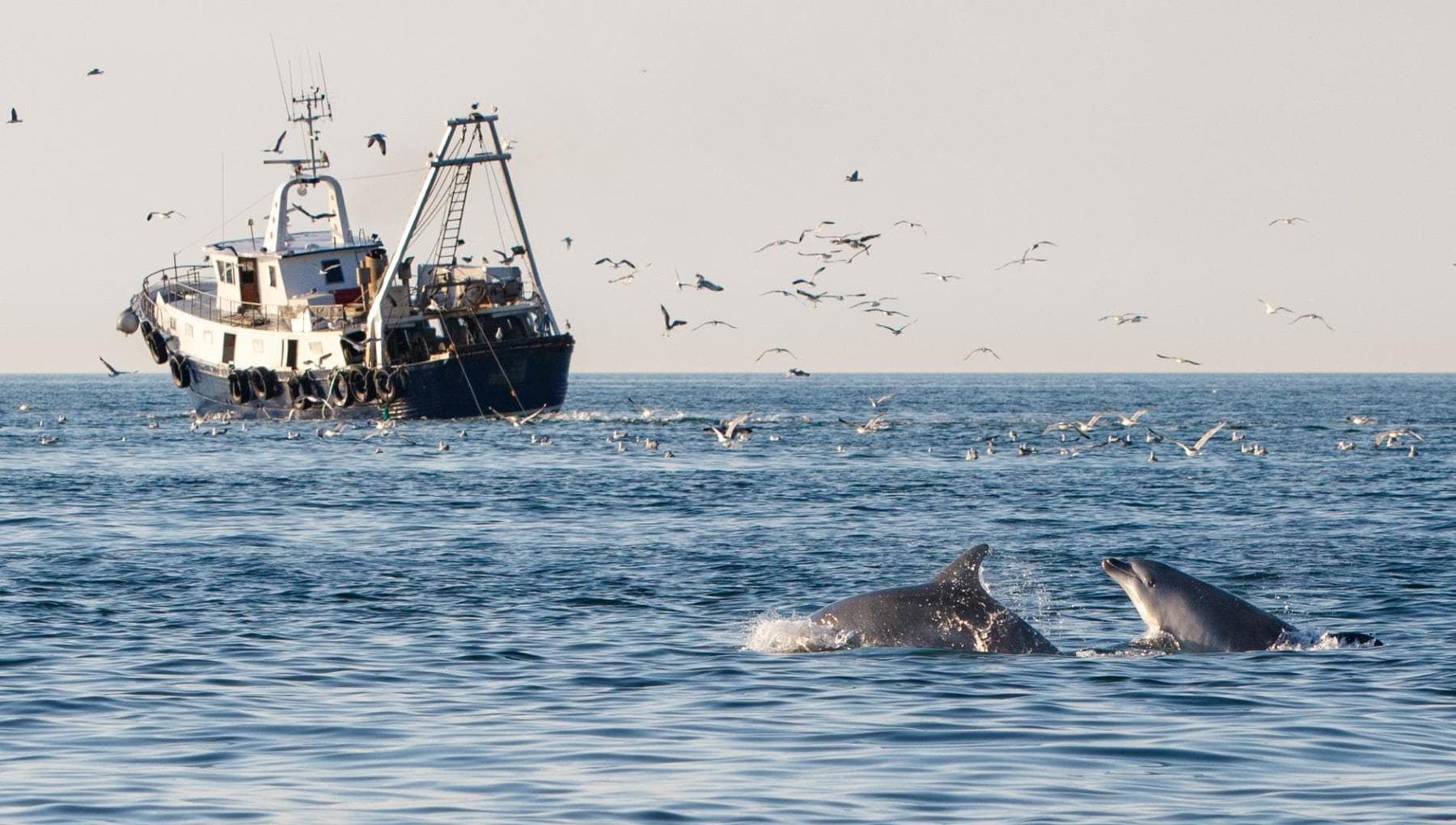
Seeing a group of dolphins swimming behind a fishing boat is a familiar sight for many fishers in the Adriatic. At first glance, it might appear to be yet another demonstration of these cetaceans’ intelligence and their ability to exploit new opportunities to find food. In reality, according to a new study published in the journal Frontiers in Mammal Science, this behaviour tells a far more complex story: that of an ecosystem profoundly altered by human activity, in which even one of the Mediterranean’s most adaptable predators is changing its feeding habits.
The research, coordinated by the Dolphin Biology and Conservation association together with several other Italian research organisations, examined the relationship between common bottlenose dolphins (Tursiops truncatus) and commercial fishing along the northern Adriatic coast. To do so, the researchers monitored fishing-vessel activity between 2018 and 2025, covering a total of 17,755 kilometres at sea and carrying out 859 systematic observations of different types of fishing boats. Their aim was to determine how frequently dolphins approached the vessels and whether certain fishing techniques attracted them more than others.
The results reveal a phenomenon that has become extremely widespread. Overall, the researchers observed dolphins near approximately one in four fishing vessels. The frequency rose considerably, however, in the case of grid trawling, one of the most commonly used techniques in the Adriatic. In these situations, the cetaceans followed the vessels in more than 40% of cases, with the figure rising to 75.9% along the coast of the Marche region. Another finding is even more significant: 86% of the bottlenose dolphins identified in Veneto and 90% of those observed in the Marche were photographed at least once while feeding behind fishing boats.
This behaviour is not entirely new. Dolphins have been following fishing boats for decades, but the frequency with which they do so has increased considerably. In the 1990s, for example, only around 10% of fishing vessels were accompanied by groups of bottlenose dolphins. Today, in some areas of the Adriatic, the proportion exceeds three quarters of all vessels observed. According to the study’s authors, this change reflects a growing dependence on fishing activity as a source of food.
Bottlenose dolphins are among the most intelligent and versatile marine mammals known to science. Found in temperate and tropical seas around the world, they are the most common coastal dolphin species in the Mediterranean. They generally live in highly complex social groups, within which they form lasting relationships and cooperate while hunting. In addition to communicating through a broad repertoire of whistles, dolphins use echolocation, a sophisticated biological system that allows them to map their surroundings and locate prey in conditions of poor visibility.
One of the species’ most remarkable characteristics is its ability to transmit behaviours through social learning. For this reason, researchers believe that following fishing boats is not merely an individual response to the availability of food, but a behaviour that may be passed down from one generation to the next. Calves follow the vessels alongside their mothers and observe adults while they hunt, learning and reproducing this foraging strategy.
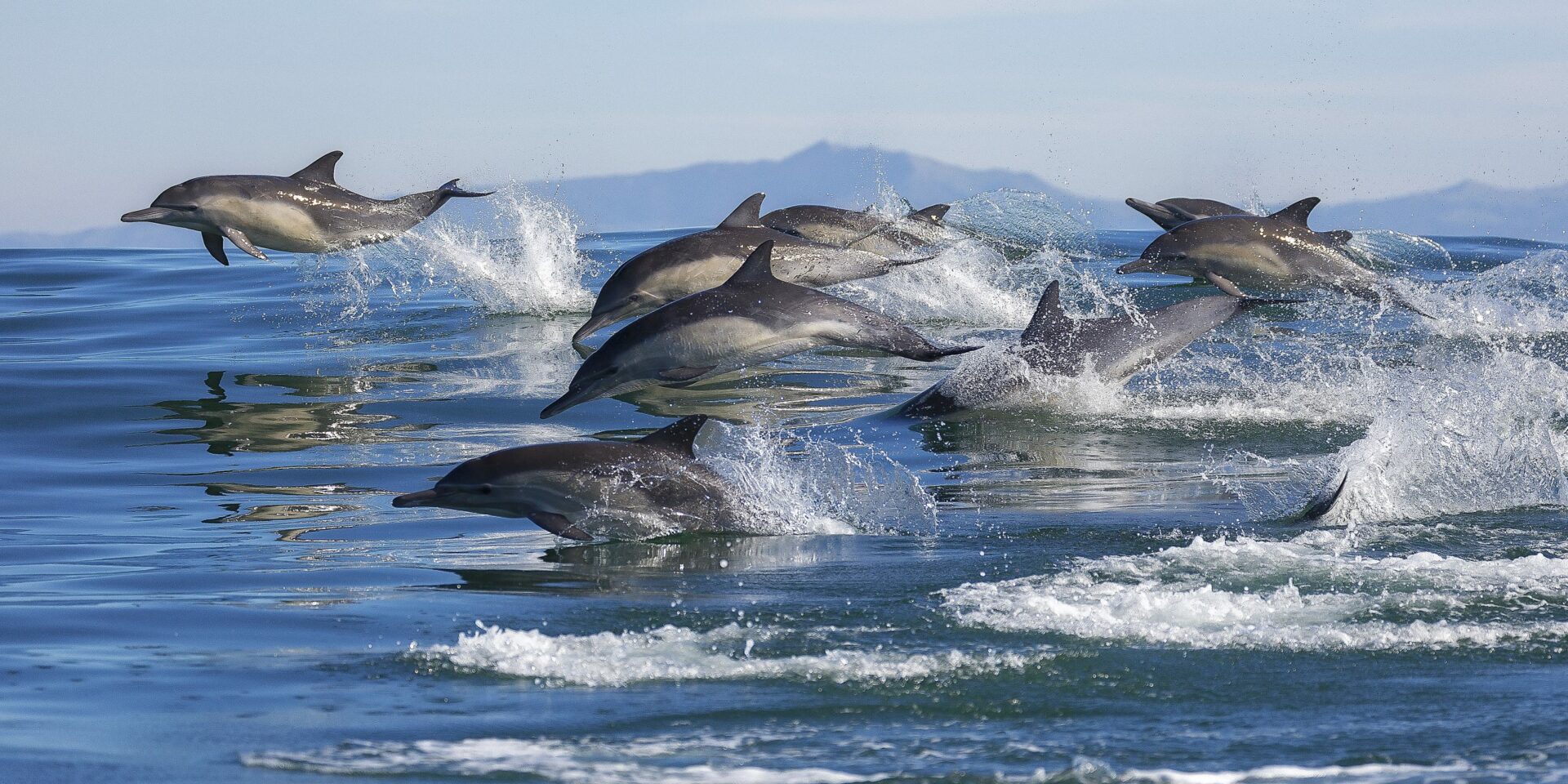
But why do dolphins choose to follow fishing boats? The answer is simple: the vessels provide an easily accessible source of food. During fishing operations, many fish either escape from the nets or are discarded into the sea because they are too small or have no commercial value. For a predator such as the bottlenose dolphin, exploiting these resources means obtaining a large meal while using far less energy than it would during natural hunting. It is rather like the behaviour of urban seagulls feeding on the organic waste we throw into rubbish bins.
What might appear to be an advantage, however, conceals numerous risks. Repeatedly approaching fishing vessels increases the likelihood of becoming entangled in nets or being injured by fishing equipment. Constant exposure to the noise produced by engines and machinery may also interfere with communication and echolocation, two tools that are essential to the survival of these cetaceans. Their diet itself may change over time, making some populations increasingly dependent on fishing waste rather than on the prey naturally available in their environment.
According to the study’s authors, however, the problem lies not only in the dolphins’ behaviour, but also in what that behaviour reveals about the health of the Adriatic. The Mediterranean is considered one of the most intensively exploited seas in the world in terms of commercial fishing. According to FAO data, around 63% of fish stocks in the Mediterranean and Black Sea are still being harvested beyond biologically sustainable levels, despite some improvements in fisheries management in recent years. The Adriatic, in particular, is one of the basins where pressure from human activity has historically been highest.
In an environment where many fish populations have been depleted by intensive fishing, it is hardly surprising that an opportunistic predator should begin exploiting an alternative food source. In this sense, following fishing vessels may not necessarily represent an extraordinary example of adaptability. It may instead be a symptom of an ecosystem providing fewer and fewer natural resources. For these animals, it appears that risking injury by following fishing boats is preferable to starving.
The phenomenon takes on an even deeper significance when considered in the context of the Adriatic’s recent history. Until only a few decades ago, these waters were home to large populations of common dolphins (Delphinus delphis), which have now almost completely disappeared from most of the basin because of the dramatic reduction in prey and the effects of human activity. The bottlenose dolphin, which is more ecologically flexible, has managed to adapt to environmental change by altering its feeding behaviour. But adapting does not necessarily mean living in a healthy environment.
The research therefore challenges a fairly widespread assumption: seeing wild animals apparently thriving alongside human activities does not automatically mean that their ecosystems are in good health. In many cases, the opposite is true. Numerous species change their behaviour precisely because their natural habitats can no longer provide the resources required for their survival.
For this reason, scientists are calling for measures to protect the area’s rich diversity of species and advising against the continued use of trawlers, in order to safeguard dolphins and preserve marine biodiversity.
Ultimately, the real news is not that dolphins have learned to follow fishing boats. The real news is that one of the Mediterranean’s most intelligent and adaptable predators appears to need them more and more. When even an animal capable of modifying its hunting strategies changes its habits so profoundly, perhaps it is not the dolphin that has found a shortcut. Perhaps the sea is simply no longer what it once was.
Alessia Mircoli