


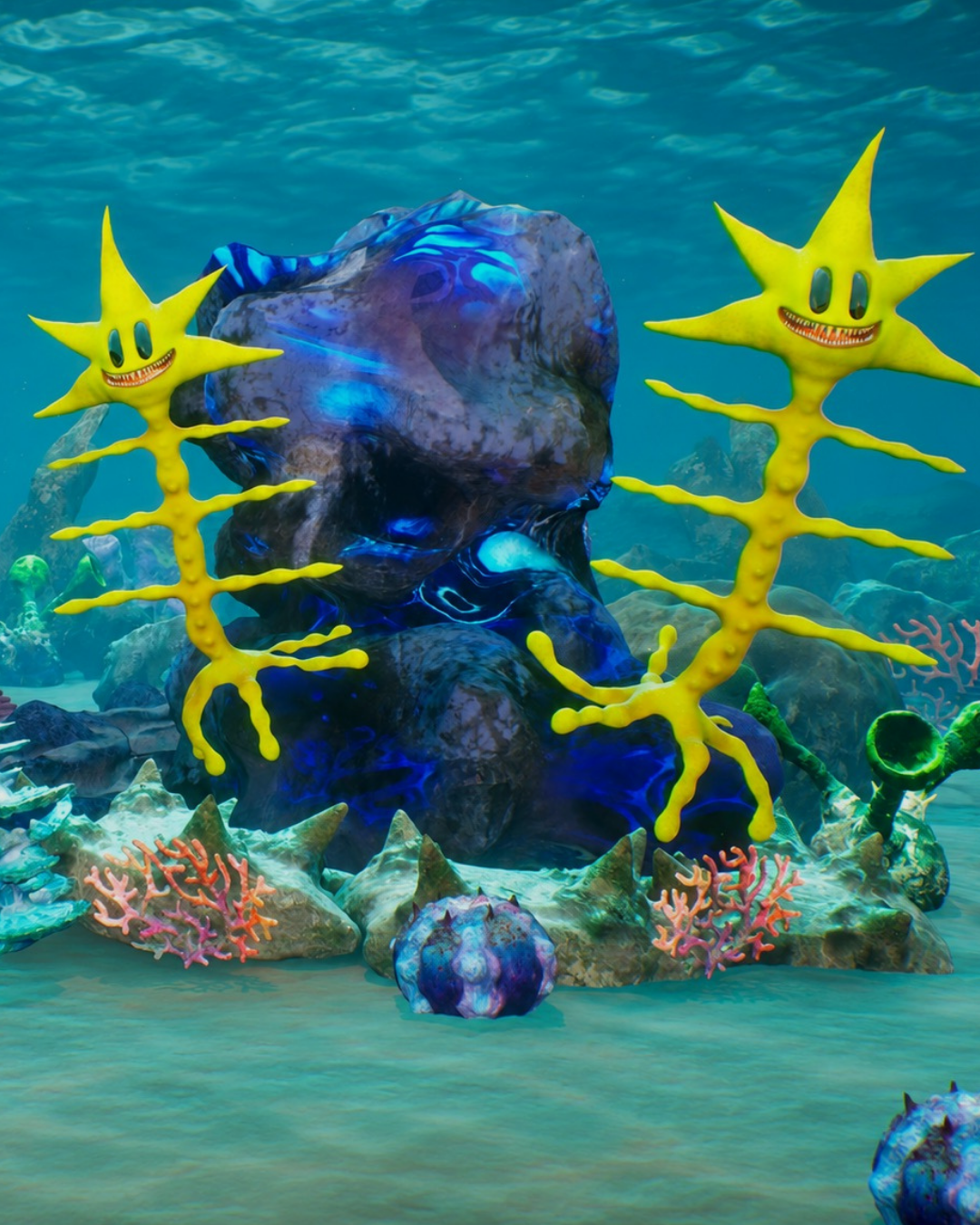
A planet covered in water, an alien civilization that has moved beyond need, consumption and conflict, marine creatures used as biological avatars, and a technology designed to make a digital artwork authentic and identifiable. These are the different layers at play in SQUAM OCEAN, August Quinn’s exhibition hosted by Rifugio Digitale in Florence from July 23 to August 23, 2026, with technological support from Traent and the involvement of its CEO, Federico D’Annunzio.
Quinn, a New York artist born in 1999, belongs to the generation that grew up at a time when 3D graphics had already overcome the stricter limitations of early digital rendering but had not yet made photorealism their primary goal. It is this aesthetic window that the curatorial text describes as “mid-poly”: the GameCube and Wii, Super Mario Sunshine and Luigi’s Mansion, and the independent animations of YouTube’s early years. In his work, this culture is not simply a source of nostalgia: game engines and CGI from the early 2000s become an inherited visual language through which he constructs a form of painting generated by movement.
His visual world also draws on cinema. Men in Black, Blade Runner, Starship Troopers and Alien helped shape an idea of science fiction built around civilizations governed by their own rules and internal logics. Spore, which Quinn discovered in 2008, was equally decisive: its sandbox system allowed players to assemble organisms by combining biological and science-fiction elements, anticipating the kind of procedural world-building that now reappears in his practice. During his years at Central Saint Martins, Quinn also absorbed the influence of Birmingham surrealist Desmond Morris, whose biomorphism intertwines with the grammar of videogame systems.
SQUAM OCEAN develops an autonomous mythology. Squam is an ocean planet that shares its solar system with its Earth-like twin, Squan. On their shared moon, Squag, lives an extremely advanced civilization known as the Squagillians. Having moved beyond need, predation and consumption, these beings face a paradox: progress has made almost everything possible, and precisely for this reason they choose to return to a more elementary form of experience. They voluntarily project their consciousness into artificially created marine life forms, using them as avatars through which they can experience a simplified existence.
This gives rise to the ecosystem’s most radical rule: its creatures have no need to compete. Nothing eats, attacks or kills anything else. Visible hierarchies exist, ranging from the most elementary fish to apex predators and almost divine figures, but they never lead to violence. Eliminating conflict, however, does not automatically produce a harmonious community. What emerges instead is a form of alien self-sufficiency, at once perfect and unsettling. Behind this apparent utopia lies a political question: if conflict is not what holds a social order together, what binds its individuals to one another?

Quinn says he developed the project intuitively. The first creature dates back to 2024, while the oceanic theme began to take shape towards the end of 2025. The characters are digitally sculpted in ZBrush using a tablet, but they can also originate in sketches made on trains, old videogames, computer graphics or dreams. The shark that appears towards the end of the exhibition, for example, first appeared in a dream and was then drawn the following day. Quinn does not ask viewers to reconstruct the mythology in its entirety: he considers the simple experience of the ecosystem meaningful in itself and leaves every possible reaction open, as long as the work generates questions.
The exhibition follows a narrative progression: saturated, vibrant colors give way to more comic passages, then to spiritual and almost divine figures, before finally descending into the dark atmospheres of the abyss. The sequence recalls narrative mural painting, the theological cycles of the early Renaissance and the Greco-Roman pantheon: an ancient structure reconstructed through a language native to the screen. If fresco painting staged a higher will through bodies, SQUAM OCEAN does something similar with an alien intelligence that never appears directly, but manifests itself through the creatures it inhabits.
The sound component, created by Mason Dreiling, translates the same idea into music. Drawing inspiration from Brian Eno’s Music for Airports, Dreiling uses loops structured according to the golden ratio and generative tools that trigger samples unpredictably. The effects are modulated by low-frequency oscillators independent of the track’s tempo: only the underlying pulse remains stable, while all the other elements slowly diverge. The result is a soothing environment built around autonomy rather than coordination.
Overlapping with this aesthetic reflection is a second one concerning the nature of the digital artwork itself. Federico D’Annunzio, CEO of Traent, a company specializing in blockchain and artificial intelligence for industrial and artistic applications, says he met Quinn through a shared interest in innovation and the protection of intellectual property. Their collaboration led to the development of UDAA, Universal Digital Art Artifact, a system designed to identify an artwork and connect it in a verifiable way to its authenticity and ownership, with the aim of eventually extending from digital art to physical art as well.
For D’Annunzio, the issue goes beyond the NFT era. The historical weakness of digital media, he argues, lies in the possibility of modifying and replicating data: blockchain and artificial intelligence should work together not only to certify ownership, but also to guarantee the integrity and authenticity of an artwork. From this perspective, tokenization could transform art and other real-world assets, such as property, into fractionalized instruments, distributing risk and opening access to new forms of investment. It is a form of democratization that nonetheless encounters a barrier: the knowledge required to enter the world of tokenization.
D’Annunzio’s argument expands to the future of digital infrastructure. In the immediate term, he plays down fears surrounding quantum computing and points instead to already available systems as a more concrete threat to cybersecurity. On the energy front, he predicts that advances in algorithms will progressively reduce the energy consumption of artificial intelligence and envisions an increasing spread of local language models hosted on PCs, servers or organizations’ internal infrastructure, allowing data to be governed closer to its source. For him, the sustainability of AI is not merely an energy issue, but also a question of authenticity and governance.
This is where the two paths converge again. Quinn constructs digital bodies inhabited by consciousnesses we cannot see; D’Annunzio works on the idea of making identifiable what, in the digital realm, could otherwise be replicated indefinitely. On one side is an imaginary civilization that has overcome scarcity and chooses to return to physical experience; on the other, a technology attempting to introduce concepts such as originality, ownership and provenance into an immaterial world. SQUAM OCEAN thus explores the same boundary from two different directions: what makes a body, an artwork or an experience authentic when whatever inhabits it can be transferred, copied or reconstructed elsewhere?
Redazione