



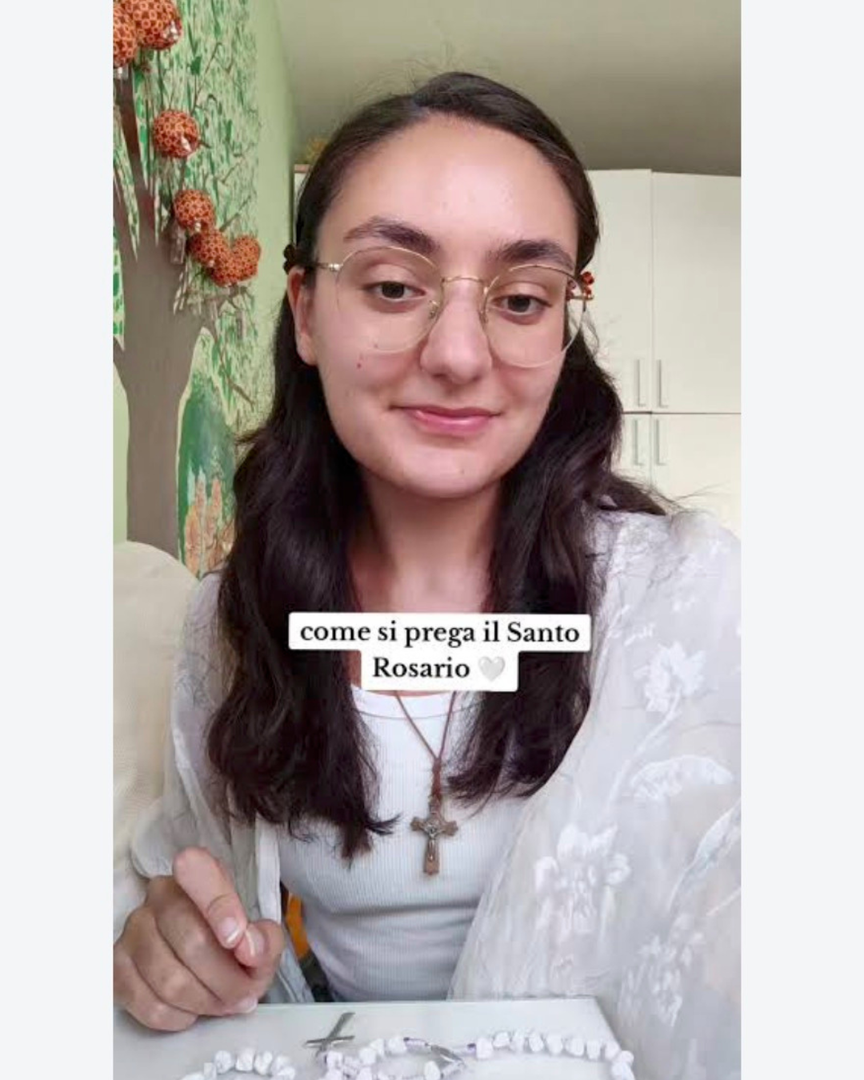
The ways of the Lord are famously mysterious, but no one could have imagined that one of them would lead straight to TikTok. On the platform, saints, religious processions, and the Gospels have become more popular than ever. Who’s behind this “miracle”? It’s hard to single out just one person, but Benedetta Palella is certainly a name that comes to mind. Twenty-five years old, originally from Puglia, and with more than 150,000 followers on the Chinese-owned platform, Benedetta has carved out her own corner of the internet to talk about faith. Her communication style closely resembles that of the Gen Z creators who populate TikTok, only repackaged through a Christian lens. The result is a strange hybrid of old traditions and modern tools, flooding people’s feeds with get ready with me videos for confession, tutorials on modest outfits for being a good Christian woman, and TikTok livestreams devoted to praying the Rosary.
To some, all this might seem absurd. But what’s even more absurd is realizing that Benedetta Palella is just one small cog in a much larger digital phenomenon: the rise of Catholic creators. Watch just a couple of these religious reels, and the algorithm can lead you into an unusual online universe populated by muscular priests making motivational videos, theology influencers, believers turned “digital missionaries,” tour operators specializing in religious itineraries, and even spiritual consultants. On the surface, there seems to be nothing wrong with the way these people inhabit the internet, and in some cases, there isn’t. But the risk of spreading ultraconservative messages under the guise of faith is never far away. Let’s start at the beginning.
There are two possible ways to understand this trend: through Church Aesthetic and through the Trads movement.
The former is essentially a cultural phenomenon that takes elements of Catholicism and monastic life out of their original context and transforms them into pop culture. Examples include Catholic Core and Nuncore, trends primarily associated with visual culture, art, and fashion inspired by ecclesiastical aesthetics. Their imagery draws heavily on the 2018 Met Gala’s Heavenly Bodies theme, collections by brands such as Dolce & Gabbana, and films like Conclave.
More broadly, this aesthetic promotes a kind of “coquettification” of Catholicism. The coquette aesthetic merges with religious imagery to produce highly “feminine” visuals filled with pink, pearls, and bows, without entirely abandoning sensuality. While these contents aren’t necessarily irreverent, they don’t demand “sexual purity” either. And that’s precisely what sets them apart from the more austere models of femininity promoted by Catholic influencers like Benedetta Palella.
The second category, meanwhile, consists of trends associated with the Trads, which originated in the United States and can be described as a digital subculture advocating a return to a more traditional way of life, rooted in conservative values and social models reminiscent of the 1950s.
In practice, Trads, or TradCaths, favor a return to liturgical rites and social teachings that predate the Second Vatican Council. Politically and socially, they display considerable affinities with right-wing ideologies. Some videos even explicitly celebrate the culture and principles of Western white civilization.
Another recurring feature is the rigid reinforcement of gender roles, which immediately brings to mind the recent tradwife phenomenon.
“These influencer models provide fertile ground for the rhetoric surrounding ‘traditional wives,’” explains Elisa Belotti, a journalist specializing in rights, marginalized communities within the Church, and digital phenomena related to religion.
“These young women casually explain, without framing it as any kind of battle, that they’ve stopped working to get married, that their only ambition is to become housewives, and they present highly romanticized scenes of domestic life as an ideal to aspire to.”
This kind of storytelling may appear harmless, but it isn’t. It is increasingly intertwined with the traditional-family worldview and a specific conception of femininity promoted by the political right. And it’s spreading at a historical moment when far-right parties appear to be gaining ground across Europe and the United States.
Many of these influencers claim to have no propagandistic intentions. Yet they frequently publish content commemorating Charlie Kirk’s death, comment on political parties’ positions regarding Italy’s Law 194 on abortion, take stands against the LGBTQIA+ community, and even collaborate on posts with the official account of the anti-abortion organization Pro Vita e Famiglia.
“In these cases, there is no boundary between discussing social issues and engaging in politics. Talking about social issues and influencing thousands of followers is already a political act, even if, to them, ‘doing politics’ means nothing more than running for office with a political party,” Belotti observes.
At the same time, another element uniting conservative men on social media is gym bro culture.
“In the United States, this is an extremely widespread practice among evangelicals. TikTok is full of videos of young men making the sign of the cross at the gym, posting workout videos accompanied by Gospel verses, or getting on treadmills during Holy Week carrying weights equivalent to the weight of Jesus’s cross. The underlying message is basically: ‘If Jesus could carry that weight, so can you,’” the journalist explains.
The gym thus becomes associated with a powerful ideal of masculinity and a way of expressing religious devotion, combining the worship of the body and the worship of the spirit in a single gesture.
It’s a trend that has also become hugely popular among priests, some of whom have turned into genuine social media stars.
For some time now, it hasn’t just been platform trends making evangelization cool. The people driving those trends have become just as important, if not more so.
And the fact that so many of them happen to be attractive, salt-and-pepper-haired priests with bulging biceps and sculpted physiques doesn’t seem entirely coincidental.
According to articles published by the New York Post and The Telegraph in July 2025, the growing visibility of handsome, gym-going priests could be a way to attract as many new believers as possible.
And who wouldn’t think so after scrolling through the profiles of gym priests like Father Giuseppe Fusari or Father Cosimo Schena?
Fusari has even earned himself the nickname “the bodybuilder priest,” although he has said he dislikes that description and insists that bodybuilding is more about necessity than vanity for him.
Father Cosimo, too, maintains a carefully groomed appearance, which he proudly displays to his nearly half a million followers between videos featuring his dogs and motivational content.
Other members of this growing club of young, handsome, internet-famous priests include Father Jefferson Merighetti, a Brazilian in his thirties also known as “the hot priest,” and Father Ambrogio Mazzai, the cycling priest, along with countless others.
Those without impressive muscles or chiseled pecs can always fall back on humor. That’s the route Father Roberto Fiscer took, amassing an impressive 870,000 followers by recreating TikTok’s trendiest dance routines surrounded by dozens of children and altar servers.
But why are these creators so successful?
“One reason is certainly that we’re all hyperconnected and that social media allows us to build relationships, create communities, or become part of niche audiences. These platforms are real social spaces, even if they exist virtually,” Belotti explains.
She adds that “this kind of communication about faith, unlike other forms that take place outside social networks, relies heavily on an individualistic dimension.”
Many of these creators present religious faith as a deeply personal experience, carefully filming themselves in churches in front of altars, in rooms filled with images of saints and the Virgin Mary, or while praying the Rosary.
They offer a highly personalized narrative of faith because it attracts audiences, generates engagement, and spreads certain ideals more effectively than a traditional Sunday sermon.
At the same time, they adopt all the strategies needed to turn their image into a recognizable and trustworthy presence in people’s daily scrolling routines.
In short, they develop such strong personal brands that their popularity can survive even when religion is no longer their main focus.
And that’s how influencers who once simply spread the word of God become influencers who sell products and make money.
Just look at Alberto Ravagnani, the former priest known as Don Alberto.
After being ordained at a very young age, and taking advantage of the isolation brought on by the COVID-19 pandemic, Italy’s first priest-influencer launched a YouTube channel and began his journey into evangelization 2.0, one video at a time.
From the beginning, he had everything it took to become a sensation: he was young, charismatic, and naturally comfortable on social media.
He even attempted to bridge the enormous gap between the Catholic institution and contemporary society by tackling taboo subjects such as sexuality, body image, and homosexuality.
But alongside videos about religious debates and serious issues, he also portrayed an unexpected side of priesthood, showing the “fun” parts of his life: parties, travel, and sports.
His profiles exploded almost overnight, his reels racked up millions of views, and the first brand collaboration offers soon followed, along with the first criticisms.
For some believers, or perhaps it would be more accurate to call them users, this kind of self-promotion shifted attention away from God and toward Ravagnani himself, turning him into something of a celebrity. He even appeared on podcasts such as Muschio Selvaggio.
But his real misstep came in September 2025, when he took part in a collaboration with BOND Supplements, a sports nutrition brand.
It wasn’t the first time Ravagnani had promoted a product. But in that particular video, he described the supplements as “necessary to carry out his mission,” explicitly drawing on his experience as a priest and his religious vocation to endorse them.
The video also featured the slogan “Santo sì, ma anche sano”, a play on words roughly meaning “Holy, yes, but healthy too.”
The line was intended to be humorous, but it attracted fierce criticism in the comments, where many saw it as presumptuous and symbolic of a faith increasingly subordinated to money.
From that moment on, something broke in the seemingly flawless mechanism Don Rava had built.
In February 2026, he left the priesthood. Just like that, the title of “Italy’s first priest-influencer” lost its religious half, leaving behind a social media career and all the benefits that popularity can bring.
Don Rava’s departure wasn’t easy for his followers. Some criticized him, others admired his courage, and still others simply missed the kind of content he used to make.
But a smaller group raised a particularly uncomfortable question: is it right to make money online from your religious faith?
Ravagnani himself had already addressed the issue in an interview with Fanpage, arguing that he saw nothing wrong with it. After all, money has always flowed into churches, and his online evangelization work also required financial resources.
Still, it’s difficult to believe that someone can become a public figure and operate on social media without eventually falling into the familiar logic of influencer marketing, or without being tempted by lucrative opportunities to monetize their following.
“I’m afraid that, given how social media platforms are designed, nobody can ever be completely ‘pure,’” Belotti comments.
And this applies to anyone operating on these platforms, particularly those immersed in the so-called ChristianTok bubble.
Which makes understanding the reasons for being on social media all the more important.
“If the goal is to educate and inform, that’s one thing. If the goal is to sell something while presenting it as a ‘mission’ or a ‘service to God,’ then you’re deliberately steering an audience toward a commercial product for profit. In the United States, they’re even selling Christian energy drinks while claiming that Jesus personally entrusted them with that business.”
“Stop turning my Father’s house into a marketplace” is what Jesus says in the Gospel of John when he enters the Temple in Jerusalem and finds merchants selling goods and livestock.
If Christ could take a stroll through today’s social media platforms, he’d probably say something very similar.
The world of Catholic creators has just about everything, and nearly everyone seems to have a product to sell or a personal brand to promote.
Ravagnani did it through advertising, podcasts, sponsored content, and three books published by major publishing houses such as Rizzoli. He successfully turned his face into a brand, securing television appearances and other paid opportunities even after leaving the priesthood. His latest move is joining the cast of Ballando con le Stelle, Italy’s version of Dancing with the Stars.
But other Christian creators are doing the same, particularly in the publishing industry.
Benedetta Palella, for example, recently published a book and promoted it using an image of the Virgin Mary.
Father Roberto Fiscer has also entered the publishing business, releasing two books through Piemme and San Paolo Editore.
Father Cosimo Schena, meanwhile, has stated that he will donate the proceeds from his book to charity, but he also earns money through Custodi della Luce, an app he launched that offers spiritual and psychological support.
Not everyone sees anything wrong with this emerging business sector.
Take Nicola Camporiondo, a micro-creator who says he recently wrote a book himself and sees no ethical problem with it.
“You always have to consider the intention behind it,” he argues.
“Obviously, if a digital missionary started promoting bars of soap, that would be inappropriate. But if they’re promoting a new edition of the Italian Bishops’ Conference Bible, that’s clearly a different matter.”
He acknowledges that a mission should not become a profession, but also points out that “it requires time, space, and energy. So if you occasionally receive some financial support for what you do, I don’t see what the problem is.”
And while making money by selling a book about yourself might not seem particularly immoral, the same can’t necessarily be said about another business religious influencers are increasingly entering: merchandise and clothing.
One especially telling example is Tommaso Alith, a twenty-year-old with no fewer than three Instagram accounts (Tommaso Alith, Christaletheia, and Alithclo) and a combined following of 300,000 people.
His content ranges from explaining Gospel verses to condemning masturbation, alongside carefully styled aesthetic reels showing him praying while prostrated inside Baroque churches.
At first glance, these videos seem harmless, the expression of a young man who developed a strong sense of religious faith early in life.
But reach the end of one of his reels, and a rather different purpose emerges: promoting his own Jesus-themed T-shirt brand.
Apparently, selling T-shirts in God’s name is a profitable business. Plenty of other creators have launched similar ventures, including Elia Catholic, who runs his own online store.
Others have seized the opportunity to sell every imaginable kind of religious merchandise, from rosaries and handmade prayer veils to online spiritual courses that can cost hundreds of euros.
“Being on social media takes time, even for an account with just 500 followers. There’s a structure to follow, videos to develop in both content and presentation, and a whole series of targets to meet,” explains Vittorio Scarpelli, a digital missionary who operates online under the name @unpapacon4figlie.
In his view, there’s nothing wrong with selling merchandise or launching a crowdfunding campaign, since both help support this kind of activity.
He also argues that “no creator can really mix faith and marketing, in the sense that every creator is a vehicle for bearing witness and a stepping stone toward discovering Christ’s love, which, however, you’ll never find inside a social media page.”
And yet, many users have little trouble imagining a faith contaminated by economic interests, particularly when its main channel of communication is social media.
After all, these platforms have become endless shopping channels, the perfect embodiment of a society immersed in turbo-capitalism.
The fact that the Church as an institution has never rejected the opportunity to make money, unlike Christian doctrine, which warns against the idolatry of wealth, is hardly news.
The fact that it’s now doing so through influencers, however, certainly is.
After all, if the ways of the Lord are infinite, the ways of marketing are even more so.
Rachele Liuzzo