



Deliberative processes are easy to explain: randomly selected people (chosen to form a statistically representative sample) are brought together in a physical space to make a decision on a specific issue. To reach that decision, they may need to debate, exchanging perspectives, opinions, and viewpoints that can sometimes be at odds. Deliberation is a form of participation built around dialogue and sustained discussion.
This simplification leaves out many variables, but two are worth examining. Certain preliminary decisions must be made before any genuinely constructive discussion can begin. First, the scale of decision-making needs to be established. Are we talking about a neighborhood park, regional data centers, national cannabis policy, or European climate transition projects? This dimension is known as “scalability”: moving from small to large and vice versa, from the neighborhood to the European Union, with all the challenges of identifying, bringing together, and organizing sufficiently diverse samples of people to represent their respective communities.
And there is an even more fundamental question: who gets to choose the subject of deliberation?
As the number of participants increases, so does the volume of data that needs to be managed, along with the wealth of information generated by these processes. This is where artificial intelligence can become a valuable ally, improving the effectiveness and efficiency of both qualitative and quantitative analysis. Automated text summarization, dialogue analysis, sentiment analysis, and topic modeling, meaning the identification and classification of recurring themes, are among the functions that, according to Apolitical, AI can perform to complement human intelligence. This is particularly relevant to the so-called Deliberative Group, whose role is to facilitate and guide the process.
Generally speaking, since deliberation is an exercise in democracy, broader participation strengthens its credibility and its ability to exert pressure on political decision-makers. Numbers matter in a democracy, and consensus should always aspire to be as widespread as possible. What matters is its breadth rather than the intensity of ideological conviction behind it. And when recommendations come from a much larger number of people, as happens with petitions, it becomes harder to justify ignoring them during the legislative process, for example.
For this reason, AI-integrated platforms can address several needs, such as monitoring urgent issues emerging from public participation and summarizing them to identify policy proposals that resonate with participants.
There are numerous examples, primarily developed by research institutions and private organizations working in the emerging field of “deliberative tech.” After all, few people realize that one of the European Union’s central objectives, and arguably a matter of its long-term survival, is to counter declining trust in institutions and the widening gap in citizens’ sense of belonging across EU member states.
The EU is investing substantial resources in institutionalizing effective deliberative processes and harnessing advances in artificial intelligence and citizens’ digital skills through the AI4Deliberation project. The initiative aims to develop ethical AI tools and guidelines to help governments implement and evaluate large-scale, gamified democratic deliberations. Funded under Cluster 2 of the Horizon Europe program, the project, titled “Artificial Intelligence for Institutionalised, Multimodal, Gamified, Mass Democratic Deliberations,” has a budget of nearly €3 million.
Google has also put its name and resources behind the effort through the Google.org Impact Challenge: Strengthening Democracy in Europe, an initiative launched by Google.org with a €15 million fund to support European organizations developing projects designed to strengthen democratic resilience, often through digital technologies and AI.
Of the initiative’s three main priorities, alongside electoral integrity and civic education through digital literacy, one specifically focuses on deliberative democracy and strengthening civic dialogue, including through deliberative tech. These are not simply online voting platforms, but something more complex: pixelated replicas of citizens’ assemblies. The call is open to nonprofits, civic organizations, universities, and social enterprises, with grants ranging from €250,000 to more than €1 million per project.
Among the best-known platforms today are CitizenLab and vTaiwan, whose first major success involved facilitating public discussion on the regulation of Uber.
Others include Your Priorities, developed by Citizens.is with the aim of integrating an open-source language model similar to ChatGPT; Polis, developed by the Computational Democracy Project, which uses clustering techniques to identify areas of agreement and disagreement among users’ opinions; Adhocracy+, a platform built around surveys, discussions, and voting, developed by Liquid Democracy according to explicit principles of rationality, reciprocity, respect, and constructiveness; and finally ZenCity, which helps governments and organizations better understand their communities through participation tools, social media monitoring, and data analysis using natural language processing (NLP).
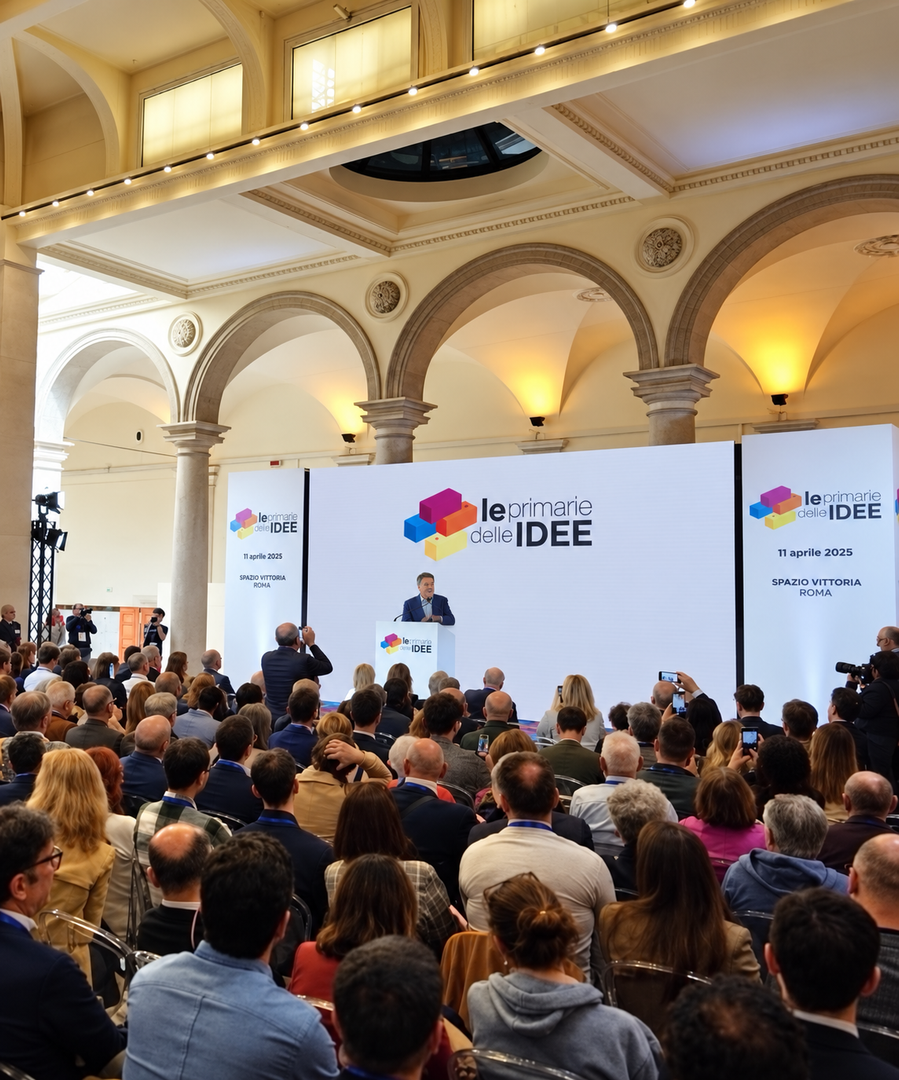
In Italy, an initiative comparable to these international examples is called Primarie delle Idee, or “Primaries of Ideas.” Launched less than six months ago, it addresses precisely those two questions: who decides which issues should be discussed, and how can everyone gain access to that decision-making process?
An important distinction needs to be made to understand the role of Primarie delle Idee within Italy’s political landscape. A platform such as Rousseau was primarily used by the Five Star Movement to organize deliberation among its members and reach decisions.
Primarie delle Idee, by contrast, draws inspiration from Decidim, an open-source participatory democracy platform that allows institutions and organizations to create digital spaces where citizens can take part in collective decision-making. Developed in Barcelona, Decidim is a technopolitical project conceived as a digital commons, and is therefore both open-source and free to use.
A similar example is “Decidiamo Emilia-Romagna,” a digital space based on Decidim and established by the regional government to collect proposals, promote public consultations, and support participatory processes throughout the region.
Primarie delle Idee is therefore not designed to make binding decisions, but to increase participation by allowing people to submit their own proposals and vote on those put forward by others. Unlike deliberative processes, where participants are selected through “democratic lotteries,” anyone can take part in this AI-integrated platform.
The initiative was strongly championed by two individuals in particular: Matteo Renzi and Tommaso Nannicini. I asked Nannicini, an economist, politician, and professor at the European University Institute, a few questions about the platform.
Why now? What prompted you to make a serious investment in digital participation?
Because the distance between citizens and politics can be measured in terms of both the “what” and the “how.” The “what” concerns the issues politics deals with, which often seem disconnected from people’s everyday lives. The “how” concerns the technicalities and procedural details that political discussions constantly risk getting bogged down in. Our platform was created to bring the “what” closer to citizens by allowing members to choose which issues should be prioritized, and to make the “how” more accessible by using generative artificial intelligence to help members develop their proposals in a sound and rigorous way.
The quality of democratic deliberation also depends on whether participants have access to sufficiently balanced information. The AI agent AIDEA helps users draft their proposals, making it a significant tool for empowerment, designed, for example, to bridge gaps in technical literacy surrounding a particular issue.
Why is AIDEA, the civic facilitator, so important? Could you also explain how it differs from the participatory platform promoted by AVS?
AIDEA aims to bridge the divide between political insiders (professional politicians) and ordinary citizens. We often find ourselves wondering why politicians don’t take a particular action to solve a particular problem. But then we don’t have the time to investigate why, what constraints exist, what unintended consequences might arise, or whose interests might be adversely affected. AIDEA is an AI-powered civic facilitator whose task is to help members turn an idea into a solution, and a problem into a concrete policy.
But another defining feature of a deliberative process is its legitimacy.
AIDEA is an AI assistant built on top of a foundational generative model, with an application architecture designed specifically for the needs of a platform with these objectives. It has been configured using political documents, policy proposal templates, and guidelines governing how it should interact with users, including the tone it should adopt and the questions it should ask to encourage deeper reflection.
What political and ideological framework does it operate within? And who was responsible for defining the boundaries of acceptable proposals?
AIDEA has been trained according to our precise instructions regarding its tasks, style, and the knowledge base it should use. In fact, several versions exist, and we would like to conduct scientific studies on their effects. But their purpose remains the same: helping users develop concrete proposals.
There are, of course, guardrails built into the model to prevent the development of ideas or language that are vulgar or discriminatory. Beyond that, there are non-automated filters overseen by an oversight committee. These involve assessing the degree to which a proposal may be unconstitutional, financially unsustainable, or inconsistent with our “reformist” charter of values.
So far, the committee has not flagged a single proposal as incompatible. This suggests a relatively homogeneous, self-regulating community.
After helping users formulate their proposals, AI processes the material and categorizes it. It then does what politics, in theory, should always do: bring ideas together, encouraging similar proposals to merge in order to build broader consensus.
The platform’s governance is structured around three main bodies: a political steering committee, an oversight committee responsible for ensuring the quality of the process, and an executive committee managing the platform’s operations.
Proposals submitted to the Public Space of Ideas compete with one another. Through the platform, users can endorse proposals, comment on them, and organize events to discuss them. Every interaction is recorded and contributes to a proposal’s score, increasing its visibility and position in the rankings.
In September, users will vote on the highest-ranking proposals. Those receiving the most votes will become the policy priorities of the reformist political camp.
Transparency is fundamental to the legitimacy of any decision-making process. How can you be sure you will be able to guarantee it?
Many ideas involve similar or closely related proposals. The oversight committee’s task, supported by AI tools, will be to combine related proposals into packages, giving them greater strength and visibility. Everything will take place on the platform, transparently and with the possibility for those who submitted proposals to appeal the decisions.
September will be devoted to mobilization and discussion around the selected proposals. After all, the initiative’s slogan is about starting with ideas rather than names. And those ideas come from the people who live in and contribute to every corner of the country, every single day.
In concrete terms, what does this platform mean for the political positioning of Italia Viva–Casa Riformista within the broader center-left coalition ahead of the national elections?
It means talking about proposals rather than personalities. It means bringing together ideas and expertise scattered across the country and making them available to a broader process aimed at building a credible alternative to the current center-right majority.
That alternative won’t emerge from organizing events or inventing more or less arbitrary political labels. It will come from powerful ideas rooted in real life.
There are currently 1,220 proposals. But there is still time.
There is always time to participate.
Ludovica Taurisano