


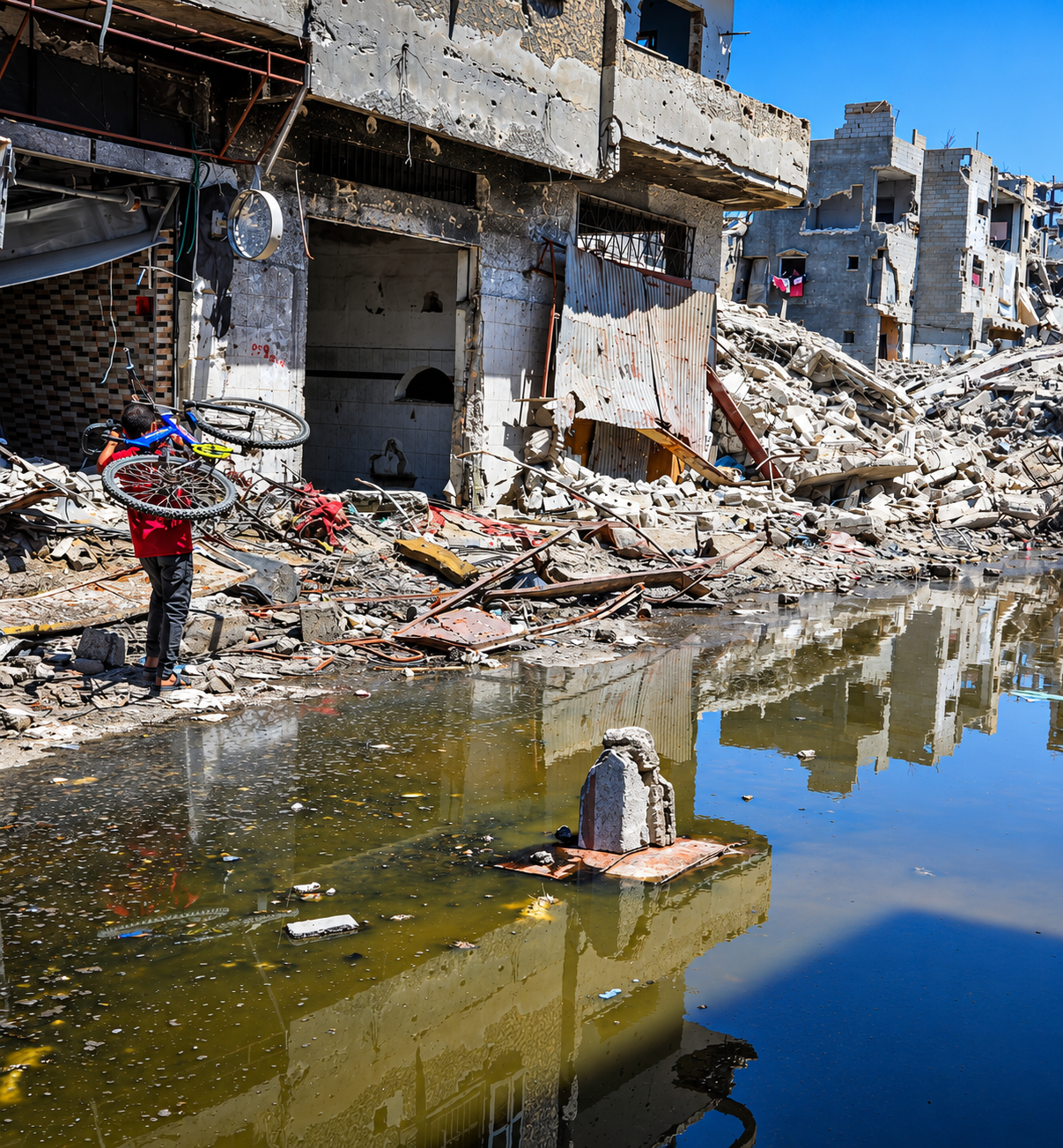
When we talk about the consequences of war, the images that come to mind are those of destroyed cities, people forced to flee and infrastructure reduced to rubble. But there is another victim of armed conflict, often less visible and rarely at the centre of public debate: the environment. From the greenhouse gas emissions produced by military operations to fires, from groundwater contamination to the destruction of ecosystems, wars leave a wound that does not necessarily heal when the fighting ends. One that can continue to affect people’s health and natural resources for decades.
In recent years, several international reports have begun to quantify this legacy. The picture emerging from the conflicts in Ukraine, Gaza and Sudan, together with the more recent military escalation in the Middle East, shows how war is not only a humanitarian tragedy but also a source of pressure on the climate and ecological balances. Assessing the extent of this damage, however, is complex: affected areas may be inaccessible, monitoring systems are damaged and information collected during hostilities is often incomplete. For this reason, the available estimates do not always represent a definitive assessment, but they already provide important indications of the scale of the problem.
A significant example comes from Ukraine. According to a report published in February 2026 by the Initiative on GHG Accounting of War, in the first four years of Russia’s full-scale invasion, from February 2022 to February 2026, the conflict generated approximately 311 million tonnes of CO₂ equivalent, an amount comparable to France’s annual emissions. The estimate includes several factors: military activities, fires across the country, attacks on energy infrastructure, population displacement, changes to air routes and the emissions expected from reconstruction. It is therefore not simply the result of explosions or the fuel burned by military vehicles, but the cumulative effect of a war that profoundly changes the functioning of an entire country.
A study published in 2024 in the scientific journal Science of the Total Environment had already highlighted how these emissions risk escaping conventional climate reporting systems. The authors estimated that, during the first 18 months of the full-scale invasion of Ukraine, war-related emissions potentially not adequately recorded in national inventories amounted to approximately 77 million tonnes of CO₂ equivalent, with an estimated uncertainty of 22%. The calculation included fuel consumption for military operations, the use of bombs and missiles, fires at oil depots, buildings, infrastructure, forests and agricultural land, as well as emissions associated with waste generated by the conflict. The study also emphasises that current international guidelines do not explicitly account for all these sources of war-related emissions.
This is a fundamental point: to assess the climate impact of a conflict, it is not enough to count the fuel consumed by armies. An attack on a refinery or fuel depot can cause fires and release large quantities of pollutants into the atmosphere; the destruction of buildings and industrial facilities generates further emissions; and reconstruction, finally, requires materials, transport and energy. Even when the weapons fall silent, therefore, part of the climate footprint of war continues to grow. In the case of Ukraine, the report by the Initiative on GHG Accounting of War also highlights that attacks on energy infrastructure can increase dependence on fossil-fuel-powered generators, while restoring destroyed facilities risks producing new emissions.
But global warming is only part of the problem. The environmental consequences of conflicts also manifest themselves through the contamination of air, water and soil, with effects that can compromise ecosystems and the living conditions of communities for a long time. In Ukraine, the United Nations Environment Programme (UNEP) has documented damage to energy infrastructure, industrial facilities, hazardous substance storage sites, water treatment systems and natural areas. Explosions and fires can release harmful substances, while damage to industrial facilities and sewage systems increases the risk of contamination of surface water and groundwater. The presence of rubble containing hazardous materials and destroyed military vehicles also presents a challenge for clean-up operations.
Another example comes from the Gaza Strip, where the conflict that began in October 2023 has caused extensive damage not only to buildings but also to water systems, agricultural land and coastal ecosystems. In September 2025, UNEP published an environmental assessment, also based on satellite imagery and observations collected by other United Nations agencies. The report estimates that approximately 78% of the 250,000 buildings in the Strip have been damaged or destroyed, producing around 61 million tonnes of rubble. Approximately 15% of this debris could pose a relatively high risk of contamination from asbestos, industrial waste or heavy metals if the materials are not properly separated and managed.
Rubble, in fact, is not merely a physical obstacle to reconstruction. It can contain hazardous substances, fragments of munitions and materials from buildings and industrial facilities. If moved or disposed of without adequate precautions, it can transfer contaminants to other locations, exposing people and ecosystems to new risks. For this reason, debris removal cannot be regarded as a simple construction operation: it requires an assessment of the materials, the separation of hazardous components and appropriate disposal procedures.
The problem also concerns the availability of clean water. In Gaza, the destruction of water and sewage networks, the collapse of wastewater treatment systems and reliance on inadequate sanitation facilities have increased the risk of contamination of groundwater and coastal areas. According to the assessment published by UNEP in 2025, water storage and pumping capacity had fallen by 84%: as of April that year, only nine of the 54 facilities and reservoirs assessed were still operational, and just three remained intact. No wastewater treatment plant was operational. Contamination of the aquifer and marine environment is considered likely, although precise quantification is hampered by the inability to carry out all the necessary sampling.
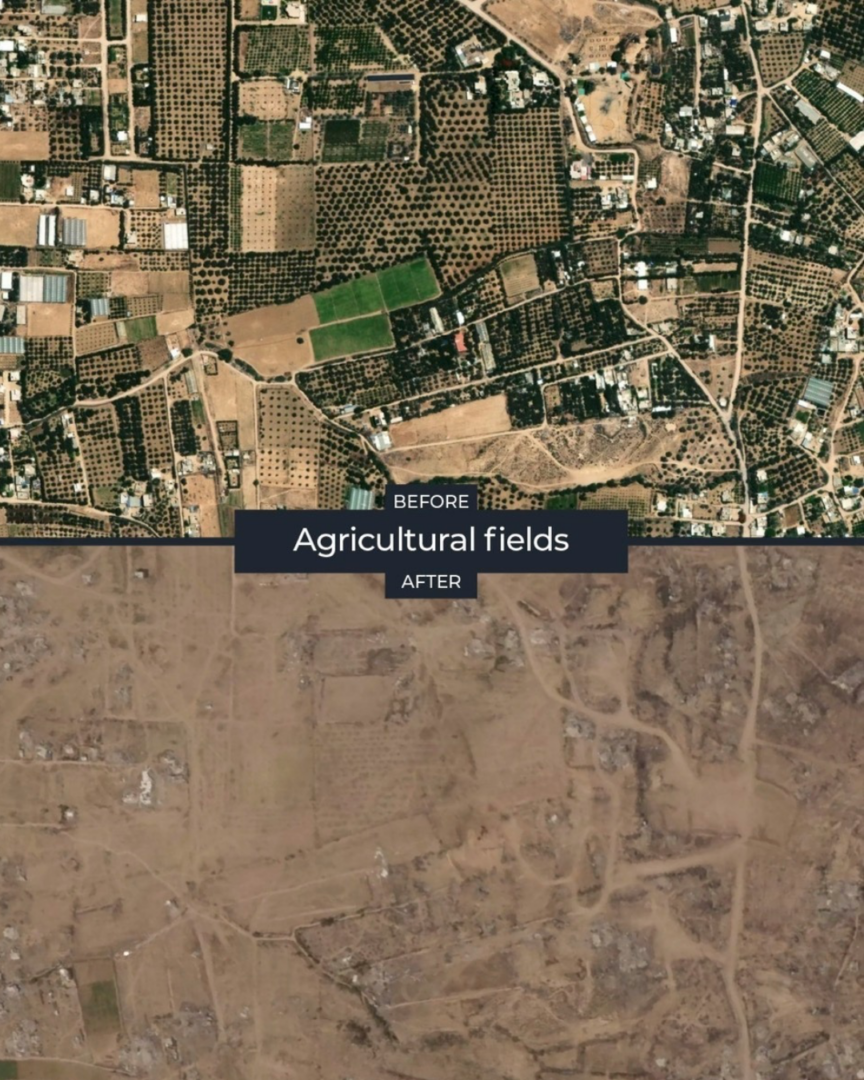
When wastewater enters the environment untreated, the problem is not limited to the quality of the water used by people. Contaminants can reach beaches and the sea, altering the balance of coastal ecosystems and increasing risks to aquatic organisms. At the same time, the shortage of safe water undermines agriculture and makes it more difficult to produce food under adequate hygienic conditions. This is an example of how war can trigger a chain of consequences: the destruction of infrastructure generates pollution, pollution reduces the availability of essential resources, and the loss of these resources makes a population already affected by conflict even more vulnerable.
Gaza’s vegetation and agricultural land have also suffered extensive damage. UNEP’s September 2025 assessment estimates that, since 2023, 97% of tree crops, 95% of shrub vegetation and 82% of annual crops have been lost. The report also notes that the movement of military vehicles and the loss of vegetation cover have altered soil structure and reduced the soil’s capacity to absorb water. This can increase surface runoff and the risk of flooding, while reducing groundwater recharge. Restoring vegetation, soil fertility and freshwater ecosystems will therefore be important not only for biodiversity but also for the population’s food and water security.
Marine pollution adds to this damage. In 2026, the Persian Gulf and the Strait of Hormuz became a new focus of concern over the possible environmental consequences of the military escalation between Iran and the United States. On 14 August, Reuters reported that satellite imagery had revealed two oil slicks in Iranian waters, one near Qeshm Island and another near Sirri Island. The first could be linked to a leak from the merchant vessel Minoan Pioneer, which was struck by a projectile near the coast of Oman while crossing the Strait of Hormuz. The problem? Reuters specified that it had been unable to independently confirm the cause of the slicks or identify with certainty the substances involved.
This caution is important: satellite imagery can help identify possible contamination, but it does not always make it possible to immediately establish the origin of a spill or the composition of the substances released. Nevertheless, oil spills at sea can spread over time, reach coastlines and damage marine habitats. In the case reported by Reuters, experts noted that difficulties in gaining access and the military situation could complicate assessment and clean-up operations. In a context of war, therefore, the risk does not depend solely on the initial incident: the ability to intervene promptly can also be compromised.
The environmental impact of conflicts, however, is not limited to the most extensively documented cases or the territories receiving the greatest international attention. In Sudan, where war began in April 2023, the ecological consequences have featured less prominently in global debate, despite representing an important part of the crisis. In May 2025, the Conflict and Environment Observatory (CEOBS), an organisation that monitors the environmental consequences of conflicts, published an analysis of the environmental costs of the war in Sudan. The report describes risks to people and ecosystems associated with fires, infrastructure damage and pollution, emphasising how little attention these consequences have received.
The case of Sudan also shows how difficult it is to separate the environmental consequences of war from vulnerabilities already present in the territory. In September 2025, a joint United Nations report examined the interaction between climate risks, security and conflict in Sudan’s Blue Nile State. The analysis describes a crisis aggravated by the war that began in 2023, which has complicated the management of natural resources already under pressure from climate change. When institutions and services are weakened by hostilities, it becomes more difficult to manage resources, protect ecosystems and respond to the effects of drought or other environmental stresses. War is not necessarily the origin of every ecological problem, but it can make such problems more severe and more difficult to address.
There is another aspect common to all these scenarios: the difficulties of measurement and reporting. During a war, collecting soil or water samples, checking the condition of facilities and monitoring ecosystems can become impossible or dangerous. Estimates must therefore also rely on satellite imagery, available data and models, with levels of uncertainty that vary from case to case. For this reason, UNEP’s assessments of Ukraine and Gaza both emphasise the need for further investigations and clean-up operations to understand the extent of contamination and plan environmental recovery. Furthermore, information relating to military activities may be restricted for security reasons. The result is that part of the climate impact risks remaining less visible than emissions from other economic sectors, for which more established monitoring systems exist.
This does not mean that all military emissions are completely excluded from climate inventories, nor that there is a single figure capable of describing the environmental footprint of all wars. Rather, it means that calculation and reporting methods have gaps and that comparing estimates requires care: the periods covered, the sources considered and the calculation criteria may differ. This is precisely why data such as those relating to Ukraine are important not only for quantifying the consequences of a single conflict, but also for highlighting the need for more transparent and consistent tools to assess the climate impact of wars.
Reconstruction, finally, represents a decisive stage. Rebuilding homes, roads, electricity networks and water facilities requires resources and energy, but also offers an opportunity to prevent environmental damage from simply being carried forward into the future. Where rubble is contaminated, soils degraded or water polluted, restoring what has been destroyed without first assessing the risks may leave communities facing unresolved problems. For this reason, in the case of Gaza, UNEP recommends systematic soil analysis, safe management of debris and munitions, and the reconstruction of water and sewage infrastructure. Recovery should be guided by scientific assessments in order to protect people and restore, as far as possible, the functions of ecosystems.
Wars destroy lives, homes and economic systems, but they also compromise the natural resources on which the survival of communities depends: drinking water, fertile soils, marine ecosystems, forests and clean air. Some of this damage is immediately visible; other damage only emerges through scientific analysis, monitoring and clean-up operations. In both cases, the consequences can last well beyond the end of hostilities, making a return to normality more difficult and increasing the vulnerability of future generations.
While the climate crisis requires a reduction in emissions and greater protection of ecosystems, we cannot regard armed conflicts as a separate episode unrelated to environmental issues. Estimates of emissions, contamination of water resources and risks to marine ecosystems show that the ecological cost of war is real, even when it remains difficult to measure in its entirety. Recognising this means calling for independent assessments, transparent monitoring, adequate clean-up operations and reconstruction that does not ignore the health of ecosystems.
Because the price of war is not measured only in lives lost or cities razed to the ground. It is also measured in land that can no longer be cultivated, water that can no longer be drunk, habitats that disappear and emissions that continue to accumulate in the atmosphere. If the climate crisis is a global emergency, then the environmental cost of conflicts must also enter the debate: not as a negligible side effect, but as an essential part of the overall cost of war. A cost that the planet, and those who will inhabit it in the future, will continue to pay.
Alessia Mircoli