


In 2015, Longquan Temple, on the outskirts of Beijing, introduced a robot just over half a meter tall, with a “shaved” head and a yellow robe. Named Xian’er, it recites mantras, answers questions about the dharma, and has developed its own following of devotees. In 2019, Kōdai-ji Temple in Kyoto unveiled Mindar, an android with a silicone face and exposed mechanical components in its skull that preaches the Heart Sutra. A monk at the temple reported that Japanese visitors greeted it with curiosity, while Westerners reacted by invoking Frankenstein and blasphemy. In August 2022, when Jason Allen won the digital art and digitally manipulated photography category at the Colorado State Fair’s fine arts competition with an image created using Midjourney, the public reaction was largely a variation on that old (and consistently unsuccessful) refrain about the “death of art.” Many factors lie behind these reactions and differences, but I believe they share the same cultural roots.
More specifically, my argument is that artificial intelligence is emerging within an essentialist ontology that makes it extraordinarily difficult to digest, whereas relational philosophy offers a conceptual framework better suited to accommodating it. And that contemporary Chinese philosophy of technology currently represents the most developed intellectual environment for confronting this revolution.
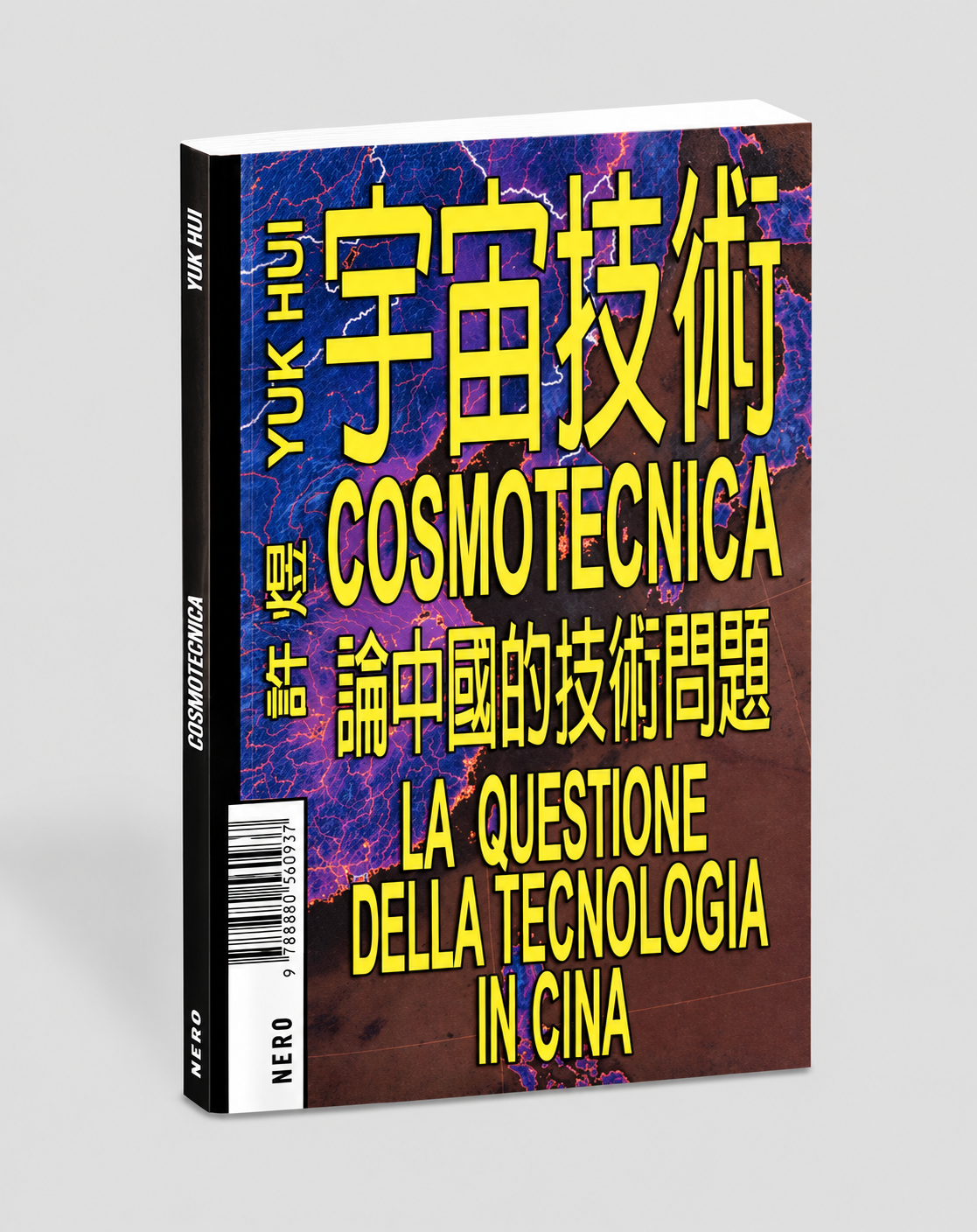
Before explaining what I mean, I should clarify that I have no intention of naively setting a wise East against a blind West. Yuk Hui himself, arguably the best-known thinker in this field in Europe, concludes The Question Concerning Technology in China: An Essay in Cosmotechnics with a warning about Sinofuturism, which, in his view, moves in the opposite direction from cosmotechnical thinking and merely accelerates the modern European project. I do not believe that clear-cut cultural distinctions can be drawn without producing false dichotomies. What I want to emphasize is rather a tendency, an intellectual atmosphere.
That said, a few definitions are in order. By “essentialism,” I mean the idea that entities possess some internal substance or soul that makes them what they are, distinct from the accidental properties that accompany them, and that knowledge derives from recognizing this essence. Roger Ames summarizes the idea by arguing that Greek ontology privileges being qua being, the essence-attribute dualism, and the question of what something is. From this follows an immutable logic founded on the principle of noncontradiction. Borrowing from Zhao Tingyang, Ames describes this as a “dictionary-style” explanation of the world, in which all concepts become footnotes to being.
Applied to human beings, this dictionary-style explanation generates a fallacy already identified by John Dewey: we abstract a supposedly fixed “human nature” from a continuously changing process and then place that abstraction before the process, as though it were its cause. First, we infer reason from the fact that we reason; then we claim that we reason because we possess reason.
Every time a machine succeeds in doing something that belonged to the list of properties defining this essence, the essence itself becomes thinner, and we search for new, supposedly inimitable qualities to preserve it. This is why the history of artificial intelligence, viewed from the West, resembles a continuous retreat: calculation was once considered uniquely human, then chess, then Go, then translation, drawing, language, the body, and so on.
Li Chenyang develops this idea in an essay collected by Song Bing in Intelligence and Wisdom: Artificial Intelligence Meets Chinese Philosophers. He concludes that for millennia we have searched for a property that would make us the measure of all things, from our position at the center of the cosmos to our status as beings made in God’s image, and finally to rationality. Yet each time, that property has proved less exclusive than expected. Perhaps we are simply one among many possible forms of existence, and rather than defending our improbable supremacy, we should be thinking about how to flourish alongside others.
Yao Zhongqiu, meanwhile, observes that the Western fear of machines rebelling has a theological structure: an omniscient God creates humanity, and their relationship is one of master and servant, with obedience as the only virtue. When we think about machines, we automatically place ourselves in the creator’s position and expect our creations to display the same rebellious tendencies as ourselves. In Chinese cosmology, Yao argues, there is no personal God standing outside things. Heaven has no absolute will, and the ten thousand beings arise within it, machines included. Hence his proposed terminology: humans and artifacts are xiangyuzhe, companions, beings who share the same home. To put it bluntly, they are friends.
If the trauma caused by artificial intelligence has an ontological foundation, art is where it can best be measured, because art is where Western essentialism preserves its last sanctuary, however dilapidated. The old cliché of the artwork as a mirror of the soul remains remarkably widespread, despite the severe blows dealt to it by deconstructive philosophies and contemporary art.
Experimental psychology has accumulated some rather useful findings on the subject: the same image, presented either as a human creation or as the product of an algorithm, receives different aesthetic evaluations, and the difference depends primarily on the attribution of intention and effort. A 2023 study by Bellaiche and colleagues demonstrates a preference for supposedly human-made works even when participants cannot distinguish between the images. This seems to me connected to a line of research initiated by George Newman and Paul Bloom on authenticity, in which the value of an original compared with an indistinguishable copy is explained through two mechanisms. The first is contagion, whereby an object acquires value because it has been “touched” by the artist’s body, almost like a relic. The second is performance, meaning the evaluation of the artwork as an unrepeatable creative act. Those who think this way are applying, often without realizing it, an ontology of substance.
In Chinese painting, fang, the practice of painting “in the manner of” an ancient master, is an honored tradition that no one confuses with fraud. The first of Xie He’s six principles, formulated in the sixth century, does not demand the expression of individual interiority but rather the resonance of vital energy, qiyun shengdong, something that flows through the painter and the brush without belonging to either. This should not be taken too literally, since the tradition was perfectly familiar with the concepts of forgery and originality. The point is that this category of authenticity did not depend on contact with a unique and unrepeatable body, and the idea that an image might be produced by recombining previous images would not, in itself, have caused scandal.
It is Yuk Hui, in The Question Concerning Technology in China, who reminds us that the Book of Rites contains a section, the Li Qi, devoted to ritual implements, and that for Confucianism morality can only be maintained through their proper use. In the chapter Tom Xiaowei Wang contributed to Harmonious Technology, a collection bringing together various attempts to develop a Confucian ethics of technology, the argument is illustrated through Confucian archery and the taishi chair. The chair, the bow, the calligrapher’s brush, and the musical instrument do not merely serve particular functions. By sitting in a certain way and releasing an arrow in another, one cultivates the heart-mind and becomes a particular kind of person.
Wang explicitly distinguishes this idea from the notion, now familiar in Europe thanks to Peter-Paul Verbeek, that values are embedded in objects. A speed bump that slows a car changes behavior without transforming the agent, so much so that the driver accelerates again as soon as the bump is behind them. The ritual artifact, by contrast, is constitutive of the agency of the person using it. As Wang writes: “The aesthetic, attitudinal, and bodily interactions between human beings and artifacts constitute our capacity to act. This can be understood as a form of nourishment and self-cultivation. A person using a taishi chair should live as a junzi, spontaneously and effortlessly. Taishi chairs are not merely used, but also enacted or performed.”
When I work with a generative model, there is no inner self of mine passing into a neutral instrument. Rather, there is a device that participates in constituting who I am as I use it, just as the brush and pencil already did, and just as the language into which we are born does. If I accept this description, the question of “whether a human made it” becomes sterile. What matters instead is the quality of the relationship and how we might reap its benefits.
Why did artifacts enter moral philosophy so early in China, while in the West they only arrived there with Heidegger (who was, not coincidentally, influenced by Zen), several centuries later? Yuk Hui’s answer is that China has no equivalent to the opposition between technē and physis, and that the relationship underlying everything is the one between qi, tools and vessels, and dao, the course of things. Here, technology emerges already embedded within a cosmological and moral order, and the question has never been whether to use it, but whether its use preserves or disrupts the coherence between human activity and the way the world unfolds. Hence the term Hui has introduced into contemporary debate, cosmotechnics: the unification of the moral and cosmological spheres through technical activities, varying from one civilization to another and challenging the idea of a single technology with a single destiny.
The example everyone cites is Cook Ding in the Zhuangzi, who has been butchering oxen for nineteen years with the same knife, whose blade remains as sharp as if it had just been sharpened, because he does not cut through bones but follows the spaces between them. It is a celebration of technique in harmony with the world, far removed from the Promethean image of an artifact violently wrested from the gods. Prometheus steals fire and is punished; Ding steals nothing, merely discovering the naturalness of his movements. Two different cosmotechnics, precisely.
For Hui, the relationship between qi and dao was ruptured by the Opium Wars, through forced modernization and the separation of imported technology from a tradition that had been rendered harmless. Hui calls this condition dis-orientation and observes that Chinese philosophy of technology over the past thirty years has largely imported Marcuse, Feenberg, Borgmann, and Dreyfus, as though China and Europe shared the same understanding of technology. His diagnosis of the universalization of European philosophy is that it functions as a pharmakon in Stiegler’s sense: both remedy and poison.
Song Bing, who directs the Berggruen Institute’s China Center and edited both of the collective volumes from which I draw much of this material, opens the 2020 book by observing that more than fifty documents setting out ethical principles for artificial intelligence had been published since 2015, and that almost all of them began from a Western framework of values built around the intrinsic worth of the individual, their agency, and their subjectivity. The global debate takes place entirely on the level of shu, technique and procedure, whereas the volume she edited seeks to move it to the level of dao. The title itself places two words in tension that Italian struggles to distinguish: zhineng, intelligence understood as performance, and zhihui, wisdom understood as orientation.
Here lies the trap of a familiar cliché. It is true that Greek philosophy cultivated a desire for disinterested knowledge that found less room in China, and it is true that this has something to do with Europe’s development of modern science. But the question “Why didn’t China develop science?” is poorly framed, as becomes clear from the answer Feng Youlan gave in 1922, at the age of twenty-six, in an article that caused a sensation: China did not have science because it did not need it. Traditions differ not in their capacity for knowledge, but in the questions they considered worth asking and in the kinds of knowledge to which they assigned prestige. Now that the problem will no longer be so much the production of knowledge, since we already generate more than we can absorb, but deciding what to do with it, the Western paradigm is struggling.
This does not mean that the East is free of contradictions or critical voices. Gan Chunsong writes that after the Qin and Han dynasties, Chinese thought progressively moved away from reflection on the relationship between science, technology, and human order, concentrating instead on human nature and social relationships. And when the scandal involving He Jiankui’s genetically modified babies erupted, neither China’s scientific community nor its philosophical community produced an analysis equal to the seriousness of the event, because ethicists were not involved in research and scientists were unfamiliar with the ethical debate. The primacy that the Chinese tradition could once claim in its understanding of human nature, he concludes, no longer exists.
The most interesting book I have found on the subject was published this year by Palgrave. Entitled Co-Becoming, it is edited by Song Bing and Mark McConaghy. It contains a collective document presented as an open invitation arising from discussions among scholars working between Taiwan, Beijing, Tokyo, Seoul, Hong Kong, and Chicago. Its demand is unequivocal: an ontological reset is needed. The key term is gongsheng, which the editors translate as co-becoming and which recalls the meaning of symbiosis. The thesis is that no form of existence can be isolated, from particles to planets, and that existence and relationality define one another.
Within the volume, Ames proposes replacing ontology with zoetology, a neologism constructed from zoe, rendered in Chinese as shengshenglun, and referring to the art of living. The resulting world consists of events that happen rather than things that are, and people are better expressed as gerunds than as proper nouns. It is the difference between a leg and walking. Lai Hsi-san derives a non-substantialist ontology from the Laozi and the Zhuangzi, attributing human conflicts to the tendency to turn a system of values into a substance and to treat dissenters as enemies to be eliminated. Sun Xiangchen shifts the metaphysical foundation from being to sheng, generation. Futoshi Hoshino observes that parasitism describes our current condition better than harmony, and Song replies that, in biology, even parasitism is a form of symbiosis.
“Harmony” is a recurring term in these texts, but it needs to be contextualized. It is the first principle in the AI governance guidelines published by China’s Ministry of Science and Technology in 2019, and it has also been a watchword of the party-state for the past twenty years. The editors of Harmonious Technology emphasize that Chinese technology policies often frame regulation in Confucian terms. The political and social context, consistently enough with a relational ontology, also influences their content. The Berggruen Institute, which funds both of Song’s volumes, is itself a political actor with its own agenda.
There is also an obvious objection: if there is no human essence, what exactly are we protecting? The entire edifice of rights rests on the idea of human dignity, and anyone who dismantles it ought to explain what should replace it. Wong Pak-Hang, one of the two editors of Harmonious Technology, responds that obligations are grounded in relationships and that harmonization should be understood as a process of continuous adjustment rather than a state to be achieved. Our task is not to establish what is right in the abstract, but to recognize harmony and disharmony within specific, concrete relationships. In the interconnected condition in which we live, decisions we once considered private, such as consenting to the sharing of our personal data, have become acts that affect others, generating new responsibilities.
As I said at the beginning, we must avoid historical and cultural oversimplifications. Anne Cheng has spent much of her career dismantling the idea of a “Chinese thought” endowed with permanent characteristics. Classical China had its own forms of essentialism, from the debate between Mencius and Xunzi over human nature to the Neo-Confucian concept of li as the principle underlying all things. Conversely, developmental psychology, through the work of Susan Gelman, has shown that essentialism is a cognitive default that appears very early in children from widely different cultures. It is not merely a European philosophical bad habit.
Europe, moreover, has had its own relational thinkers: Spinoza conceives of modes as configurations of a single substance; Hegel regards personhood as an achievement; Whitehead replaces things with events; Simondon understands individuation as a process that never reaches completion; Latour dismantles the separation between subjects and objects; and Clark and Chalmers’ notion of the extended mind breaks down the boundaries of the brain. In Chinese history, however, this strand of thought is older and more enduring, and it has developed a remarkably complex vocabulary.
An ontology should be judged on its own merits rather than its origins, and it seems to me that relational ontology has roots scattered everywhere: the biology of endosymbiosis, ecology, systems physics, cognitive science. Artificial intelligence has put to the test a conception of humanity that was already untenable, and the panic with which we greet it is proportional to our reluctance to let that conception go. But perhaps the time has come to abandon the idea of eternal essences for which, in truth, we have never had any evidence.
Francesco D’Isa