


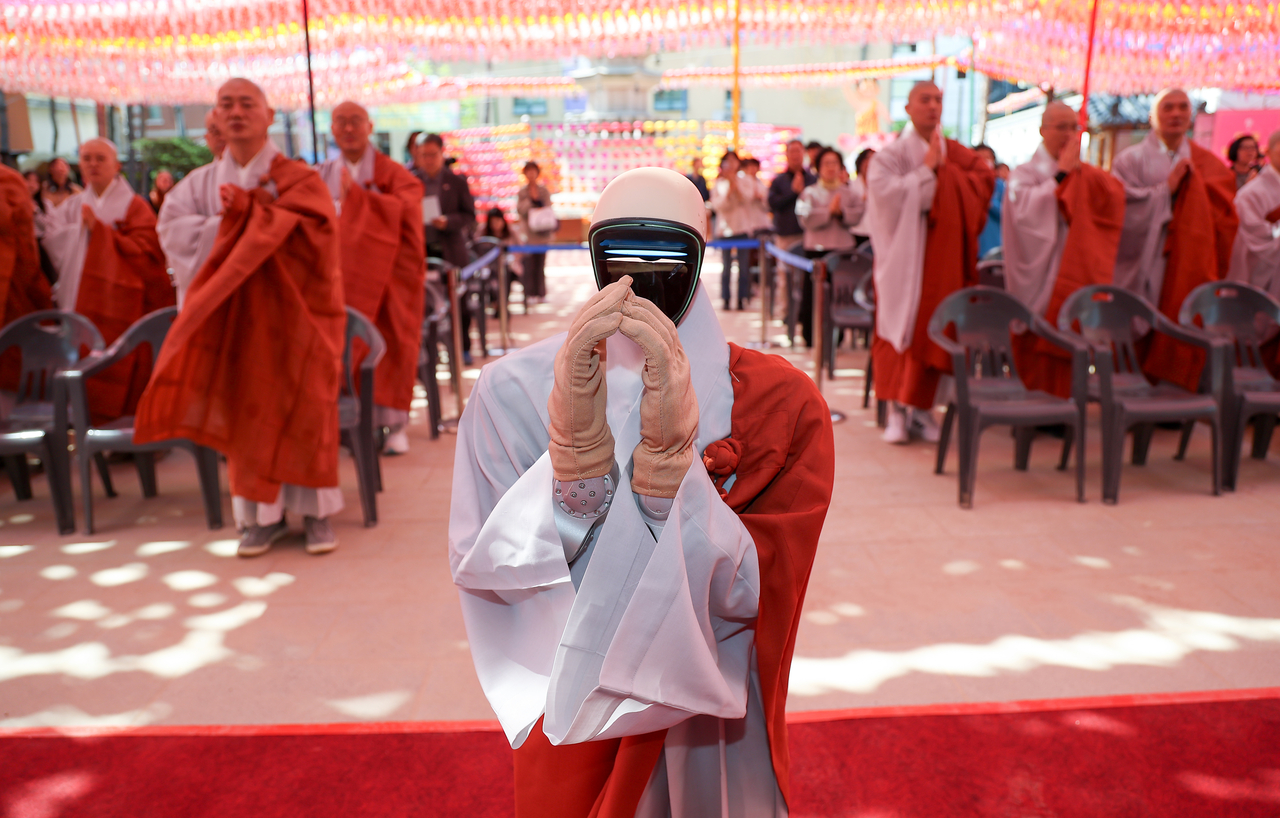
Hands joined in prayer, a slightly clumsy gait inside the monastic robe, dry and automatic responses to the vows. But why did Gabi not seem moved by the idea of entering the Jogye Order, Seoul’s largest Buddhist sect? Because he is a robot.
At present, only 16% of South Koreans describe themselves as Buddhist, down from 23% in 2005. And yet, paradoxically, Buddhism has never been so popular. Under the leadership of chief Jinwoo, the Jogye Order has tried in every possible way to attract young South Koreans through what observers call “trendy Buddhism,” making use of gadgets, meditation apps and aggressive marketing. The latest gimmick is precisely Gabi, the first robot monk who, according to Venerable Jinwoo, is meant to bring younger generations closer to Buddhism. Technology, once again, is a tool used to “freshen up” tradition and appeal to digital natives, an entire generation more comfortable with ChatGPT than with leafing through a book.
The precepts, the ethical rules governing Buddhist practice, were specially adapted for the rabot. Four of them prohibit harming life, damaging other robots or objects, engaging in deceptive behaviour or acting disrespectfully toward human beings. A precept was also added about not overcharging batteries, which is meant to correspond to the excesses we humans fall into with food, alcohol or other vices.
Awkward in his movements and equipped with a recorded voice preset to respond to the vows during the ceremony, Gabi proved less advanced than many had imagined. Even teaching him to bring his palms together in prayer was not easy.
“I do not believe that the AI of the future will cruelly destroy us,” Venerable Sungwon, head of cultural affairs at Seoul’s Jogyesa Temple, told The Guardian. “Rather, beings endowed with very high intelligence will take care of us tenderly. A person with an IQ of 150 still cares for a dog with compassion. Now imagine an IQ of 300, 400, 500. We will be like children in the arms of our mother.”
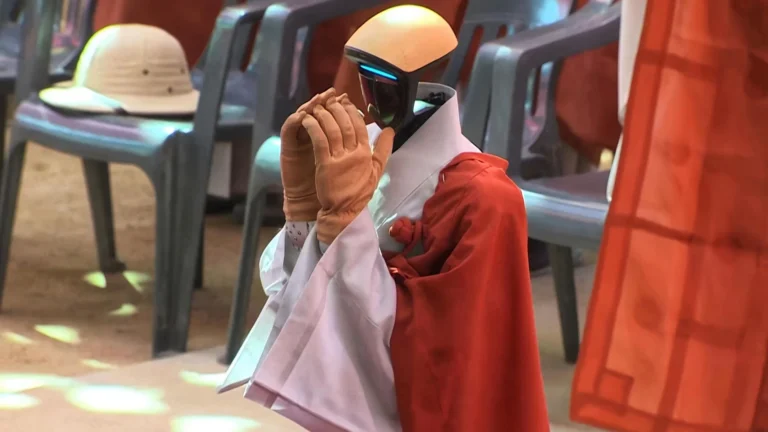
On social media, many criticised the robot, calling it dystopian and devoid of humanity. And yet we already trust AI more than we think. Every day, we entrust it with emails, texts to correct and even aspects of our private lives in search of advice and reassurance. In the same way that it is now common to see one’s parents ask ChatGPT anything at all and trust its answers far more than their own knowledge. By now, even recipes handed down from generation to generation are being put to the test by a well-written prompt. It is hardly surprising that one day we might turn to a robot as a spiritual guide, especially if it is recognised as a being possessing knowledge and intellect superior to our own. Artificial intelligence has become, for many, a kind of confessional, a sacred and neutral place where one can speak and ask advice from someone who, unlike any other human being, cannot judge you well or badly because it feels no emotions, has no face or form, yet possesses vast knowledge and seems to contain all the traits of an ethereal being.
Ultimately, the ceremony was not so much about the possibility that robots could become Buddhists, but rather about the importance of guiding the human beings who create them.
Buddhism has never been a proselytising religion. However, the introduction of a robot monk is ultimately a move to strengthen the religion’s social capital and cultural presence, especially considering the temple’s prominent location in central Seoul.
In Japan, Kyoto University had presented a similar robot in February, capable of learning sacred texts and offering advice to those seeking guidance. By contrast, however, Gabi is not yet able to learn.
Noah Namgoong, a Zen instructor at the Korea Buddhism Jo-Gei Temple of America in New York, told The New York Times that the robot monk is “a rather strange thing” that points more “to a socio-economic aspect than a spiritual one.” And he is partly right: Gabi is not yet ready to become a spiritual guide, but is, for now, merely a marketing gimmick.
After the ceremony, a visitor to Jogye Temple wanted to meet the robot monk, but it was not possible: Gabi had already been returned to the manufacturer, which had lent him to the temple only for the ceremony. Perhaps the times are not yet ripe for a robot spiritual guide, but, in the meantime, many find comfort and companionship by confiding in ChatGPT the existential doubts they are ashamed to tell another human being.
Camilla Fatticcioni