



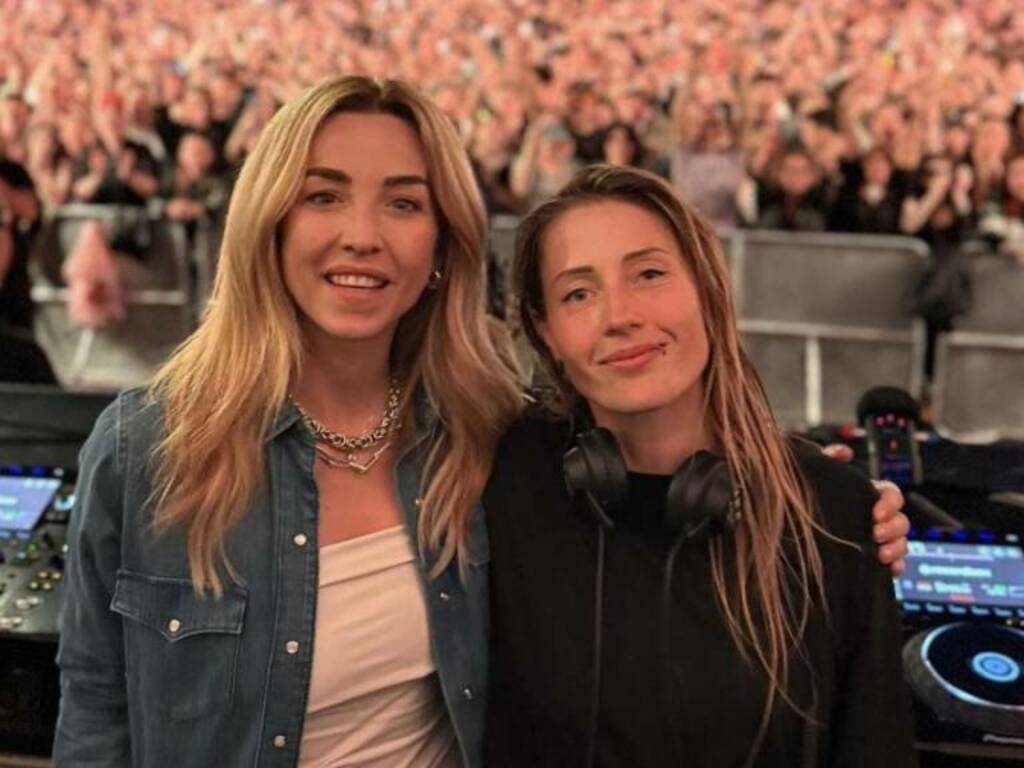
“Genova is burning,” as people might have said a few years ago. There was certainly at least some excitement last Saturday in Piazza Matteotti, where Charlotte de Witte, an internationally renowned DJ and producer, got at least twenty thousand people dancing—or so they say. Just another festival? Certainly not. It was a public event strongly backed by the city’s mayor, Silvia Salis (Democratic Party), who was also captured in a photo that quickly made the rounds online: the half-smile of someone who knows she has pulled off something big, soft-clubber glasses, and behind her de Witte doing her thing—“cooking,” to borrow a slang expression currently very much in vogue—for a massive dancing crowd.
But the point is not the photo. It is everything that photo carries with it: a perfect synecdoche summarizing the meaning that techno culture has come to embody in recent years. And de Witte is one of that culture’s leading figures.
Charlotte de Witte was born in Ghent in 1992 and came of age within the Belgian clubbing scene, beginning to frequent underground environments while still a teenager. Ghent, after all, despite being a relatively small city, boasts a solid tradition in electronic music: it is the city of Soulwax, for one. “I started going to underground clubs when I was 16 or 17. I left my heart there,” she said in an interview a few years ago.
The decisive turning point came shortly afterward, when she discovered a more stripped-back and hypnotic form of techno, especially through artists like Len Faki, who pushed her to leave electro behind in favor of a more minimal techno sound.
Her entry into the scene, however, did not happen under her own name. For several years she used the male pseudonym Raving George, an openly strategic choice tied to the industry’s gender dynamics. In an environment perceived as hostile, de Witte initially preferred to conceal her identity: “I didn’t want to make a big deal out of being a female producer.”
Her concerns were not unfounded. Very young and already part of important circuits, she became the target of explicitly sexist attacks, including actual hate groups on Facebook and recurring accusations that she had been booked at festivals “just because she was a woman” or because she had “slept with the manager.”The shift from Raving George to Charlotte de Witte therefore represented a genuine act of self-assertion. But it did not stop there: putting her own name forward became an integral part of her narrative, a recurring motif in interviews that structures her image within a scene that still partly operates according to exclusionary logics.
Exclusionary indeed: because, while techno has now firmly entered the mainstream, the conditions of access and representation within it remain far from true equality. It is within this state of the industry that Charlotte de Witte’s rise takes place. Her trajectory, as DJ Mag already described it in 2019, was meteoric: after more than ten years of activity, the leap came very quickly, with the magazine cover in 2017 marking a first moment of consecration, and her entry into the Top 100 DJs in 2019 as a new entry.
Within just a few years, de Witte became a regular presence at all the major festivals and, by far, one of the best-known faces among DJs, both male and female. Even so, the gender issue in the world of techno festivals remains far from resolved. If, in the first phase of her career, de Witte was concerned with presenting herself under a pseudonym, today the conversation has shifted onto a more explicit and collective plane. On the one hand, data from the female:pressure FACTS 2022 report show a gradual improvement in female representation in lineups and festivals, while still confirming a significant gap from parity. On the other hand, the recent debate has also reignited on the public front: the open letter by the collective Not Bad For A Girl, also published by DJ Mag at the beginning of the year, denounced the decline in gender parity in the programming of two UK festivals, bringing the issue back to the center of discussion in contemporary club culture.
It is within this same framework that the recent photograph taken in Genoa must also be understood. Shot during her DJ set in Piazza Matteotti, it had a strong impact not only musically but also in media and political terms. The event, organized as a major public occasion, generated wide circulation on social media, further strengthening Mayor Silvia Salis’s visibility and fueling a narrative of success linked to the urban and cultural dimension of the initiative.
At the same time, as often happens, the discussion became polarized. On the right, criticism focused on the overall cost of the operation, said to be around 140,000 euros in public money, often reduced in the debate to the figure of Charlotte de Witte’s fee alone, forgetting that this budget covered not only her performance but also all the crew members and therefore the work of the many people involved in producing the event, in addition to all related expenses. On the left, by contrast, the initiative was mostly celebrated, contrasting the “rave” in the square with the anti-rave decree with which the Meloni government began its mandate. In this reading, the event thus becomes a symbolic counter-shot, as though it were a reclaiming of public space through techno.
And yet, in both narratives, a fundamental linguistic and conceptual step tends to be lost: the two meanings of “rave” are not always interchangeable. In the case of the Genoa concert, the term is used in its original Anglo-Saxon sense, where it broadly refers to electronic music events regardless of the context in which they take place. In the so-called anti-rave decree, by contrast, “rave” is used in the meaning now established in colloquial Italian and European usage, namely as a synonym for illegal free parties. This semantic divergence, stabilized over time but still active, produces an interpretative short circuit that helps fuel confusion in public debate.
Be that as it may, the debate quickly broadened, and the very figure of Silvia Salis seems to have gained immediate political visibility even before her administrative action had clearly consolidated. Because in the end the point was not the event itself, but what its imagery was able to activate. Techno and “rave” culture, in their now stable and lively semantic muddle, remain themes of extremely high symbolic intensity, capable of producing reactions that go well beyond the bubble of insiders or that of enthusiasts.
With one photo, Salis—or her team—pulled off a small communications masterpiece built on the symbolic force of Charlotte de Witte, who, almost metonymically, embodies for many a certain way of living life: club culture.
Pierluigi Fantozzi