


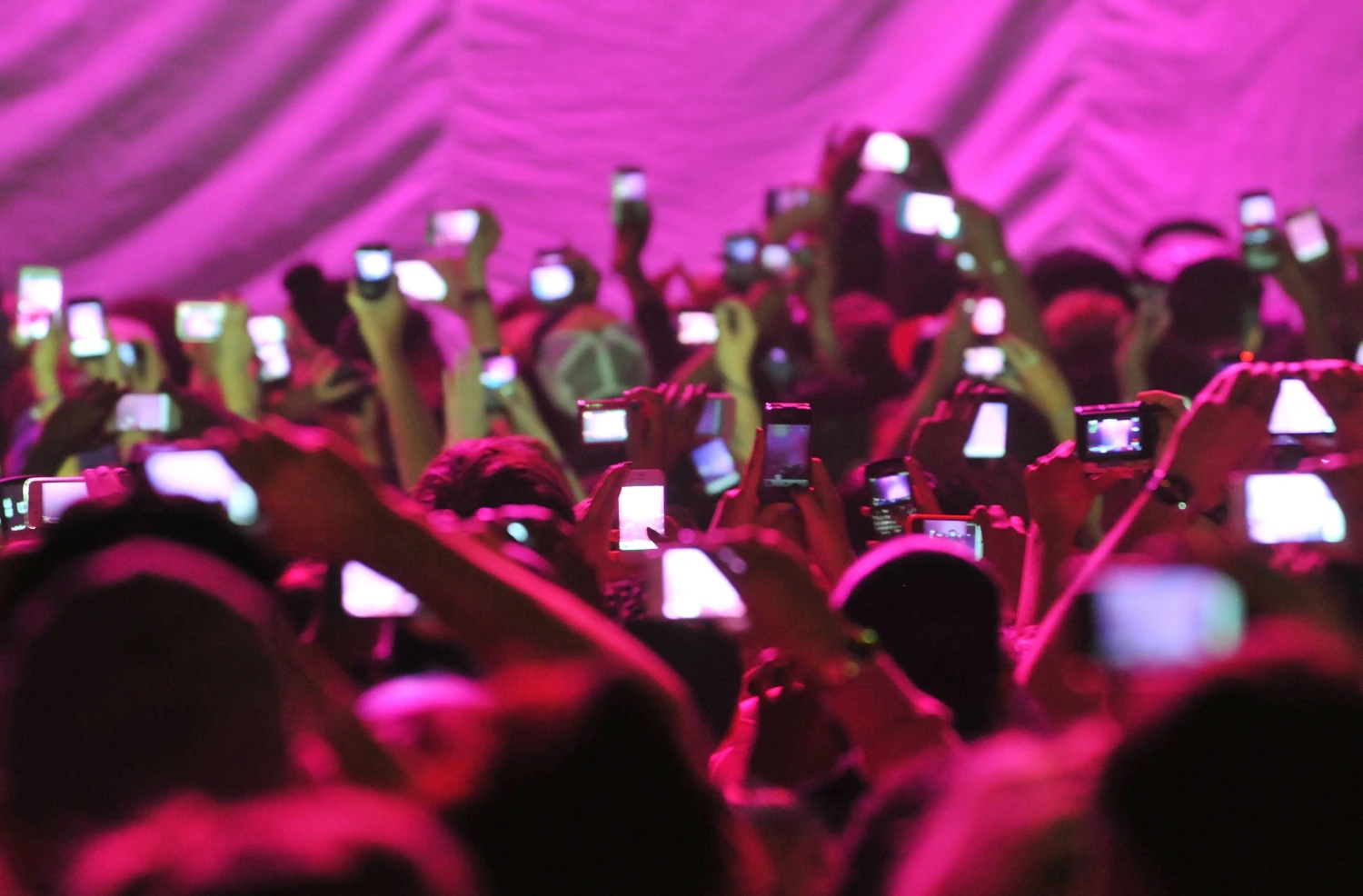
A year ago, I had the opportunity to interview Geoff Farina, frontman of the historic American band Karate. They had broken up in 2005, only to return to the stage in 2024 with a tour celebrating their reunion and a new album. When I asked him what had changed more than thirty years after their debut, his answer came immediately: “Mobile phones. The worst thing is when you’re on stage and everyone pulls out their phone.” He told me that during the live shows on that tour, they had often stopped playing to ask the audience not to point their smartphone cameras at them. “Sometimes,” he told me, “it feels like you have to teach the audience how to behave at a concert.”
In May 2025, it was not the first time I had heard a similar stance from artists of varying degrees of fame. The year before, for example, Cosmo had stickers placed over phone cameras at every date of his tour, adopting what was ultimately a moderate measure compared with Bob Dylan’s more radical choice in 2023, when he required audiences to place their phones in special magnetic pouches for the entire duration of his concerts. In short, year after year, the issue of phones at concerts, and the countermeasures used to combat what many consider a widespread bad habit, has become an increasingly discussed topic. The real novelty is that phone-free events have increased fivefold in recent years.
This is what emerges from a recent report published by Eventbrite, Offline by Design: The Rise of Phone-Free Experiences in 2026’s Analog Era, which attempts to quantify the phenomenon on a global scale. According to the data collected, between 2024 and 2025 explicitly phone-free events grew by 567%, while attendance increased by 121%, with geographical expansion from 5 to 12 countries involved. This acceleration, at least according to the platform’s interpretation, indicates a shift from an occasional practice to a recognizable format that is becoming progressively stabilized within the cultural and live entertainment offering.
In addition to assessing changes in supply, the report also emphasizes several figures related to demand. Forty-nine percent of Gen Z and Millennial users say they prefer experiences that are less “curated” and closer to a dimension perceived as authentic, while 79% identify spontaneity as a central element in evaluating an event. In the report, this spontaneity is directly linked to the absence of the smartphone: removing the screen would help create an environment perceived as less constructed and more immersive. It is no coincidence that 84% of Americans say they are increasingly turning to analog habits to balance the time they spend online. Within this framework, the phone-free event is presented as a space in which the experience is not oriented toward recording or sharing, but toward immediate enjoyment.
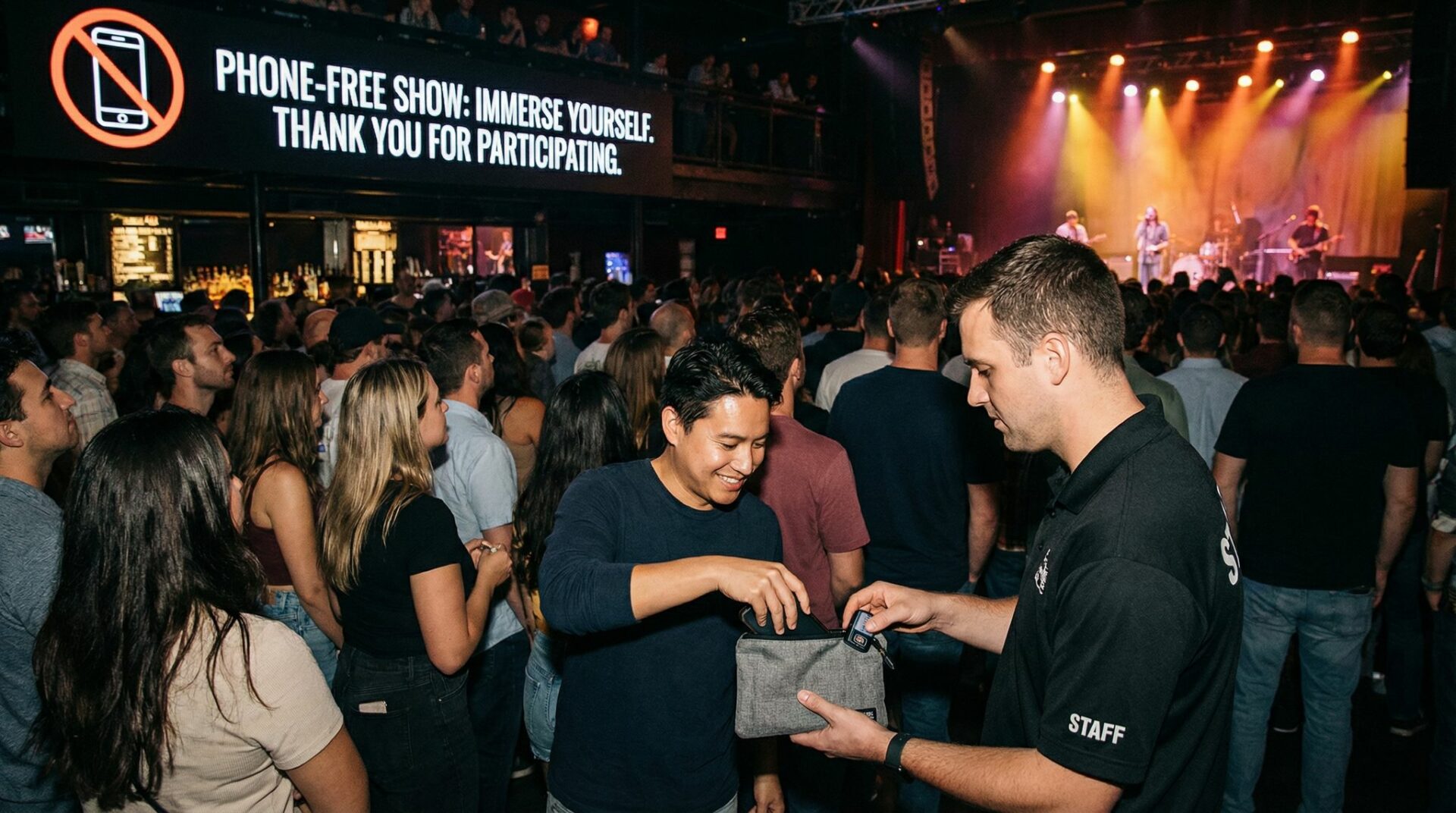
From the point of view of the distribution of these events, growth is anything but uniform. The United Kingdom appears to be one of the main hubs, with a 1200% increase in the number of events and a 1441% increase in attendance, while in the United States the more contained growth in supply, equal to 388%, is accompanied by a much more marked expansion of the audience, reaching +913%. This signals a gradual shift toward larger-scale formats. Overall, the trajectory outlined by Eventbrite suggests that the phone-free dimension no longer functions merely as a regulatory device, but as a genuine element in the design of the experience, capable of influencing modes of gathering and audience expectations.
So, is it a trend? In part, yes, and it would be naive to deny it. Experiences like those proposed by Cosmo fall within a line that had already been traced for years in specific contexts, particularly in Berlin clubs, where limits on smartphone use long predate their recent media framing. Spaces such as Berghain or KitKatClub have long adopted practices such as placing stickers over cameras, not so much to encourage some generic form of “presence,” but to guarantee a regime of absolute privacy. In clubs like these, managing visibility and the exposure of people’s bodies is fundamental. The certainty of escaping the digital gaze becomes a necessary condition for preserving forms of expression that include explicit sexuality, performative practices, and modes of sociality that are difficult to reconcile with the recording and online circulation of images.
As a result, with the recent popularization of techno and its gradual institutionalization even outside its original contexts, it is almost inevitable that practices of this kind are extracted from their environment of origin and reused in a broader, and perhaps simplified, key. In this sense, the spread of certain phone-free formats follows a dynamic we have already seen: elements born within circumscribed scenes with strong internal coherence are gradually absorbed, reworked, and transformed into recognizable signs of an aesthetic to reference. Humanity discovers subculture, extracts the logo, and calls it innovation. Ancient ritual, same depressing spreadsheet.
One of the most discussed recent positions in Italy on the subject of no-phone policies also comes from the world of techno. Marco Faraone, a Tuscan DJ and producer who has long been active between house and techno, addressed the issue quite directly during an interview.
Faraone first questions a certain nostalgia for 1990s clubbing: “It pisses me off when people say: things were better in the 90s. In the 90s there weren’t phones with video cameras. If people had had a compact iPhone, with a built-in camera, and had wanted to make videos, they would have made them in the 90s too.” The point, then, more than a change in behavior, would be linked to the availability of tools.
When asked how he handles things at his own events, his answer is just as clear-cut: “At my parties, everyone can do whatever they want. I don’t want to forbid anyone from doing anything. I’m neither in favor nor against it. This no-phone policy thing is a bit fashionable.” From here also comes a criticism of the stricter choices adopted by some artists: “You became big partly because your videos went viral, made with mobile phones, and then at parties you ask for a no-phone policy? That seems a little hypocritical to me.”
One could counter Faraone, however, and more generally counter a purely skeptical reading of the phenomenon, by saying that becoming visible or recognizable also thanks to the digital circulation of content does not automatically invalidate the possibility of questioning today what is desirable in clubbing etiquette or, more broadly, in the live experience. Artists’ trajectories are neither linear nor immutable: changing position over time, even with respect to practices that were once accepted or even exploited, is a natural part of paths within the music world, where the conditions of production and reception are constantly changing.
In the same way, reducing the spread of phone-free policies to a simple trend or contradiction risks oversimplifying a more complex picture. As the data and examples cited also show, from Berlin club culture to the more recent formats in contemporary live music, limiting smartphone use responds to different needs: in some cases it is a measure to protect privacy and bodies; in others, an attempt to redefine the quality of listening and presence; in still others, a response to the saturation of screen-mediated experience.
In this sense, the growth of phone-free events can be read both as a cultural trend and as a symptom of an increasingly widespread intolerance toward one’s own mobile device. And precisely because the motivations are heterogeneous and at times ambivalent, the question remains open, without any clear or unambiguous synthesis.
Pierluigi Fantozzi